A Deadly Day in Kyiv, a Police Force Under Pressure
What began as a neighborhood quarrel in Kyiv turned, within minutes, into a burst of mass violence that killed six people, wounded more than a dozen and ended in a supermarket siege. By the next day, the story had shifted from the gunman alone to a second public shock: why some police officers at the scene appeared to run instead of respond.
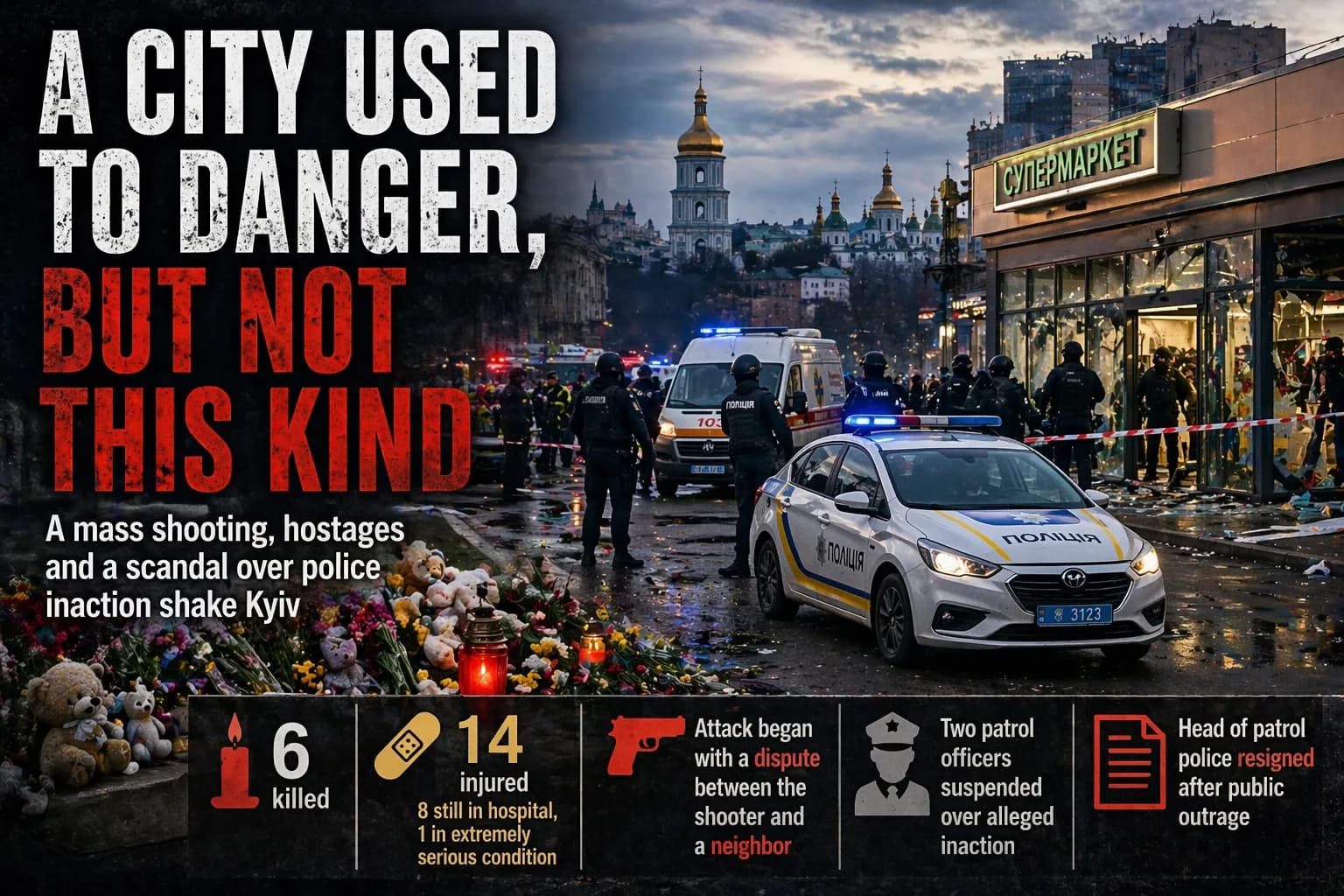
A city used to danger, but not this kind
Kyiv has lived for years with missile alerts, sirens and the steady pressure of war. What happened on 18 April felt different. This was not an attack descending from the sky or arriving from the front. It erupted in the middle of an ordinary urban afternoon, at street level, among neighbors and passersby.
According to reporting across the provided sources, the violence unfolded in the Holosiivskyi district. A gunman opened fire outdoors, then barricaded himself inside a supermarket with hostages before being killed during a police assault. By Sunday, the death toll had risen to six, with 14 people reported injured and eight still in hospital, one in extremely serious condition (Radio Svoboda, 2026).
That progression matters. The attack did not remain a single shooting scene. It moved, widened and changed character — from street violence to hostage crisis to counter-assault — which is one reason it hit so hard in public consciousness.
The trigger was local. The consequences were not.
One of the most striking details in the aftermath came from the head of Ukraine’s National Police, Ivan Vyhivskyi. As cited by Fakty ICTV, the attack began with a dispute between the shooter and a neighbor. Police first received a call connected to that quarrel, not to what would become a mass-casualty event (Fakty ICTV, 2026).
That makes the episode all the more unsettling. The initial spark appears mundane, almost painfully so: not an organized raid, not a complex plot announced in advance, but an argument at close range that spiraled into a public atrocity. It is precisely this collapse of scale — from domestic conflict to mass killing — that has left many Ukrainians asking how such an escalation was possible, and how a man in that condition still had access to a firearm.
Ukrainian authorities are treating the case as a terrorist act. President Volodymyr Zelensky said investigators are examining not only the attack itself, but also the suspect’s condition, his access to the weapon and his broader background (Radio Svoboda, 2026). That suggests the inquiry is no longer confined to motive. It is also about state failure, screening failure and institutional response.
The second scandal arrived on video
In many countries, a mass shooting would dominate the news cycle on its own. In Kyiv, the outrage deepened when footage circulated showing two patrol officers allegedly leaving the scene instead of confronting the attacker.
That video changed the emotional center of the story. Public grief quickly turned into anger. The question was no longer only how the gunman had acted, but how officers who were already there did not.
Zelensky said a criminal investigation had been opened into the inaction of the two patrol officers and called for a full review of patrol conduct, response protocols and training standards. He also said personnel decisions would follow throughout the chain of command (Radio Svoboda, 2026). In other words, the presidency signaled that this would not be treated as an isolated lapse by two individuals alone.
The criticism from within the system was unusually sharp. Fakty ICTV, citing Vyhivskyi, reported that the officers who fled were suspended for the duration of the investigation, while the wider response of police units was also being examined (Fakty ICTV, 2026). The institutional instinct here was not to close ranks, but to acknowledge visible failure before the public did it for them.
A resignation that made the fallout unmistakable
By 19 April, the political cost inside law enforcement had become clear. Deutsche Welle’s reporting focused on the resignation of the head of Ukraine’s patrol police after the controversy over the officers’ actions. That resignation turned what might have remained a disciplinary scandal into something bigger: a crisis of confidence in the command culture of policing itself (Deutsche Welle, 2026).
The meaning of the resignation is larger than the resignation letter. It suggests that the state understood the damage was not only operational, but symbolic. A capital at war can absorb fear. It has a harder time absorbing the appearance of paralysis from those meant to act first.
This is where the Kyiv attack becomes more than a crime report. It becomes a test of public trust. In wartime, citizens are constantly told that security institutions must be resilient, quick and disciplined under pressure. When that image breaks on camera, even briefly, the damage spreads well beyond one district or one day.
More than a single act of violence
Le Monde’s coverage emphasized the scale of the immediate tragedy — the dead, the wounded, the hospitalizations, the hostage situation. BBC Ukrainian, like other outlets following the aftermath, placed greater weight on the accountability question that followed. Together, the sources point to a grim dual reality: six people were killed by one man, but the national shock deepened because the state’s first visible response also came under suspicion (Le Monde, 2026; BBC News Ukrainian, 2026).
That is why this story has lingered. Not because mass killing in itself is unfamiliar to Ukraine — tragically, war has ensured that — but because this violence exposed a different vulnerability. It showed how quickly private rage can become public slaughter, and how devastating it is when the first line of response appears to falter in plain sight.
Kyiv is mourning the victims. It is also asking harder questions now: about firearms oversight, about mental health screening, about patrol readiness, and about what citizens should expect from police when seconds matter. Those questions will likely outlast the headlines.
References
BBC News Ukrainian. (2026, April 19). [Article on the Kyiv attack and police aftermath].
Deutsche Welle. (2026, April 19). Теракт в Киеве: глава патрульной полиции подал в отставку из-за действий полицейских.
Fakty ICTV. (2026, April 19). Теракт у Києві все почалося зі сварки з сусідом: Вигівський про деталі трагедії.
Le Monde. (2026, April 19). At least 6 killed after gunman opens fire in Ukrainian capital.
Radio Svoboda. (2026, April 19). Розпочато розслідування щодо бездіяльності двох патрульних: Зеленський про теракт у Києві.
Oleh Behunts
Contributing writer at EUReflect.
Follow EUReflect
See more of our reporting on Google
Mark EUReflect as a preferred source and our stories are ranked higher for you in Top Stories, Discover and Google News — and carry a “preferred” badge when they are cited in AI results.
Add EUReflect as a preferred source