At the Heart of Munich Security Conference 2026
At the Heart of Munich 2026: A Security Conference Marked by Transatlantic Fractures
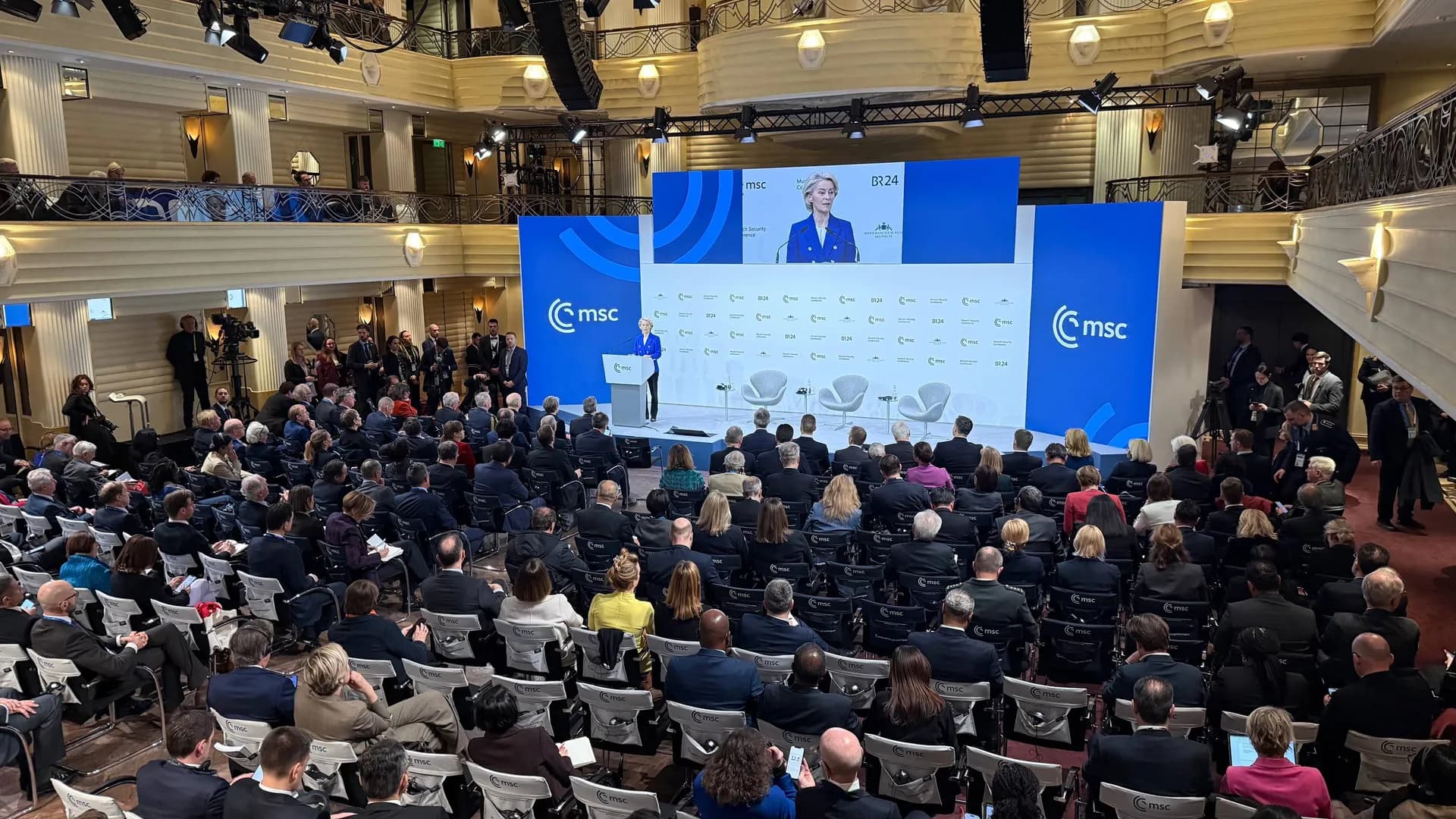
The Munich Security Conference (MSC), held from 13 to 15 February 2026, brought together dozens of heads of state, ministers, and policy experts to debate the state of global security. This year’s edition was dominated by two central tensions: the evolving role of the United States toward Europe, and the question of European strategic autonomy in an increasingly unstable world.
1. A Measured but Demanding American Message
The highlight of the conference was the speech delivered by U.S. Secretary of State Marco Rubio. Adopting a more conciliatory tone than in previous editions, Rubio emphasized the historical and cultural roots shared by the United States and Europe, referring to America as a “child of Europe” and calling on allies to “save the West together.”
Yet this reassuring rhetoric came with clear political conditionality. Rubio criticized certain European policies on climate and migration, raised concerns about sovereignty, and suggested that the transatlantic relationship cannot function effectively unless Europe reassesses some of its political and economic choices.
According to several observers, despite the softer tone, the substance of Rubio’s message reflects a more transactional approach to the alliance—one that redefines cooperation on terms that do not fully align with European expectations.
2. Europe’s Response: Strategic Autonomy Back on the Agenda
In response, European leaders advanced a different narrative—one focused on strengthening Europe’s capacity to act independently.
Ursula von der Leyen, President of the European Commission, called for making the EU’s mutual defense clause operational and emphasized the urgent need for significant investments in defense and industrial capabilities. Her message was clear: Europe must be prepared to assume greater responsibility for its own security.
Across the conference, several European officials stressed that while the transatlantic partnership remains essential, Europe can no longer rely unconditionally on American protection, particularly in a geopolitical landscape shaped by Russia’s aggression and China’s growing influence.
This renewed push for strategic autonomy reflects broader concerns that the post–World War II security architecture is under increasing strain. Munich 2026 thus became a platform for rethinking Europe’s role within—and potentially beyond—the traditional transatlantic framework.
3. Ukraine and the Security Imperative
The war in Ukraine remained a central theme throughout the conference. European leaders reiterated their commitment to continued military assistance, particularly in air defense systems, and reaffirmed their political support for Ukraine’s integration into Euro-Atlantic structures.
For Kyiv, the conference also represented an opportunity to seek clearer commitments regarding EU membership. Ukrainian officials argue that a defined accession pathway would not only strengthen the country internally but also counter Russian efforts to prevent its European integration.
4. Competing Visions of the “West”
Beyond military and diplomatic discussions, Munich 2026 exposed a deeper ideological debate about the meaning and future of “the West.”
Some American officials warned against what they describe as a form of civilizational decline, criticizing European approaches to migration, climate policy, and cultural governance. In contrast, European voices strongly rejected this narrative, arguing that Europe’s model seeks to balance security, democracy, and social cohesion rather than abandon them.
The conference thus revealed not merely strategic disagreements, but diverging conceptions of political identity and governance within the Western alliance itself.
Conclusion: A Turning Point for Transatlantic Relations
The 2026 Munich Security Conference may well be remembered as a pivotal moment:
-The United States reaffirmed its commitment to Europe,
-But on increasingly conditional and strategic terms,
-While Europe signaled a growing determination to enhance its own autonomy.
As global instability intensifies, Munich demonstrated that the transatlantic alliance remains intact—but it is evolving. Whether this evolution leads to renewed partnership or gradual divergence will depend on how both sides reconcile security needs with political values in the years ahead.
Enes Taskin
Contributing writer at EUReflect.
Follow EUReflect
See more of our reporting on Google
Mark EUReflect as a preferred source and our stories are ranked higher for you in Top Stories, Discover and Google News — and carry a “preferred” badge when they are cited in AI results.
Add EUReflect as a preferred source