Europe Braces for a Prolonged Era of Confrontation, Security Report Warns Ahead of Munich Conference
Brussels / Munich — Europe is entering a prolonged period of strategic confrontation marked by persistent security threats, geopolitical instability, and uncertainty over transatlantic guarantees, according to
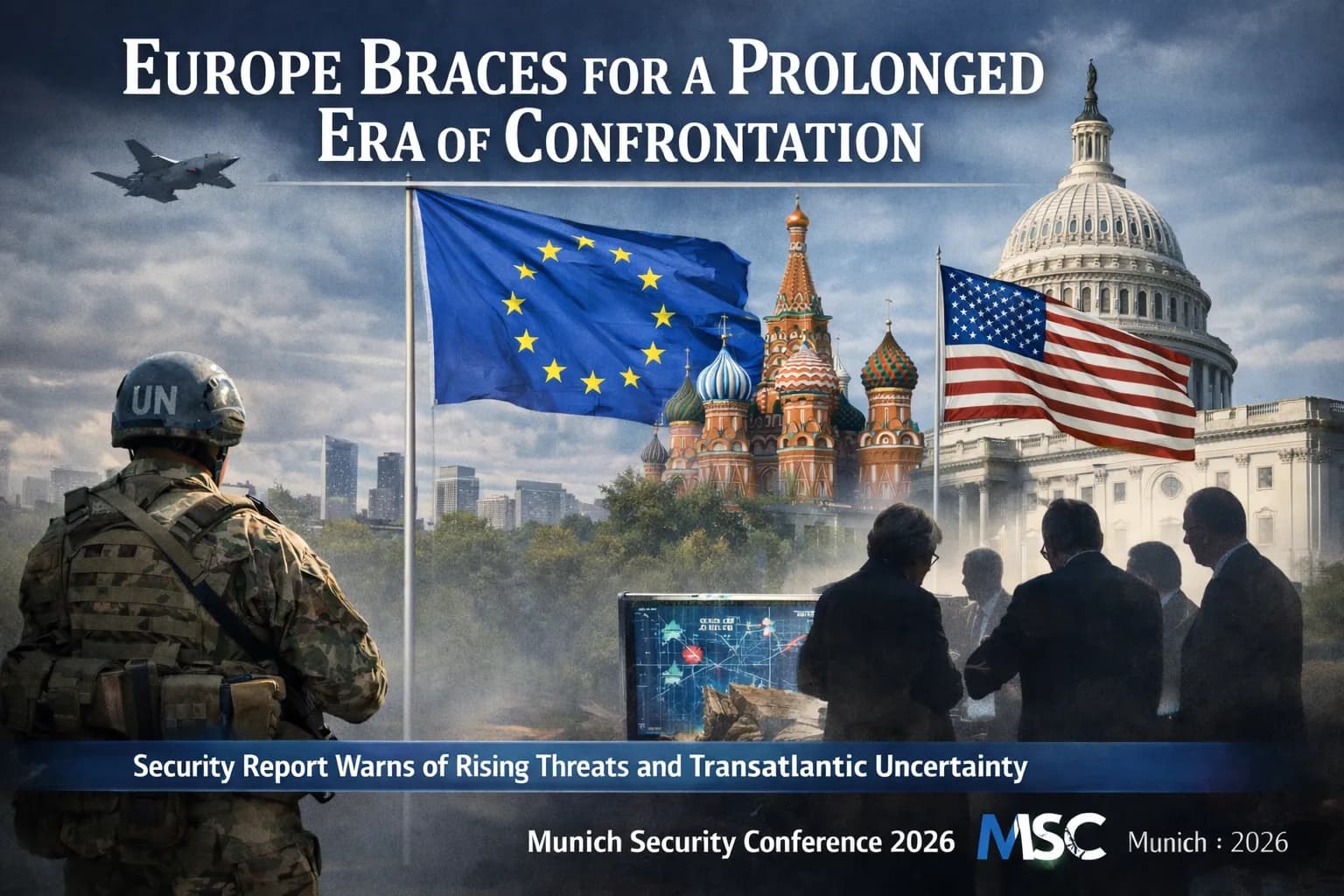
The report, prepared for policymakers and senior diplomats gathering in Munich later this month, concludes that the European security environment has fundamentally deteriorated. It identifies Russia’s continued aggression, the erosion of arms-control frameworks, and growing doubts about long-term U.S. security commitments as central drivers of instability across the continent.
Security analysts warn that the post-Cold War assumption of a stable European order no longer holds. Instead, Europe faces a sustained period of confrontation in which military deterrence, economic resilience, and political cohesion will be tested simultaneously.
Transatlantic Uncertainty
A central concern highlighted in the report is the evolving nature of the transatlantic relationship. While NATO remains the cornerstone of European defence, the document notes increasing anxiety among European capitals over Washington’s strategic focus and domestic political volatility.
Several European officials, speaking ahead of the conference, acknowledged that reliance on U.S. military leadership can no longer be taken for granted. The report stops short of predicting a withdrawal of American support but stresses that Europe must be prepared for scenarios in which U.S. engagement becomes more selective or conditional.
This uncertainty has accelerated debates over European strategic autonomy, particularly within the European Union. Calls for greater defence integration, joint procurement, and coordinated military planning are expected to dominate discussions in Munich.
Russia and the End of Strategic Illusions
Russia’s war against Ukraine remains the defining security challenge for Europe. The report argues that Moscow’s actions represent not a temporary deviation, but a long-term strategic posture aimed at reshaping the European security architecture through force and coercion.
Despite ongoing diplomatic efforts and intermittent talks, the assessment finds little evidence that the Kremlin is prepared to abandon its confrontational approach. Hybrid threats, cyber operations, and pressure on energy and critical infrastructure are expected to persist even in the absence of major battlefield escalations.
As a result, the report urges European governments to plan for enduring tension rather than a rapid return to pre-2022 conditions.
Push for European Defence Capacity
In response, the document calls for a significant strengthening of Europe’s defence capabilities. This includes increased defence spending, deeper cooperation between national armed forces, and the expansion of Europe’s industrial defence base.
Particular emphasis is placed on coordination among key European states, including Germany, France, Poland, and Italy, as well as closer alignment between EU defence initiatives and NATO structures.
The report also stresses that security is no longer solely military. Economic resilience, protection of supply chains, and safeguarding democratic institutions are described as integral components of Europe’s defensive posture.
A Defining Moment for European Policy
The findings set the tone for this year’s Munich Security Conference, which is expected to focus heavily on Europe’s strategic responsibility in an increasingly fragmented global order. With conflicts ongoing in Eastern Europe and the Middle East, and global power competition intensifying, European leaders face mounting pressure to translate strategic rhetoric into concrete policy.
As one senior European diplomat noted ahead of the conference, “The question is no longer whether Europe must take greater responsibility for its own security, but how quickly it can do so.”
The report’s warning is clear: the era of relative strategic comfort has ended, and Europe must adapt to a future defined by sustained confrontation, uncertainty, and hard geopolitical choices.
Written by Olha Pashchenko
Olha Pashchenko
Contributing writer at EUReflect.
Follow EUReflect
See more of our reporting on Google
Mark EUReflect as a preferred source and our stories are ranked higher for you in Top Stories, Discover and Google News — and carry a “preferred” badge when they are cited in AI results.
Add EUReflect as a preferred source