Hormuz: Open for Hours
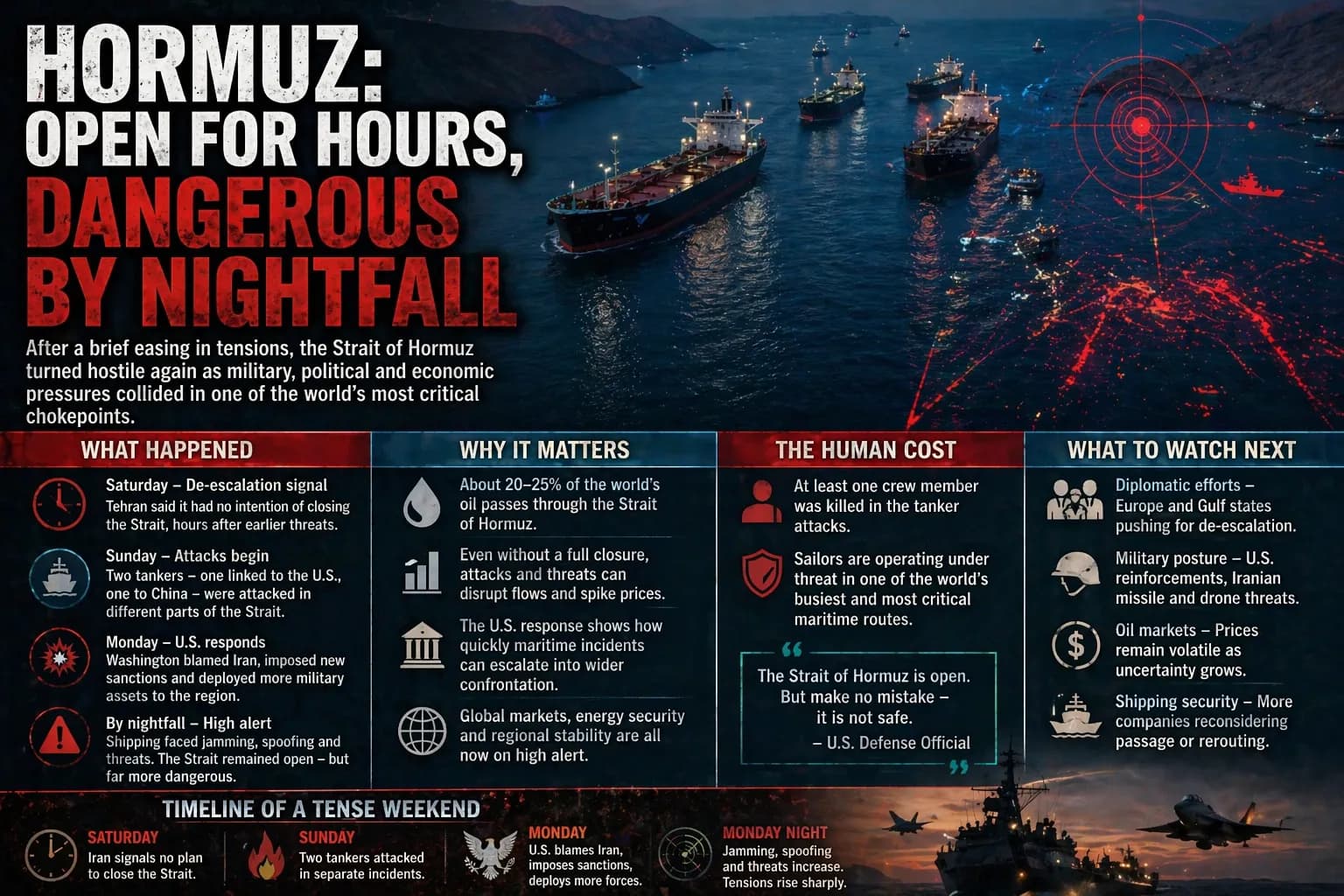
Hormuz: Open for Hours, Dangerous by Nightfall The Strait of Hormuz did not slam shut in one dramatic moment. It narrowed, then darkened, then turned openly hostile. By the end of the weekend, what had briefly looked like a fragile easing had become something else entirely: a maritime confrontation with oil markets, diplomacy and military signaling all colliding in the same strip of water. Hormuz: Open for Hours, Dangerous by Nightfall The Strait of Hormuz did not slam shut in one dramatic moment. It narrowed, then darkened, then turned openly hostile. By the end of the weekend, what had briefly looked like a fragile easing had become something else entirely: a maritime confrontation with oil markets, diplomacy and military signaling all colliding in the same strip of water.
The brief illusion of relief
For a short time, there was a sense that the crisis might be loosening. That did not survive contact with reality.
The first strong sign came from the sea rather than the negotiating table. Reuters reported on Saturday morning that at least two merchant vessels trying to pass through the Strait of Hormuz said they had been hit by gunfire. That detail matters more than any formal declaration about whether the route was “open” or “closed.” A shipping lane can exist on paper and still fail in practice if civilian crews are taking fire (Reuters, 2026).
That is really the hinge of this story. Not law, not rhetoric, not the wording of official communiqués. Risk. Once passage becomes physically unsafe, the legal status of the corridor starts to matter less than the fact that shipowners, insurers and crews no longer trust it.
Tehran makes the ambiguity disappear
Later that same day, Iran removed much of the ambiguity. According to The Guardian, Tehran restored the strait to its “previous status” under armed-forces control and said restrictions would remain unless Washington ensured freedom of navigation for Iranian-linked shipping. The article also noted that the brief reopening had already been marred by an attempted tanker passage under fire, which made the policy reversal look less like a surprise than an admission that the reopening had never really held (Williams, 2026).
So the sequence was already clear before Sunday began. First, ships reported gunfire. Then Iran formally tightened control again. In that sense, the political closure followed the operational breakdown. The waterway had become unreliable before it was fully re-declared restricted.
Then Washington raised the stakes
Sunday pushed the confrontation into a new register.
AP reported that the United States forcibly seized an Iranian-flagged cargo ship near the Strait of Hormuz after saying it had tried to get around the naval blockade. Tehran responded by calling the move a provocation and promising a swift reply. That was not just another tense episode in a crowded shipping lane. It was a shift from pressure around commercial traffic to direct action against an Iranian vessel itself (Associated Press, 2026).
And that changes the atmosphere around everything else. Gunfire at sea can still be framed as volatility. A state seizure is harder to blur. It draws cleaner lines, hardens positions and makes retaliation more likely to be expected rather than feared.
Why this matters far beyond the Gulf
The obvious effect is on oil. The deeper effect is on confidence.
When a chokepoint like Hormuz starts operating under duress, markets react not only to what has happened, but to what suddenly feels possible. Reuters’ market coverage later reflected that shift, noting a sharp jump in Brent prices after the strait was closed again. CNBC’s focus on tankers and oil prices fits the same broader pattern: once passage is threatened, energy markets stop treating disruption as a temporary scare and start pricing in continuity of danger rather than continuity of trade (Reuters, 2026).
That distinction helps explain why every new incident seems to have an outsized effect. Hormuz is narrow, but its importance is not. The route is a commercial artery, a strategic lever and a political symbol at the same time. Trouble there is never just local trouble.
A crisis moving faster than diplomacy
There is still diplomatic language floating around this confrontation, but the events of the weekend suggest military momentum is now outrunning political restraint.
What makes the current phase especially unstable is that neither side appears willing to absorb symbolic loss. Iran is signaling that it will not tolerate a situation in which its own shipping is boxed in while others proceed. The United States is signaling that it is prepared not merely to warn, but to intercept. Those are not abstract positions. They are positions enforced at sea, in real time, with commercial vessels moving through the same waters.
That is how narrow crises become wider ones. Not necessarily through a single spectacular strike, but through a chain of actions that slowly removes the middle ground. By the end of this weekend, Hormuz looked less like a contested transit corridor than a place where each side was testing how much control it could exercise without triggering something larger.
The pattern is the point
Seen together, the weekend’s developments tell a more revealing story than any single headline.
The line through them is escalation by layering. Unsafe passage. Renewed closure. Vessel seizure. Threatened response. Each development made the next one easier to imagine. The danger now is not simply that the strait remains tense. It is that instability there is becoming structured, almost procedural — something repeated, calibrated and folded into the wider U.S.-Iran confrontation.
That is what should worry governments and markets alike. A one-off crisis can be absorbed. A crisis that starts to develop its own rhythm is much harder to contain.
References
Associated Press. (2026, April 19). Live updates: Iran vows swift response after US seizes vessel near Strait of Hormuz. AP News.
Reuters. (2026, April 18). Merchant vessels report gunfire as they attempt to cross Hormuz, shipping sources say. Reuters.
Reuters. (2026, April 19). Oil prices rebound 7% as Strait of Hormuz is closed again. Reuters.
Williams, J. (2026, April 18). Iran closes strait of Hormuz again “until US lifts blockade”. The Guardian.
Oleh Behunts
Contributing writer at EUReflect.
Follow EUReflect
See more of our reporting on Google
Mark EUReflect as a preferred source and our stories are ranked higher for you in Top Stories, Discover and Google News — and carry a “preferred” badge when they are cited in AI results.
Add EUReflect as a preferred source