India and Malaysia Deepen Strategic Partnership with Focus on Trade, Defence and Technology
India and Malaysia have agreed to strengthen their bilateral relationship through a series of new agreements aimed at expanding cooperation in trade, defence, and high-technology sectors, marking a significant step in the evolving strategic landscape of the Indo-Pacific.
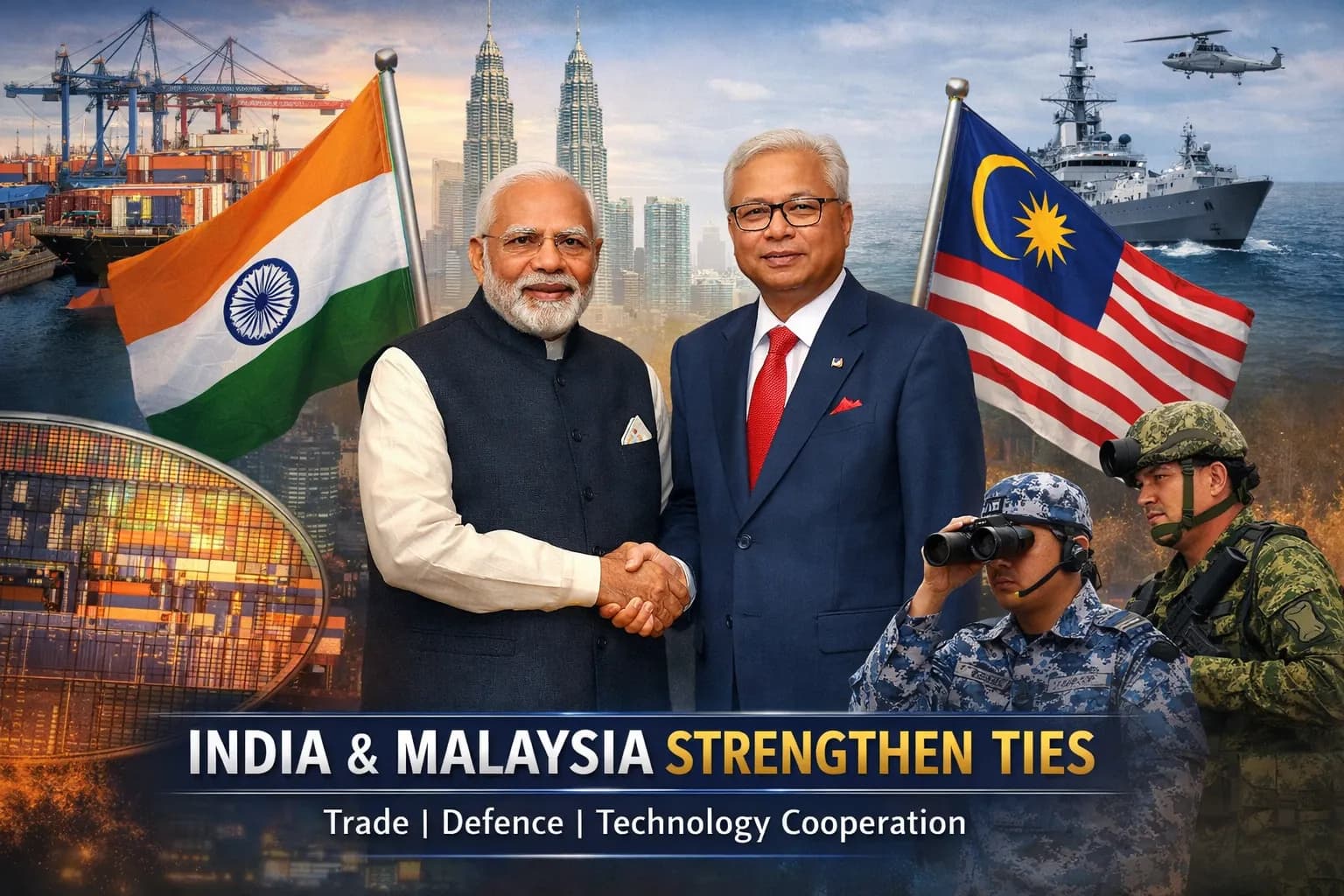
The accords were concluded during Indian Prime Minister Narendra Modi’s official visit to Kuala Lumpur, where talks with Malaysian leadership focused on elevating ties beyond traditional economic exchange toward a more comprehensive strategic partnership. Both sides framed the agreements as a response to shifting global economic conditions and growing regional security challenges.
Economically, the two countries committed to deepening trade integration, with particular attention to manufacturing, digital services, and investment facilitation. India is already one of Malaysia’s key trading partners in South and Southeast Asia, while Malaysia remains an important gateway for Indian companies seeking broader access to ASEAN markets. Officials emphasized the need to reduce non-tariff barriers, improve logistics connectivity, and encourage private-sector participation on both sides.
A central pillar of the new cooperation is the technology sector, notably semiconductors. Malaysia, a long-established hub for semiconductor assembly and testing, and India, which is actively investing in domestic chip manufacturing, identified complementarities that could support supply-chain diversification. Joint initiatives are expected to focus on skills development, research collaboration, and industrial partnerships, reflecting wider international efforts to reduce vulnerabilities in critical technologies.
Defence cooperation also featured prominently in the discussions. The two governments agreed to enhance collaboration in defence training, maritime security, and defence-industrial engagement. While neither side described the agreements as directed at any third country, officials acknowledged the importance of maintaining stability, freedom of navigation, and respect for international law in the Indo-Pacific region.
Diplomatically, the visit underscored India’s continued outreach to Southeast Asia under its “Act East” policy and Malaysia’s interest in balancing relations among major regional and global powers. Both governments reaffirmed support for multilateralism and ASEAN centrality, positioning their partnership within a broader commitment to regional dialogue and rules-based cooperation.
The agreements are expected to be followed by technical consultations and sector-specific working groups in the coming months. Analysts note that their success will depend on implementation and sustained political engagement, particularly at a time when global economic uncertainty and geopolitical competition are placing increased pressure on middle powers to diversify partnerships.
For India and Malaysia, the renewed momentum signals an intent to move beyond transactional ties toward a more resilient and forward-looking partnership, aligning economic priorities with strategic considerations in an increasingly interconnected region.
By Olha Pashchenko, EuReflect
Olha Pashchenko
Contributing writer at EUReflect.
Follow EUReflect
See more of our reporting on Google
Mark EUReflect as a preferred source and our stories are ranked higher for you in Top Stories, Discover and Google News — and carry a “preferred” badge when they are cited in AI results.
Add EUReflect as a preferred source