Nation-Building and the Symbolism of the Andorran Flag
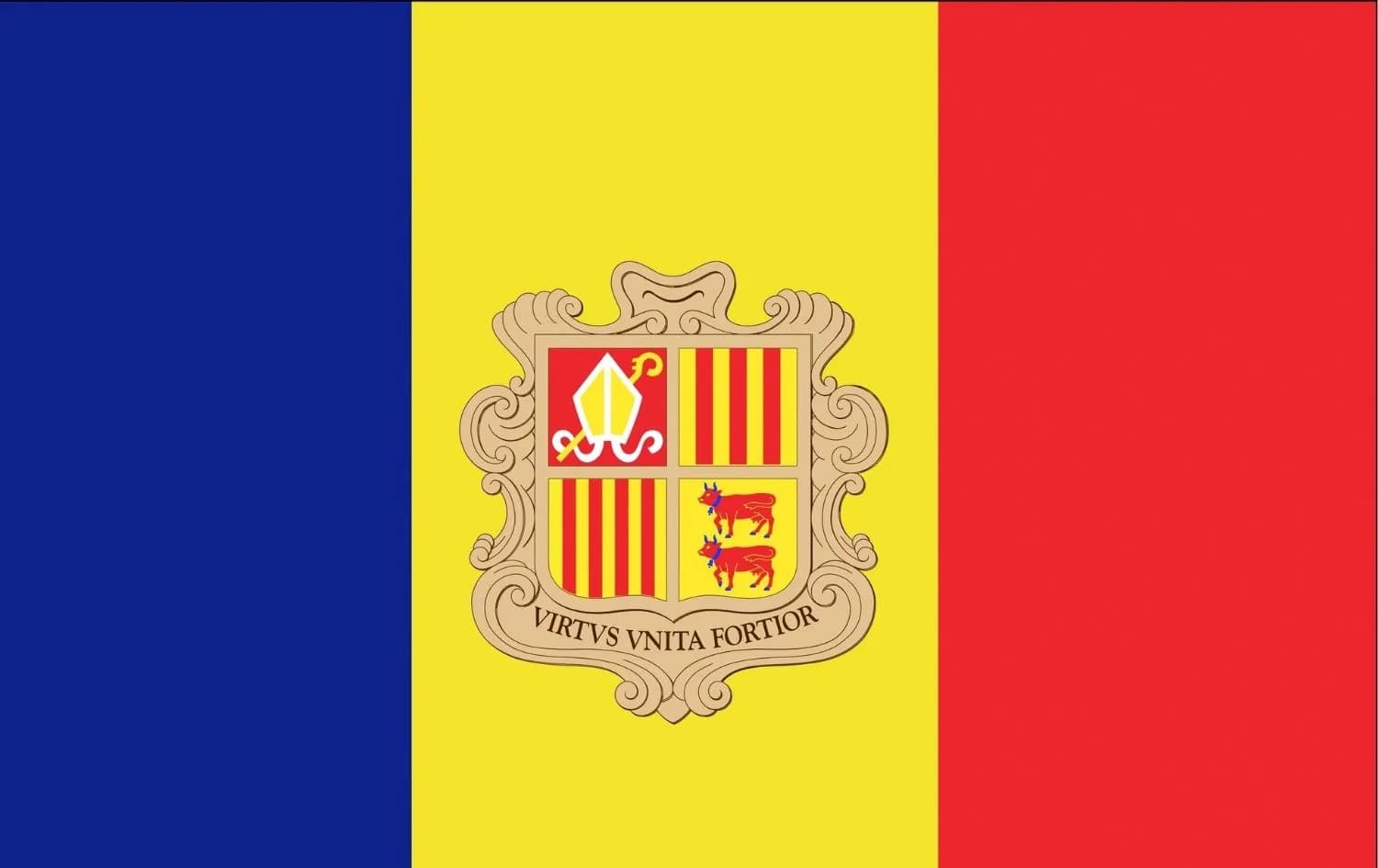
The Andorra flag, with its blue, yellow, and red stripes and central coat of arms, symbolizes the principality’s historical dual sovereignty under France and Spain. Its design reflects political agreements, cultural heritage, and the consolidation of national identity over centuries.
Introduction
The flag of Andorra represents a distinctive case in nation-building, where geography, shared sovereignty, and historical compromise converge into a symbolic form. Officially adopted in 1866 and standardized in 1993 following Andorra’s accession to the United Nations, the flag reflects the principality’s unique political structure and its historical relationship with neighboring powers. Composed of three vertical stripes—blue, yellow, and red—with the national coat of arms centered, the flag functions as a visual synthesis of independence, dual protection, and institutional continuity. Within the framework of nation-building, Andorra’s flag illustrates how small states construct identity through layered symbolic references rather than singular historical narratives.
1. Structural Symbolism and External Influences
The tricolour design of the Andorran flag directly reflects the principality’s geopolitical position between France and Spain. The blue and red elements are associated with France, while the red and yellow are linked to Spain. This deliberate combination of colors symbolizes Andorra’s historical independence under the joint protection of these two powers.
From a nation-building perspective, this structure represents a negotiated identity rather than a purely autonomous one. Unlike larger nation-states that emphasize internal revolutionary origins, Andorra’s symbolic framework acknowledges external influences as integral components of its political existence. The vertical arrangement of the stripes also aligns Andorra visually with European tricolour traditions, reinforcing its belonging to a broader continental political culture while maintaining a distinct identity.
2. The Coat of Arms: Historical Authority and Composite Identity
At the center of the flag lies the coat of arms, a complex emblem that encapsulates Andorra’s historical governance structure. The quartered shield incorporates symbols from four key historical authorities: the Bishop of Urgell, the Count of Foix, Catalonia, and Béarn. Each element reflects a dimension of Andorra’s political and cultural heritage.
The bishop’s miter and crosier represent ecclesiastical authority, while the red bars of Foix and Catalonia signify feudal and regional affiliations. The two red cows of Béarn further emphasize the principality’s connection to French territories. Beneath the shield appears the Latin motto “Virtus Unita Fortior” (Strength United is Stronger), which encapsulates the core principle of Andorran nationhood: unity through duality.
In the context of nation-building, the coat of arms serves as a visual constitution, representing the historical agreements that shaped the state. It reflects the 1278 paréage agreement, which established joint sovereignty and laid the institutional foundations of Andorra. Thus, the emblem does not merely decorate the flag; it encodes the legal and political origins of the nation.
3. Historical Evolution and the Consolidation of National Identity
The evolution of the Andorran flag demonstrates the gradual consolidation of national identity. Early versions of the flag featured horizontal stripes and often lacked the coat of arms, indicating a less formalized symbolic system. The addition of the blue stripe in 1866 and the eventual adoption of the vertical tricolour marked a shift toward a more structured and recognizable national symbol.
The brief episode in 1934, when Boris I proclaimed himself king and introduced an alternative flag design, highlights the fragility of symbolic authority in small states. The rapid return to the traditional design underscores the importance of historical continuity in Andorra’s nation-building process.
The standardization of the flag in 1993, alongside the adoption of a new constitution, represents a निर्णctive moment in the modern consolidation of Andorran identity. By formalizing its symbols within an international legal framework, Andorra reinforced its sovereignty while preserving its historical uniqueness. The continued role of the co-princes—the Bishop of Urgell and the President of France—further illustrates the coexistence of tradition and modern statehood.
Conclusion: Symbolism as a Foundation of Andorran Nationhood
The flag of Andorra exemplifies how nation-building can emerge from a synthesis of external influences, historical agreements, and symbolic continuity. Its colors reflect geopolitical realities, its coat of arms encodes institutional memory, and its evolution demonstrates the gradual stabilization of national identity.
In contrast to larger nation-states that derive their symbols from singular revolutionary narratives, Andorra’s flag represents a model of composite nationhood. It illustrates that unity can be constructed through shared authority and negotiated sovereignty. As expressed in its motto, “Virtus Unita Fortior,” the strength of Andorra lies in its ability to transform historical duality into a coherent and enduring national identity.

İsmail Polat
Ph. D. in International Relations
Follow EUReflect
See more of our reporting on Google
Mark EUReflect as a preferred source and our stories are ranked higher for you in Top Stories, Discover and Google News — and carry a “preferred” badge when they are cited in AI results.
Add EUReflect as a preferred source