Rising Tensions in Venezuela: Trump’s Military Pressure on Maduro and the Threat of Regime Change
Trump’s second-term policy toward Venezuela mirrors Bush-style interventionism: a huge U.S. military buildup, airspace closure, lethal strikes, and pressure for regime change disguised as a drug war. These actions violate international law, expose U.S. double standards, and risk turning Venezuela into “another Iraq.” The text argues that only diplomacy—not threats—can prevent deeper instability.
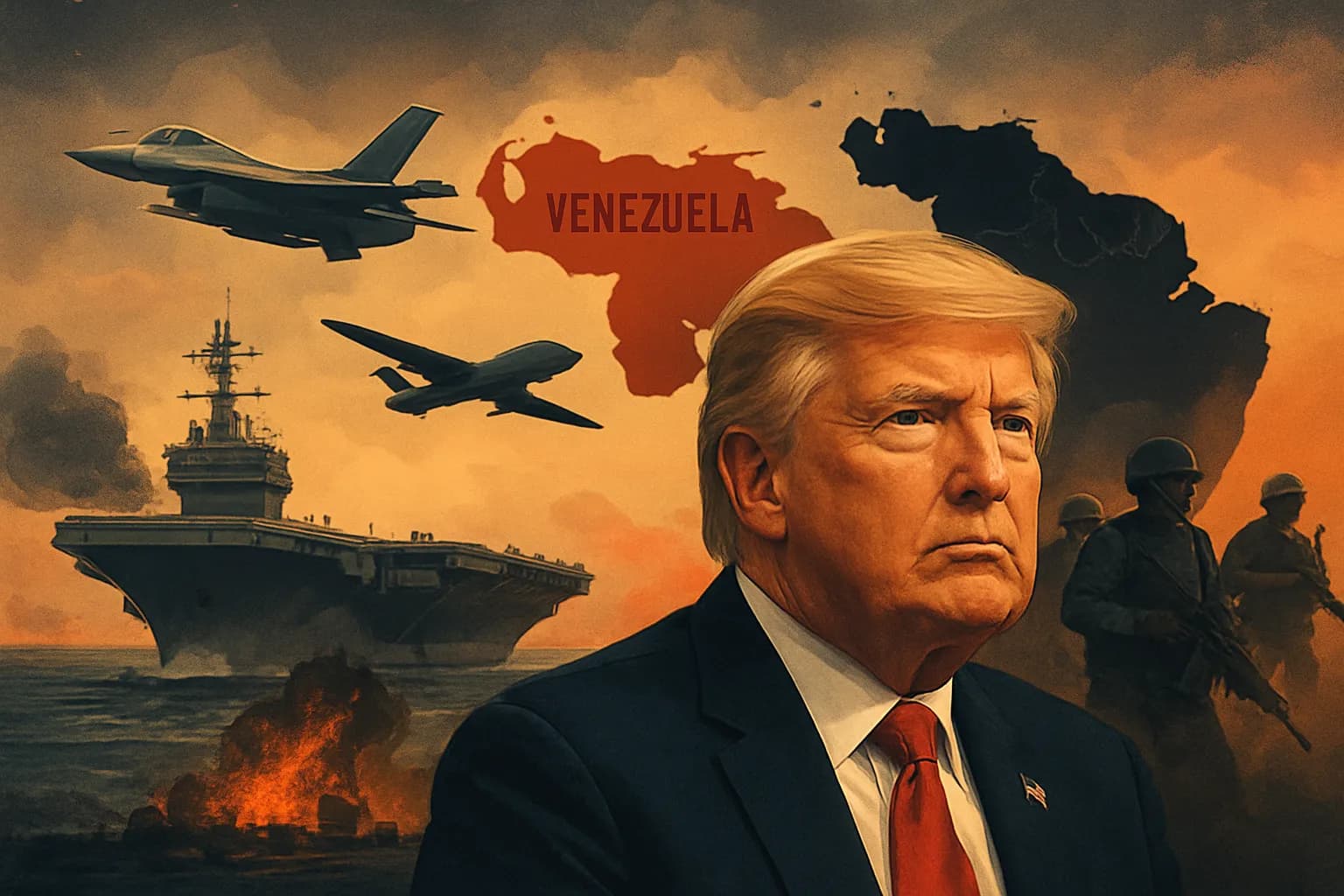
President Donald Trump’s Venezuela policy is rapidly escalating with a massive military buildup in the Caribbean, the unilateral closure of Venezuelan airspace, controversial strikes that have killed more than 80 people, and a thinly veiled regime-change campaign justified under the banner of fighting drug trafficking. Riddled with contradictory pardons, violations of international law, and a clear focus on the world’s largest oil reserves, the picture bears a striking resemblance to the Bush-era intervention in Iraq.
Bush the Third? More Aggressive, More Unpredictable
The evolution of U.S. foreign policy after the Cold War tells the tragic story of a country that built the liberal international order only to become its own worst enemy. This transformation reached its peak under George W. Bush with the 2003 invasion of Iraq – a textbook example of unilateralism and sovereigntism – and now appears to be resurface, even more intensely, in Donald Trump’s second term. From a critical perspective, both presidents’ approaches reflect the same strategic blindness: an obsessive desire to preserve American hegemonic power that, paradoxically, only accelerates its erosion.
According to Immanuel Wallerstein, the Bush neoconservatives believed they could reverse three decades of hegemonic decline by wielding overwhelming military power unilaterally. The Iraq invasion was the pinnacle of that strategy, yet it achieved the opposite: it alienated traditional allies, destroyed America’s moral legitimacy, and dragged the country into a military and economic quagmire. Kenneth Waltz had already warned that the unbalanced power structure following the Cold War would remove structural constraints on U.S. foreign policy, allowing the hegemon to indulge its “fantasies” and “desires” beyond narrow security interests – a dynamic that produced ethically questionable and unnecessary wars from Vietnam to Iraq.
Today, facing China’s rising alternative world vision, Russia’s growing aggression in Europe, and a wavering European Union, and the accelerating loss of faith in America’s messianic project, the Trump administration is responding with the same – if not greater – aggressiveness. Statements about turning Canada into the 51st state, offers to “buy” Greenland, escalating tariffs, and a barrage of threats reveal a mindset convinced that American supremacy can only be preserved through sharper, more brutal methods. The national debt has now climbed to $38 trillion, yet the response remains the same: more unilateral muscle.
The Venezuela crisis has become the latest laboratory for these parallels. Just as Bush’s “preemptive war” doctrine justified the invasion of Iraq, Trump’s massive military buildup in the Caribbean – under the pretext of fighting drug trafficking – is clearly aimed at regime change while trampling international law and alliance relationships. Both eras show the same pattern: abandonment of multilateralism, defiance of the intergovernmental institutions the U.S. itself created, and the unraveling of the “self-binding” mechanisms that once restrained American power. The result is the same: the erosion of Western European allies’ loyalty and the deepening of America’s geopolitical isolation and economic exhaustion.
Trump’s Venezuela Policy: Diplomacy, Threats, and a Regime-Change Attempt Shrouded in Contradictions
Venezuela, one of Latin America’s most complex geopolitical knots, has moved to the center of the global agenda in recent months. With Donald Trump’s second term, rising military tension in the Caribbean, intensifying pressure on the Nicolás Maduro regime, and a strategy shaped in the shadow of the world’s largest oil reserves threaten to upset the global balance of global power.
The Storm Behind a Single Phone Call
On November 30, 2025, aboard Air Force One, President Trump confirmed that he had spoken by phone with Venezuelan leader Nicolás Maduro. “No comment. The answer is yes,” he said, offering no further details. That brief admission marked the climax of months of mounting tension. According to reports, Trump issued a clear ultimatum: “You can save yourself and your family, but you must leave the country immediately.” Maduro refused to resign and demanded a global amnesty instead.
The exchange perfectly encapsulates Trump’s Latin America policy: one hand leaves the door of diplomacy slightly ajar while the other tightens the screws with military threats. Yet the contradictions are glaring. While targeting Venezuela in the name of the war on drugs, the same administration granted full pardon to former Honduran president Juan Orlando Hernández – convicted in the U.S. and sentenced to 45 years for drug trafficking. Such double standards seriously undermine the credibility of America’s “drug war” narrative.
Military Buildup and Extrajudicial Killings: Drug War or Regime Change?
Since September 2025, U.S. operations have intensified in the Caribbean and Eastern Pacific. The U.S. Navy has killed more than 80 people in strikes against suspected drug-running vessels. Some incidents reportedly involved follow-up strikes on survivors – a clear violation of the Geneva Conventions’ prohibition on attacking the wounded.
The issue has sparked fierce debate in Congress. Democratic Senator Tim Kaine called it “war-crime level” if proven true; even Republican Representative Mike Turner labeled it “illegal.” Venezuela is not a fentanyl hub but a transit route for cocaine heading mainly to Europe, weakening the official justification. The administration has designated the nonexistent “Cartel de los Soles” a terrorist organization – a move eerily reminiscent of the Bush-era “weapons of mass destruction” pretext.
The military deployment is the largest in the Caribbean since the Cuban Missile Crisis: the Gerald R. Ford carrier strike group is on station, and Trump unilaterally declared Venezuelan airspace “completely closed” on November 29 – a step widely regarded as illegal under international law. Commercial flights have been canceled, stranding thousands. Maduro complained to OPEC+, accusing Washington of trying to seize Venezuela’s oil; Treasury Secretary Scott Bessent openly hinted that regime change would cause oil prices to fall.
Information Warfare and the Role of AI: Next-Generation Interventionism
Trump’s strategy is not limited to kinetic action. Experts have proposed using “agentic AI” to generate targeted content that amplifies anti-regime sentiment inside Venezuela, scanning local sources and producing dialect-appropriate messages even in regime strongholds. Given the climate of phone surveillance and mandatory denunciation apps, such operations carry serious risks for civilians.
Contradictions and Violations of International Law
Trump’s policy lacks ideological consistency. While attempting to revive the Monroe Doctrine while systematically violating international norms. Closing airspace, extrajudicial killings, and fabricating terrorist designations breach both the UN Convention on the Law of the Sea and the Geneva Conventions. Public opinion polls show 70 % of Americans oppose military intervention in Venezuela – directly contradicting Trump’s 2024 campaign promise to end “unnecessary wars.”
Conclusion: History Repeating Itself – Only Louder
Trump’s Venezuela policy is a labyrinth where diplomacy and threats, economic interests and ideological warfare are hopelessly entangled. Talks with Maduro offer a flicker of hope, but the military buildup and glaring contradictions paint a dark picture. This approach repeats the historic pattern of U.S. interventionism in Latin America (Guatemala, Chile, Panama): short-term gains purchased at the price of long-term instability.
If regime change succeeds, Venezuela risks becoming another Iraq. If it fails, Trump’s credibility will suffer serious damage. Either way, his aggressive posture is already triggers anxiety and balancing behavior across the international arena. The world is witnessing the return of a familiar pattern – only this time, it’s Bush the Third at the helm: more aggressive, more unpredictable, and far less restrained.
The crisis ultimately reminds us of one thing: international law and genuine diplomatic dialogue remain indispensable. The Venezuelan people deserve to stop being pawns on a great-power chessboard – and that goal can only be reached through negotiation, not threats.
Bibliography
Associated Press. “Trump Says Venezuelan Airspace Should Be Viewed as Closed; Maduro Government Slams ‘Colonial Threat.’” AP News. 2025. https://apnews.com/article/trump-venezuela-hegseth-maduro-512c66b99b2a13e9d1a3ed2699e78228
BBC News. “Venezuela-Related Developments in US Foreign Policy.” BBC News. 2025. https://www.bbc.com/news/articles/cp8zyp988zvo
Center for Strategic and International Studies (CSIS). “How to Win the Information Game in Venezuela.” CSIS Analysis. 2025. https://www.csis.org/analysis/how-win-information-game-venezuela
Council on Foreign Relations (CFR). “Israel, Russia, and the United States Are Testing the Boundaries of the Global Order.” Council on Foreign Relations. 2025. https://www.cfr.org/article/israel-russia-and-united-states-are-testing-boundaries-global-order
El País. “Trump Will Consider the Next Steps in Venezuela in a Meeting with His Team This Monday.” El País, December 1, 2025. https://elpais.com/internacional/2025-12-01/trump-valorara-los-proximos-pasos-en-venezuela-en-una-reunion-con-su-equipo-este-lunes.html
Euronews Türkçe. “Venezuela Warns OPEC: The US Wants to Seize Oil Resources.” Euronews, December 1, 2025. https://tr.euronews.com/2025/12/01/venezueladan-opeca-uyari-abd-petrol-kaynaklarini-ele-gecirmek-istiyor
Le Monde. “Trump’s Interference and Contradictions Across Latin America.” Le Monde, December 1, 2025. https://www.lemonde.fr/en/opinion/article/2025/12/01/trump-s-interference-and-contradictions-across-latin-america_6748016_23.html
Reuters. “Trump Confirms He Spoke with Venezuela’s Maduro.” Reuters, November 30, 2025. https://www.reuters.com/world/americas/trump-confirms-he-spoke-with-venezuelas-maduro-2025-11-30
The New York Times. “Venezuela, Trump, and the Question of Regime Change.” The New York Times, November 24, 2025. https://www.nytimes.com/2025/11/24/opinion/venezuela-trump-regime-change.html
Zeynep Güney
Contributing writer at EUReflect.
Follow EUReflect
See more of our reporting on Google
Mark EUReflect as a preferred source and our stories are ranked higher for you in Top Stories, Discover and Google News — and carry a “preferred” badge when they are cited in AI results.
Add EUReflect as a preferred source