The Doctrine of Khawarij and Absolutism of Military to Counter Terrorism
Terrorism has historically been used as a tool of fear and power. In Pakistan, groups inspired by Khawarij ideology threaten security, legal order, and sustainable peace due to regional instability, weak governance, and ideological radicalization.
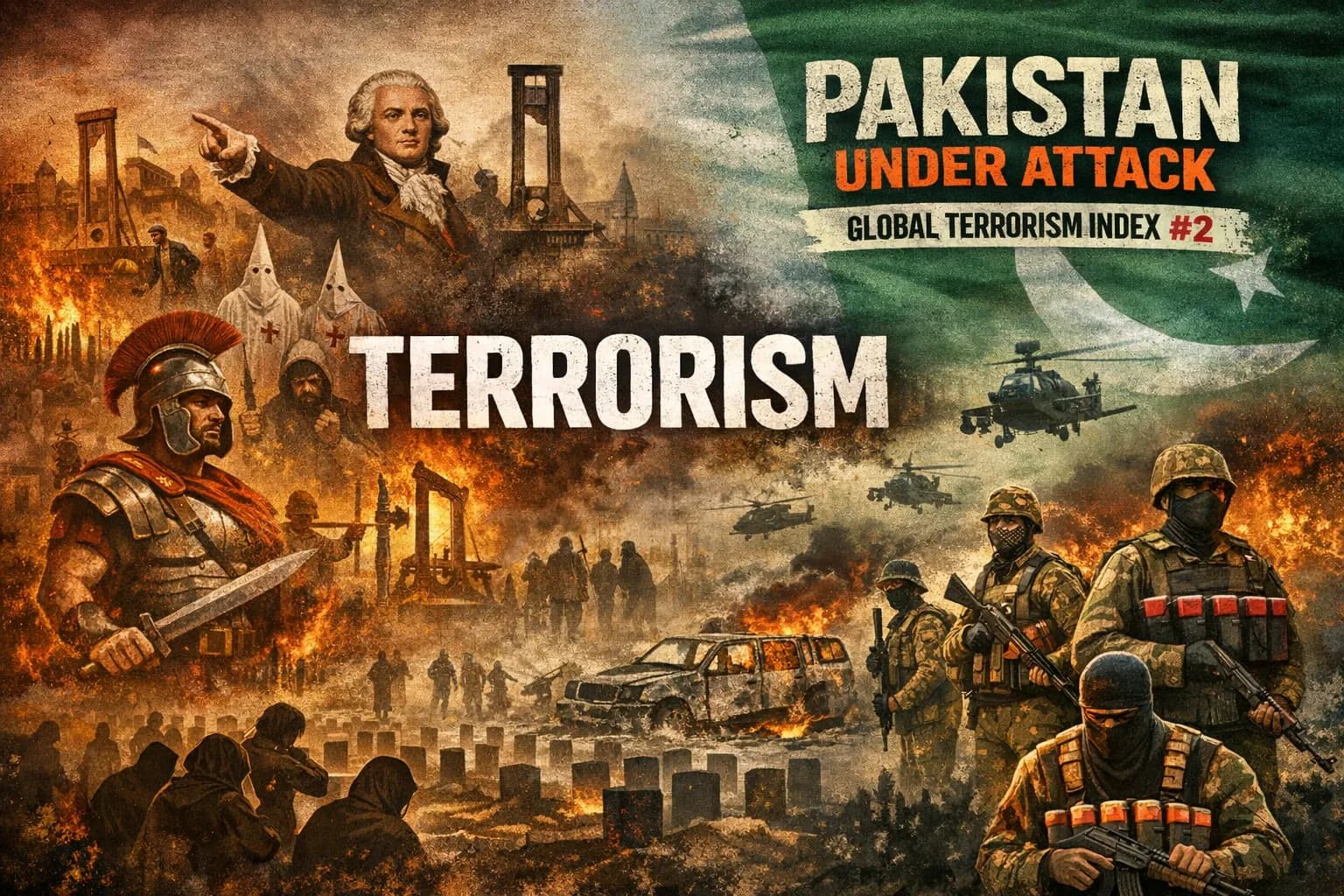
Hate is a crime without penalty while fear is a disorder implemented byincharge of powerand if exceeds the limit then it can contribute to either peace or series of conflicts. To coin the termterrorism, we may have to go back to history of ancient Greeks Xenophon (c.431–c. 350 BCE) wrote of the effectiveness of psychological warfare against enemy populations. Roman emperors such as Tiberius (reigned 14–37 CE) and Caligula (reigned 37–41 CE) used banishment, expropriation of property, and execution as means to discourage opposition to their rule. Robespierre publicly supported the use of terror during the French Revolution, while the Spanish Inquisition punished what it saw to be religious heresy with arbitrary arrests, torture, and execution. In order to scare proponents of Reconstruction (1865–77) and recently liberated former slaves, rebellious Southerners founded the Ku Klux Klan following the American Civil War (1861–65). Anarchists, who felt that assassinating people in positions of authority was the most effective way to bring about revolutionary political and social change, adopted terror in western Europe, Russia, and the United States in the latter part of the 19th century. In 20thcentury the word terrorism got modified it became official policy in totalitarian states such as those of Nazi Germany under Adolf Hitler and the Soviet Union under Stalin. In these states arrest, imprisonment, torture, and execution were carried out without legal guidance or restraints to create a climate of fear and to encourage adherence to the national ideology britannica.com/terrorism.
Power is a virtue if used correctly and sanely then it can either guard the peace or invent thedestructions.Following the 9/11 attacks, the majority of nations joined the United States in its counterterrorism efforts, starting with the Global War on Terror. Pakistan, a frontline ally, suffered greatly as a result of the United States' fervor to fight terrorism in Afghanistan. Pakistan was a vital ally of the United States due to its geostrategic location, Soviet invasion of Afghanistan, and diplomatic support for the Taliban regime economicsandpeaceGTI-2024. However prolonged regional instability and weak border governance enabled extremist wave of TTP aligned Khawarij groups, to reemerge and intensify attacks. As the saying goes, “One man’s terrorist is another man’s freedom fighter”.The term Khawarij trace back to 7thcenturyduring the caliphate of Hazrat Ali (RA). They rejected compromises, engaged in apostates (takfir) legitimized violence with their rigid interpretation of religion which is denounced by Islamic scholars.These group mirror the khawarij ideology by rejecting constitutional authority, declaring Pakistani institution un-islamic justifying violence.
In 2023, at global level deaths from terrorism increased by 22 per cent to 8,352 deaths and are now at their highest level since 2017, although they remain 23 per cent lower than at their peak in 2015.Peace is a child’s dream in a world of devil because every happiness requires the struggle and sacrifice as it nourishedbyproblems, deep down we never wanted to meet because scarifies of one is happiness of another which is why absolute peace if not impossible then unmaintainable.Pakistan ranked at 5th out of 163 countries with a score of 8.4 out of 10 on the Index, a marked improvement as it ranked 4th in 2007,Pakistan has showedimprovement inthat year for global terrorism index ranking with decline in the terrorism incidences and the deaths related to the terrorist activities. But world politics took over the peace of Pakistan in 2024 as the four major terrorist groupsIslamic State (IS), Jamaat Nusrat Al-Islamwal Muslimeen (JNIM), Tehrik-e-Taliban Pakistan (TTP), and al-Shabaab contributed in making Pakistan at number 2 of Global terrorism index as death toll raised by11%Global-Terrorism-Index-2025. Khawarij are more common to the areas which adjacent to Pak Afghan border such as Khyber Pakhtunkhwa and former FATA.
Terrorism is a destruction no country wants because, at the end of the day, it not only consumes peace but also demonstrates itself as fatal as a plague for the economy of a country. Section 6 of the Anti-Terrorism Act 1997 deals with terrorist acts throughout Pakistan, defining terrorism.There are 320 anti-terrorism courts in Pakistan; despite a comprehensive legal framework, reliance on confession-based evidence weakens effective prosecution of Khawarij-linked cases.Ina Ahmed Saeed alias bharam alias nagori vs state, prosecution case was that the accused and co-accused committed murder of brother of complainant records showed that the accused voluntarily confessed under section 164 of CrPC the offense also attracted the section 7 of anti-terrorism act 1997 and 302 of Pakistan Penal Code. The current definition of terrorism includes many offenses that are also captured under other Pakistani criminal laws. Thus, ATCs are overloaded with cases both related to, andunrelated to terrorism, contributing to major backlogs. In Johar Hussain Vs state section 497,302,324,353,427 &34 of Pakistan penal code were attracted while section 7 of anti-terrorism act 1997, Accused was charged that he and co-accused duly armed with deadly weapon assaulted on complainant party due to which six persons were died while three were injured and bail application henceforth dismissed. (JOHAR HUSSAIN VS State n.d.) case law.
People who become habitual criminals should be taken to rehabilitation centers because that's what the theories of sociology of a healthy environment suggest. Theories shows that Frustration and aggression plays crucial role in updating a noble man into a terrorist and they say “If aggression is a learned behavior, then terrorism, a specific type of aggressive behavior, can also be learned” similarly it is believed thatextremism either religious nature or political it can lead to levels of insanityPsychohistorian Lloyd De Mause (200224) observes that “The roots of terrorism lie not in this or that American foreign policy error, but in the extremely abusive families of the terrorists”Family influence.Khawarij mindset is characterized by absolutism, moral superiority and violenttakfirism. They view the world in binary terms believers versus enemies leaving no room for pluralism or dissent. Their strength lies less in number more in ability to destabilize state authority through asymmetric violence.
Misinterpretation or miscommunication canbeproven injurious to environment which is why the radical view is essential. People use religion as a covert for malicious purpose of their own businesses perk such as numerous consider the suicide bombing as jihad in lieu it’s haram(forbidden). Terrorism is a borderless issues experienced by almost every countryto combat counterterrorism in Pakistan requires a multidimensional strategy combining kinetic operations against Khawarij network, legal reforms, ideological counter narrative by scholars and socio-economic rehabilitation.Without addressing both causes and consequences of extremism peace remains fragile rather than sustainable.
Amina Noor
Contributing writer at EUReflect.
Follow EUReflect
See more of our reporting on Google
Mark EUReflect as a preferred source and our stories are ranked higher for you in Top Stories, Discover and Google News — and carry a “preferred” badge when they are cited in AI results.
Add EUReflect as a preferred source