The Golden Heritage: Decoding Bangladesh’s "King of Fruits"
Native to Bangladesh, the mango is a symbol of the country’s history, culture, and economy. With more than 270 varieties and a record harvest expected, Bangladesh is expanding exports worldwide, making mangoes a strategic crop that supports millions of livelihoods.
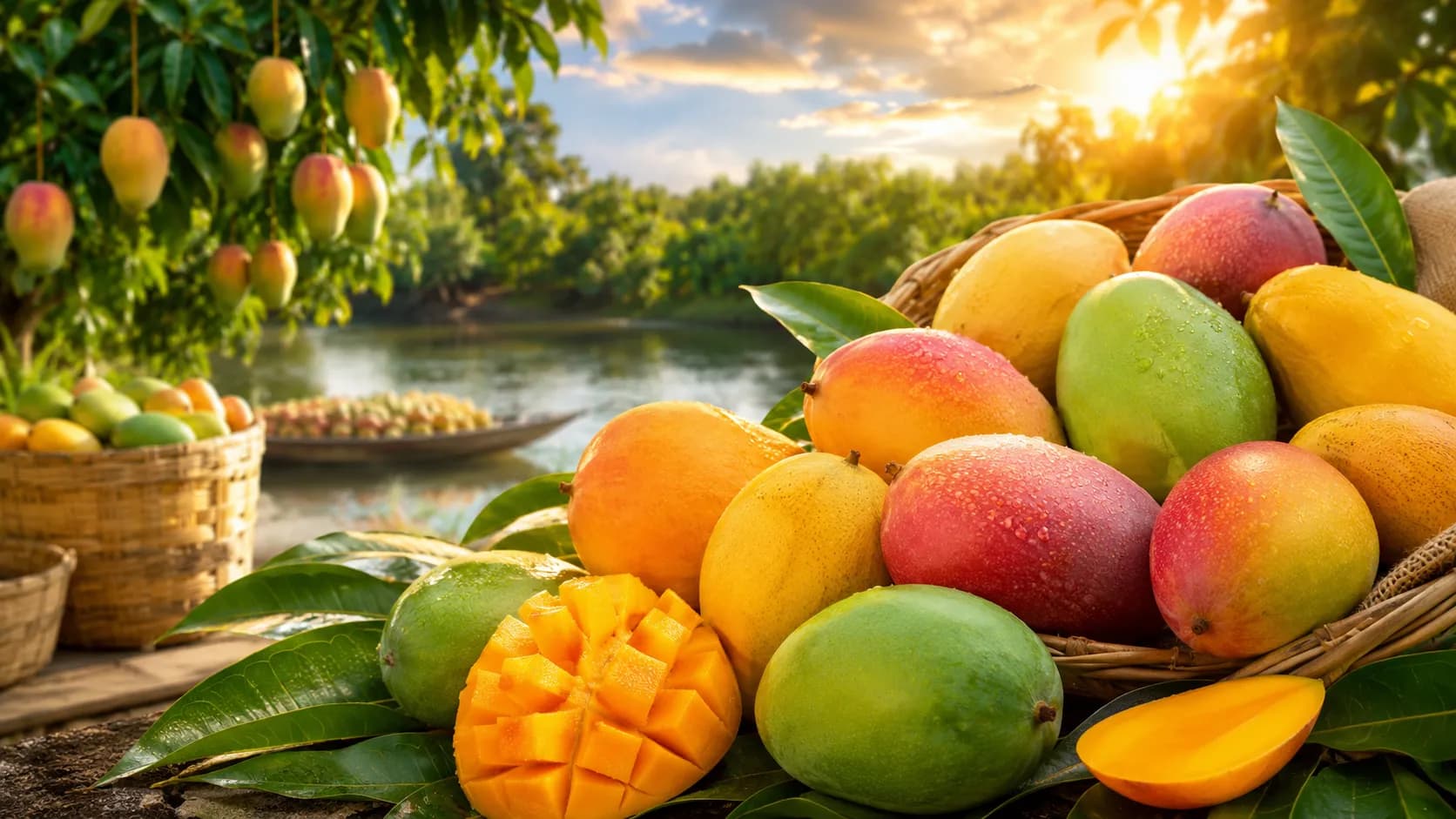
When the first monsoon rains sweep across the Bengal delta in early June, something special begins to happen. Markets fill with woven bamboo baskets overflowing with mangoes, the air becomes heavy with their sweet, resinous fragrance, and people across Bangladesh turn their attention to the harvest.Considered indigenous to Bangladesh and its adjacent areas,the mango (Mangifera indica) is much more thana fruit. It is a symbol of history, culture, and identity
The ancestors of today’s cultivated mangoes once grew wild in the rainforests of what are nowBangladesh,northeastern India, and Myanmar. Over thousands of years, the fruit became deeply woven into the region’s culture. Mangoes appear in ancient Buddhist Jataka tales, and tradition holds that Buddha himself was gifted a mango grove, for he could rest beneath its shade.
The growing international popularity of Bangladeshi mangoes has led to a significant expansion of mango cultivation, creating economic opportunities and supporting the livelihoods of millions of people.This year, Bangladesh is expecting a record harvest, with production projected to reach between 2.7 and 2.9 million metric tonnes.
The Aristocrats: FamousFlavor Profiles
Bangladesh is home to more than 270 recognized mango varieties, but only a few dominate both the marketplace and public imagination. Each has its own character, and debates about which is the finest can become surprisingly passionate.
Among the most admired isKhirsapat, also known asHimsagar, a variety that has received Geographical Indication (GI) status. Its vibrant yellow-green skin conceals a completelyfiberless flesh with an exceptionally rich sweetness. Smooth, juicy, and intensely flavorful, it is often considered the ultimate dessert mango and is harvested during the early to middle part of the season.
Another beloved variety is Langra, a medium-sized, oval-shaped mango that remains green even when fully ripe. Its appeal lies in its distinctive balance of sweetness and acidity. The fruit carries a complex aroma and a subtle tanginess that complements its natural sugars, making it afavorite among those who prefer a more nuanced flavor profile. Langra typically reaches the market during the middle of the mango season.
At the opposite end of the harvest calendar stands Fazli, the giant of traditional Bangladeshi mangoes. Individual fruits can weigh close to a kilogram, earning it a reputation as the heavyweight champion of the mango world. Although slightly more fibrous than somepremium varieties, Fazli is exceptionally sweet and fragrant. Its size andflavor make it particularly suitable for processing into jams, preserves, and other mango-based products, while also remaining a popular choice for fresh consumption late in the season.
In northern Bangladesh, especially in the Rangpur region,Haribhanga has achieved near-legendary status. Recognizable by its round shape and fiberless flesh, this variety offers a pleasing combination of sweetness and a gentle tartness that prevents it from becoming overly sugary. Its unique flavor has helped transform it from a regional specialty into one of the country's most sought-after mangoes. Haribhanga is usually harvested from the middle to the later part of the season.
Completing the group of elite cultivars isGopalbhog, an early-seasonfavorite that signals the beginning of Bangladesh's mango harvest. With its bright orange pulp, rich traditional mango flavor, and irresistible aroma, it is often the first variety that consumers eagerly await each year. Its arrival inlocal markets marks the unofficial start of mango season and generates excitement among mango enthusiasts across the country.
The Hidden Jewels: Heritage and Exotic Sorts
Beyond the famous household names, Bangladesh is home to rare heritage varieties and is also embracing a new generation of high-value international cultivars.
The Legendary Kohitoor
Considered one of the most delicate mangoes ever grown,Kohitoorwas so fragile that harvesters reportedly caught the fruit in cotton nets to prevent bruising. After picking, the mangoes were wrapped in cotton wool and turned every twelve hours to ensure even ripening. Golden-yellow, intensely sweet, and extremely rare today,Kohitoor remains the ultimate symbol of mango luxury.
BARI’s Modern Innovations
The Bangladesh Agricultural Research Institute (BARI) has played a major role in modernizing mango production through the development of high-yield, resilient varieties.
BARI Aam-3 (Amrapali) has become a major commercial success thanks to its exceptionally high sugar content, exceeding 21% Total Soluble Sugar (TSS). Its popularity has helped transform districts such asNaogaon into important mango-producing centers.
Another breakthrough is BARI Aam-11 (Baromasi), a remarkable variety capable of producing fruit almost year-round, breaking the traditional May-to-August harvesting cycle.
The "Egg of the Sun"
One of the most fascinating recent developments has emerged from the Chittagong Hill Tracts, especiallyKhagrachari, where farmers have successfully cultivated the famous Miyazaki mango from Japan.
Known in Japan as Taiyo noTamago (“Egg of the Sun”), this striking red-purple mango is famous for commanding extraordinary prices at auction. In Bangladesh, it has earned the nickname Suryadim. Farmers such asHlashimongChowdhury have demonstrated that, with careful management and suitable growing conditions, the variety can thrive locally. The fruit contains around 15% more sugar than average mangoes and sells for approximately Tk 1,000 per kilogram on the domestic market.
Culinary Versatility and Nutrition
Although ripe mangoes are beloved as a dessert, their culinary value begins long before they ripen. Green mangoes, known as Kacha Aam, are an essential ingredient in Bengali cuisine. They are roasted and blended with cumin and mint to createKacha AamerShorbot (Green Mango Juice), a refreshing summer drink, or transformed into spicy pickles preserved in mustard oil. Green mango is also a key ingredient in Tok Dal, a tangy lentil dish that offers relief from the intense heat of the pre-monsoon season.
Mangoes are equally impressive from a nutritional perspective. Ripe fruit is rich in provitamin A, dietaryfiber, and beneficial polyphenols. Most commercial varieties contain around 20% total soluble sugars, while acidity drops to approximately 0.2% as the fruit ripens, resulting in a sweet, energy-rich source of vitamin C and other nutrients.
Bangladesh's mango heritage is increasingly gaining international recognition. Reflecting this growing global interest, the Embassy of Bangladesh in Belgium is organizing an exclusive closed-door Mango Tasting Festival. The event will showcase a selection of premium Bangladeshi mango varieties, offering guests an opportunity to experience firsthand theflavors that have made the fruit a symbol of the country's agricultural excellence and cultural identity.
The Mango Economy: A Global Horizon
Mango cultivation is one of the most important seasonal industries in Bangladesh, particularly in the northwestern districts. During harvest season, entire local economies revolve around the fruit. Tens of thousands of jobs are created in orchard care, harvesting, packaging, and transportation.
One of the most visible examples is the famous “Mango Special” train, which carries fruit fromChapainawabganj to Dhaka, ensuring that mangoes reach consumers quickly and with minimal damage.
Recent studies show that commercial mango farming remains highly profitable, with an average profit-to-cost ratio exceeding 2.0. With production expected to reach around 2.7 million tonnes in 2025–2026, the Department of Agricultural Extension (DAE) is actively expanding exports. Through contract farming, fruit-bagging techniques that reduce pest damage without pesticides, and Vapor Heat Treatment (VHT) facilities that meet international phytosanitary standards, Bangladesh is successfully exporting varieties such asKhirsapat and Amrapali to 38 countries, including France, Italy, the United Kingdom, Japan, and Malaysia.
From the delicateKohitoor once reserved for elits to the carefully exported Amrapali of today, the mango remains the undisputed king of fruits in the Bengal delta - a remarkable crop where history, culture, and agricultural innovation come together in a single bite
EUReflect News
Site Administrator
Follow EUReflect
See more of our reporting on Google
Mark EUReflect as a preferred source and our stories are ranked higher for you in Top Stories, Discover and Google News — and carry a “preferred” badge when they are cited in AI results.
Add EUReflect as a preferred source