The Symbolic Imagination of Nationhood: An Analysis of Muhammad Ali Pasha’s Poem About Flag and Coat of Arms of Indonesia
The paper analyzes Muhammad Ali Pasha’s poem “About Flag and Coat of Arms of Indonesia” from his collection Romantic Whispers of the Archipelago. It argues that the poem uses metaphor, imagery, and symbolism to explore how Indonesia’s national symbols—the flag (Sang Merah Putih) and the Garuda Pancasila emblem—shape cultural memory and national identity. By linking the symbols to their historical origins, mythological roots, and the philosophical principles of Pancasila, the poem portrays them as living embodiments of unity, struggle, and collective ideals. The analysis situates Pasha’s work within poetic nationalism, showing how literature reinforces shared identity by transforming symbols into carriers of history, values, and cultural continuity.
My paper is an analysis of the poem “About Flag and Coat of Arms of Indonesia” by Mr. Muhammad Ali Pasha from his poetry collection “Romantic Whispers of the Archipelago”. The poem gives a lyrical expression to depict the national symbols of Indonesia, namely, the flag (Sang Merah Putih) and the national emblem (Garuda Pancasila). The poem in question incorporates a collection of metaphor, pictorial images, and symbols that helps us connect history, cultural values, and wrongness ideals of the nation of Indonesia. It is through this that the analysis puts the poem in the larger context of the discussion concerning the formation of national identity with an anthropocentric reference to the importance of literature in the interpretation and maintenance of collective memory.
National symbols act as crypts of meaning, they contain the sum of group fights, ideologies and dreams. The flag and coat of arms are symbols of assurance in postcolonial Indonesia, and the displays remind heroes about their independence, unity, and identity. In his poetry volume Romantic Whispers of the Archipelago, Muhammad Ali Pasha appeals not only to these symbols as an icon of national identity but as an oral ship of historical memory and culture. The poem in question is an artistic reflection over the role of these symbols in bringing Indonesian experience in its struggle to be subject and transformed into a national sovereign state.
Historical Context of the Symbols
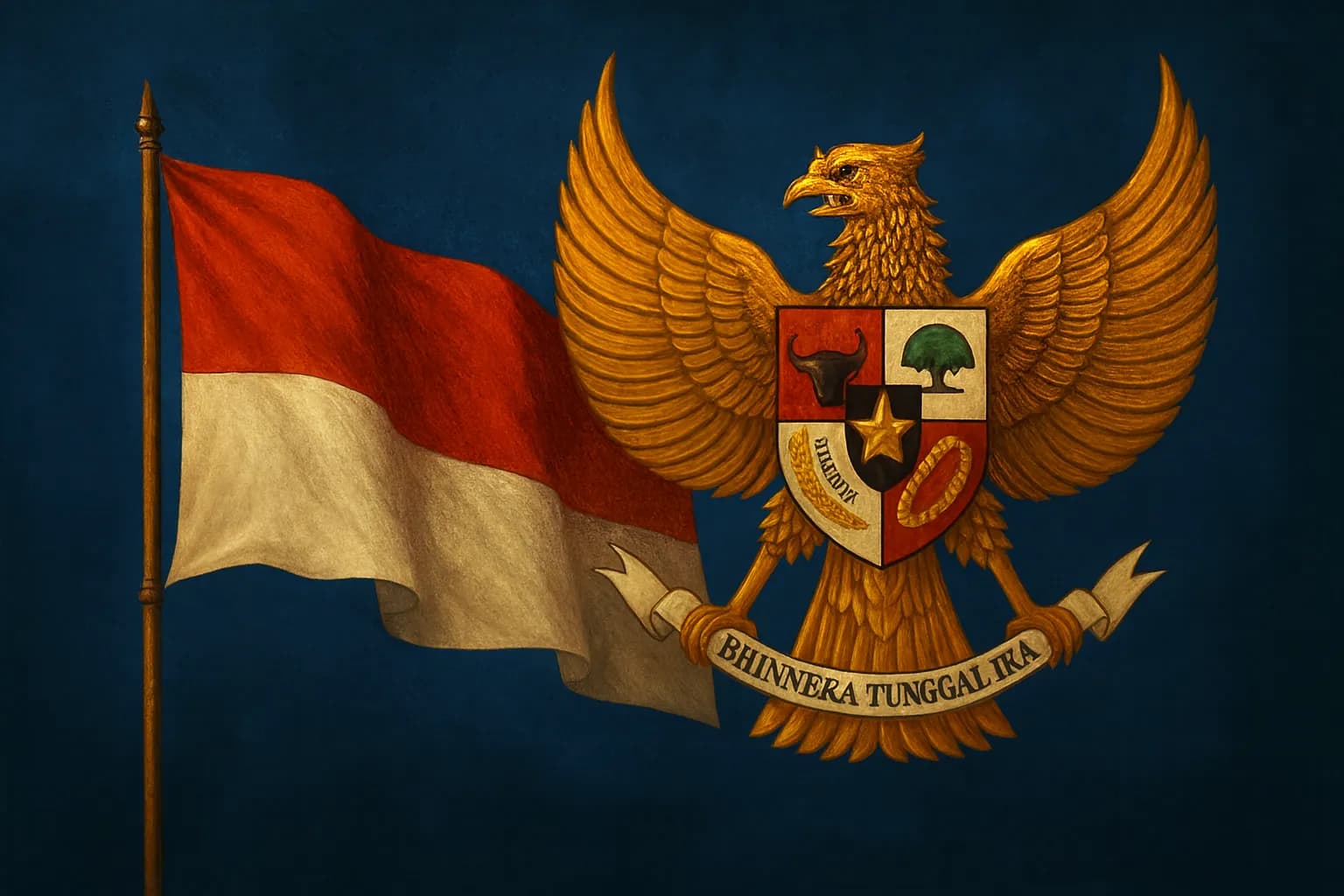
It was on 17 August 1945 that first flew the Sang Merah Putih (Red and White) flag and Indonesia declared itself an independent state. Its colors have two layers of meaning: red can be considered a symbol of courage and sacrifice, and white symbolizes the spirit and purity. These readings are very interwoven in the Indonesian culture and the remnants can be traced in Javanese and Majapahit presentations.
In 1950 the Garuda Pancasila was adopted and it represents both political sovereignty as well as philosophical unity. The Garuda is a Hindu and Buddhist creature of Hindu and Buddhist mythology, which represents the power and defense of the creature. The shield at its chest espouses Pancasila, the five icons of the Indonesian state which includes belief in God, humanitarianism, national unity, democracy, and social justice.
Literary Analysis of the Poem
1. Imagery of Birth and Aspiration
The first stanza places the flag in the decisive hour of the independence in the year 1945:
“In forty-five, a flag was raised / with dreams so vast and bright.”
In this case, the flag is not a symbol per se, but it is an expression of unity of desire. Raised and unfurled is the use of the verb to bring imagery of physical activity and spiritual openness, which is in line with the theories of nationalism as an imagined community (Anderson, 1983).
2. Symbolic Dualities of the Flag
The dialectic of red and white is predetermined in the poem:
Red → Courage, struggle, sacrifice.
White → Purity, peace, and the inner spirit.
This indicates that there was a struggle and spirituality imbalance, which resulted in a tension that defined the national identity of Indonesia during and after the revolution.
3. The Garuda as the Mythology and Modernity
The mythological foaming on the Garuda stanza in itself accentuates the Garuda mythological miasmatic in addition to associating it with the inception of liberation:
“The Garuda, their golden eagle, / spreads its wings with grace.”
In the reference to this animal of ancient heroics, Pasha emphasizes the national identity of Indonesia is debted or denominated not to political and political discontinuity but to cultural continuity itself. Through literature, transgression and modern statehood are connected.
4. Pancasila and the Emblem’s Philosophy
The poem reflects gloriously the five principles of Pancasila in imagery one at time:
Star → Faith and divine guidance.
Banyan tree → Unity across diversity.
Bull → Democracy and collective will.
Rice and cotton → Social justice and prosperity.
Pasha creates and incorporates each aspect into verse, which makes political philosophy a lyrical feeling. These stanzas have a refrain-like influenced, which underscores their universal and eternal applicability.
5. Unity in Diversity
This is affirmed by the last stanza which refers to the national motto Bhinneka Tunggal Ika (Unity in Diversity):
“The Garuda’s emblem speaks / a truth both vibrant and clear,
‘Unity in Diversity,’ a cherished tale / they hold dear.”
This sums up the argument in this poem which is that the symbols in Indonesia are not fixed designs on paper but living embodiments of oneness created out of multiplicity.
Poetic Nationalism and Cultural Memory
Being a Pakistani, the poem by Pasha belongs to the lineage of poetic nationalism, according to which literature performs and safeguards the symbolic discourse of the nation. Similar to silent revolution poems written by Chairil Anwar in the process of the Indonesian independence fight, the work by Pasha encourages the ideals of the country among domestic readers as well as the rest of the world as seen in the world of literature. The meaning of his interpretation can encourage the readers to see the flag and symbol not as arm of the state but as cultural writing that includes history, mythology, and philosophy.
Conclusion
About Flag and Coat of Arms of Indonesia by Muhammad Ali Pasha is an exegesis poem on the symbols of the nation of Indonesia. Using the combination of past citation, mythological appeal, and philosophical profundity, the poem is performed in practice, leading to what is defined as the imagined community by Benedict Anderson of the nation a group of people who identify themselves using a common set of symbols and familiar stories. This makes the poem a part of the cultural saving of the identity of Indonesia, and to make sure that the flag and the coating back are not only marks of power because of its visual representations, but also a lasting stamps of group soul, cohesion and idealism.
References
Anderson, B. (1983). Imagined Communities: Reflections on the Origin and Spread of Nationalism. London: Verso.
Ricklefs, M. C. (2001). A History of Modern Indonesia since c. 1200. Palgrave.
Vickers, A. (2005). A History of Modern Indonesia. Cambridge University Press.
Pasha, Muhammad. Ali. (2024). Romantic Whispers of the Archipelago.
Sitra Dewi
Contributing writer at EUReflect.
Follow EUReflect
See more of our reporting on Google
Mark EUReflect as a preferred source and our stories are ranked higher for you in Top Stories, Discover and Google News — and carry a “preferred” badge when they are cited in AI results.
Add EUReflect as a preferred source