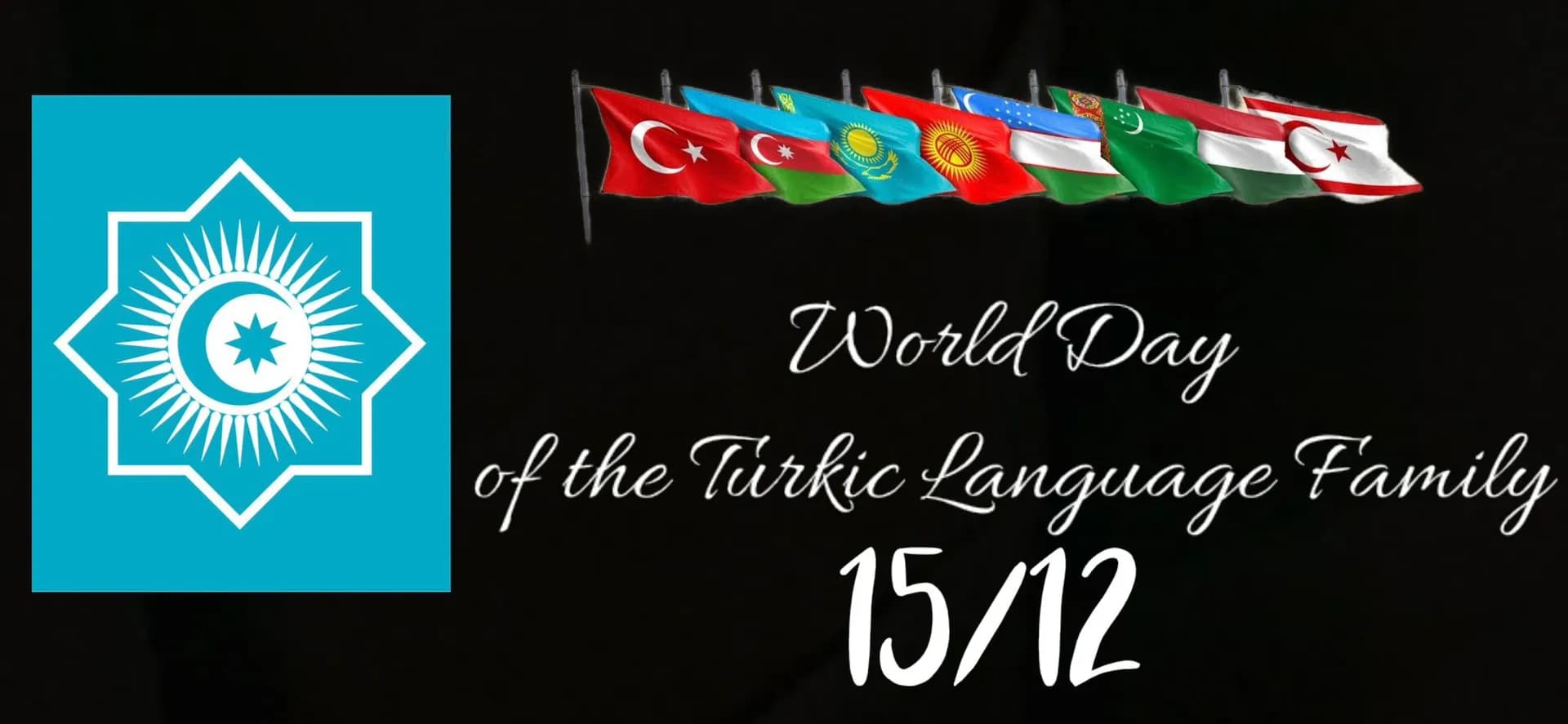
15 December 2025 – World Day of the Turkic Language Family
On 15 December 2025, the international community marks a historic milestone with the first official celebration of the World Day of the Turkic Language Family
A Historic Recognition of a Millennia-Old Linguistic Heritage
Brussels, 15 December 2025
On 15 December 2025, the international community marks a historic milestone with the first official celebration of the World Day of the Turkic Language Family, as proclaimed by UNESCO. This date commemorates the decipherment of the Orkhon Inscriptions in 1893 by Danish linguist Vilhelm Thomsen, a breakthrough that scientifically established the deep historical roots of the Turkic languages.
More than a symbolic date, 15 December now enters the global cultural calendar as a day dedicated to linguistic heritage, identity, and shared memory across the Turkic world.
From the Orkhon Valley to the World Stage
The Orkhon Inscriptions, discovered in present-day Mongolia, are among the oldest known written records of the Turkic language. Their decipherment revealed not only an advanced writing system but also a sophisticated political, philosophical, and cultural worldview dating back over a millennium.
By recognizing this legacy, UNESCO affirms the universal value of the Turkic language family, spoken today by more than 200 million people across Eurasia from Anatolia and Central Asia to the Caucasus, Siberia, and large diasporas worldwide.
A Collective Achievement of the Turkic World
The designation of this World Day is the result of joint diplomatic and cultural efforts by Türkiye and other Turkic states, reflecting a growing spirit of cooperation within the Turkic world. Its official announcement in Samarkand, one of the historic cradles of Turkic-Islamic civilization, further underscores the deep cultural continuity linking past and present.
This recognition stands as a concrete symbol of unity, demonstrating how shared language and heritage can serve as bridges between nations, generations, and cultures.
Language as Cultural Memory and Future Responsibility
Beyond celebration, the World Day of the Turkic Language Family carries a forward-looking mission:
to protect endangered Turkic languages and dialects,
to promote linguistic research and education,
and to transmit this heritage to future generations in an era of globalization and digital transformation.
Language is not merely a tool of communication , it is a vessel of collective memory, values, and worldview. Safeguarding it is therefore a responsibility shared at both national and international levels.
A New Global Cultural Landmark
With this decision, UNESCO elevates the Turkic language family to its rightful place within the world’s cultural heritage. 15 December is no longer just a historical reference point , it becomes an annual occasion for reflection, celebration, and renewed commitment to linguistic diversity.
From the stone monuments of the Orkhon Valley to the halls of UNESCO, the Turkic language’s thousand-year journey now resonates on a global scale.
By Kadir Duran – Bruxelles Korner
Kadir Duran
Contributing writer at EUReflect.
Follow EUReflect
See more of our reporting on Google
Mark EUReflect as a preferred source and our stories are ranked higher for you in Top Stories, Discover and Google News — and carry a “preferred” badge when they are cited in AI results.
Add EUReflect as a preferred source