A Mass for the Margins
Pope Leo drew 1.2 million faithful to Madrid’s Cibeles Square, delivering a powerful Mass urging Catholics to serve the poor. Declaring that God “identifies with the forsaken,” he called for inclusive cities and respect for migrants during his historic first EU visit outside Italy.
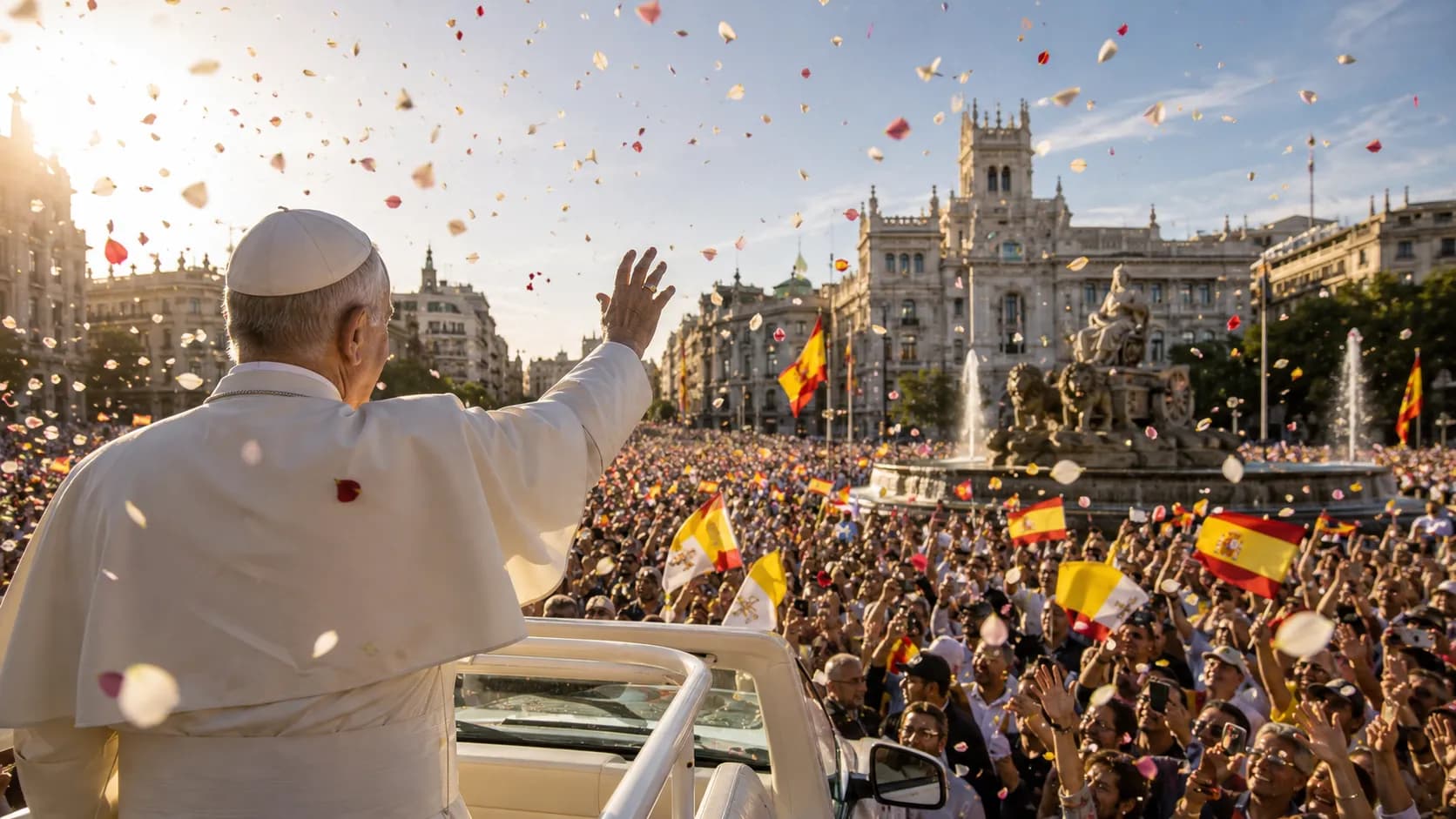
In a moment of rare and sweeping spiritual magnitude, Pope Leo stood before more than 1.2 million faithful in the streets surrounding Madrid’s landmark Cibeles Square on Sunday, delivering one of the most consequential public addresses of his pontificate to date. With flower petals raining down as his white popemobile made its way through the crowd, and thousands waving flags and chanting “Long live the Pope” in a show of fervent devotion, the occasion carried the weight of both religious ceremony and historic significance. The outdoor Mass, widely regarded as the centrepiece of Pope Leo’s week-long visit to Spain, served as a powerful platform for the Pontiff to reaffirm the Catholic Church’s enduring commitment to social justice, human dignity, and the protection of society’s most vulnerable members.
The crowd, which was estimated jointly by the Vatican and local organisers, spanned not only the iconic square itself but extended far into the surrounding streets and boulevards of the Spanish capital, transforming central Madrid into a vast, open-air cathedral. Pilgrims had gathered from across Spain and beyond, many having travelled overnight or camped in the city to secure a place. For them, the visit represented not merely a religious event, but a once-in-a-lifetime encounter with a figure who, since his election to the papacy, has placed the cause of the marginalised and dispossessed at the very heart of his ministry.
A Sermon Rooted in Solidarity: “God Identifies With the Poor”
At the spiritual centre of Sunday’s outdoor Mass lay a homily of striking moral clarity. Pope Leo urged the assembled faithful to translate their Catholic faith into concrete acts of service and compassion, insisting that authentic belief cannot be separated from action on behalf of those who suffer. His words were direct and unambiguous: God, he declared, “identifies with the poor, the downtrodden, those who are alone and forsaken.”
The message resonated across the vast crowd and beyond, amplified through speaker systems that carried the Pope’s voice along every boulevard. It spoke to a tradition of Catholic social teaching that stretches back centuries — one that holds the alleviation of suffering not as a charitable option but as a fundamental moral obligation. For Pope Leo, the sermon was not merely a reflection of theological principle but a personal call to arms, directed at each individual present regardless of their station in life.
The homily drew particular power from the context of Leo’s broader itinerary in Spain. The previous day, Saturday, the Pontiff had not begun his tour with meetings of heads of state or diplomatic receptions, but with visits to migrants and the homeless — people living at the very margins of Spanish society. This deliberate sequencing was widely interpreted as a statement in itself: that the Church’s true priorities lie not in the corridors of power, but in the shelters, alleyways, and reception centres where the invisible and forgotten struggle to survive.
Madrid as a Symbol: Inclusivity, Welcome, and Human Values
Before the outdoor Mass, Pope Leo offered a personal gesture of respect and affection for the city of Madrid when he signed the guestbook at a ceremony in which the city’s mayor formally presented him with the key to the city. In his written message, the Pontiff expressed his hope that Madrid would “remain a welcoming and inclusive city, where social life is inspired by genuine human values.” The phrase, brief though it was, carried considerable resonance in a country and a continent increasingly marked by debates over immigration, identity, and the nature of civic belonging.
The sentiment was echoed throughout the day by those gathered in the square. Among the crowd was Andrea Margarita, a 72-year-old Peruvian woman who had arrived in Spain just six months earlier and attended the Mass in a wheelchair alongside her daughter. Asked about the significance of the Pope’s visit, she spoke with quiet conviction. “I am delighted that he is praying for us migrants and for our safety,” she said. Her words, simple and unadorned, captured something essential about the meaning of the day — that for many of the newest arrivals to Spain, Leo’s presence represented not only spiritual comfort but a form of visible moral validation.
The Pope’s vision of Madrid as a model of urban inclusivity also carried a broader political dimension. In his public remarks throughout the visit, Leo urged leaders across Europe and the world to refrain from dividing electorates along lines of fear and exclusion. He expressed hope that his visit to Spain — his first to an EU country outside Italy — would set an example to the world about respecting “every human being.” In an age of populist nationalism and mounting hostility toward migrants in several European nations, the statement was received in many quarters as a pointed, if diplomatically worded, rebuke.
A Papal Tour With Purpose: From Madrid to the Canary Islands
Sunday’s Mass in Madrid represents only one chapter in a carefully constructed week-long itinerary that runs from 6 to 12 June and takes the Pope to some of the most symbolically significant locations in Spain. The tour, which began on Saturday with a vigil drawing some 600,000 young people to the Spanish capital, is designed to engage with multiple dimensions of contemporary Spanish and European society — from the vitality of youth to the anguish of those displaced by poverty and conflict.
Following his engagements in Madrid, Pope Leo is scheduled to travel to Barcelona, the cosmopolitan Catalan capital that is itself a city of deep cultural and religious heritage. From there, the Pontiff will travel to the Canary Islands, the Spanish archipelago off the coast of West Africa that in recent years has become one of the most contested frontlines of Europe’s migration crisis. There, he will meet with migrants who have made the perilous Atlantic crossing from West Africa — a journey that claims hundreds of lives each year and has drawn mounting international concern over the humanitarian conditions faced by those who survive it.
The choice to include the Canary Islands in the papal itinerary was widely praised by humanitarian organisations as a significant act of solidarity. It signals that Leo’s engagement with the migration issue is not purely rhetorical but grounded in a willingness to bear personal witness to the suffering it entails. After the Sunday Mass, the Pope’s afternoon programme included a private meeting with fellow members of his Augustinian religious order, followed by an engagement with figures from the worlds of entertainment, sport, and culture at a concert venue in central Madrid — a gathering intended to affirm the Church’s dialogue with broader civil society.
Conclusion: A Pontificate Defined by the Margins
Pope Leo’s visit to Spain, and Sunday’s Mass in Madrid in particular, offers one of the clearest expressions yet of the character and priorities of his pontificate. In gathering over a million people in the streets of a European capital and using that extraordinary platform not to speak of institutional power or theological doctrine but of the poor, the forsaken, and the necessity of human welcome, Leo has once again demonstrated that his papacy is defined above all by a commitment to those whom the world most often overlooks.
The images from Cibeles Square — the vast crowds, the flower petals, the white popemobile moving slowly through a sea of outstretched hands — will endure as a striking portrait of a Church seeking relevance and renewal in the twenty-first century. Whether in the shelters of Madrid, the streets of Barcelona, or on the shores of the Canary Islands, Pope Leo’s message throughout this tour has been consistent and uncompromising: the dignity of every human being is not negotiable, and the Church stands, as God does, with those who have been left behind.
As the week-long tour continues, the eyes of the world’s 1.4 billion Catholics — and of many beyond the faith — will remain fixed on a Pontiff who has made compassion the cornerstone of his leadership.
Alvara Merrick
Contributing writer at EUReflect.
Follow EUReflect
See more of our reporting on Google
Mark EUReflect as a preferred source and our stories are ranked higher for you in Top Stories, Discover and Google News — and carry a “preferred” badge when they are cited in AI results.
Add EUReflect as a preferred source