Belgium and Kazakhstan Look Beyond Royal Visit to Strategic Cooperation
Belgian, Kazakh and EU representatives gathered in Brussels to outline the next phase of cooperation following the Belgian royal state visit to Kazakhstan, with critical raw materials, transport connectivity and research at the heart of the agenda.
Brussels | 23 October 2026
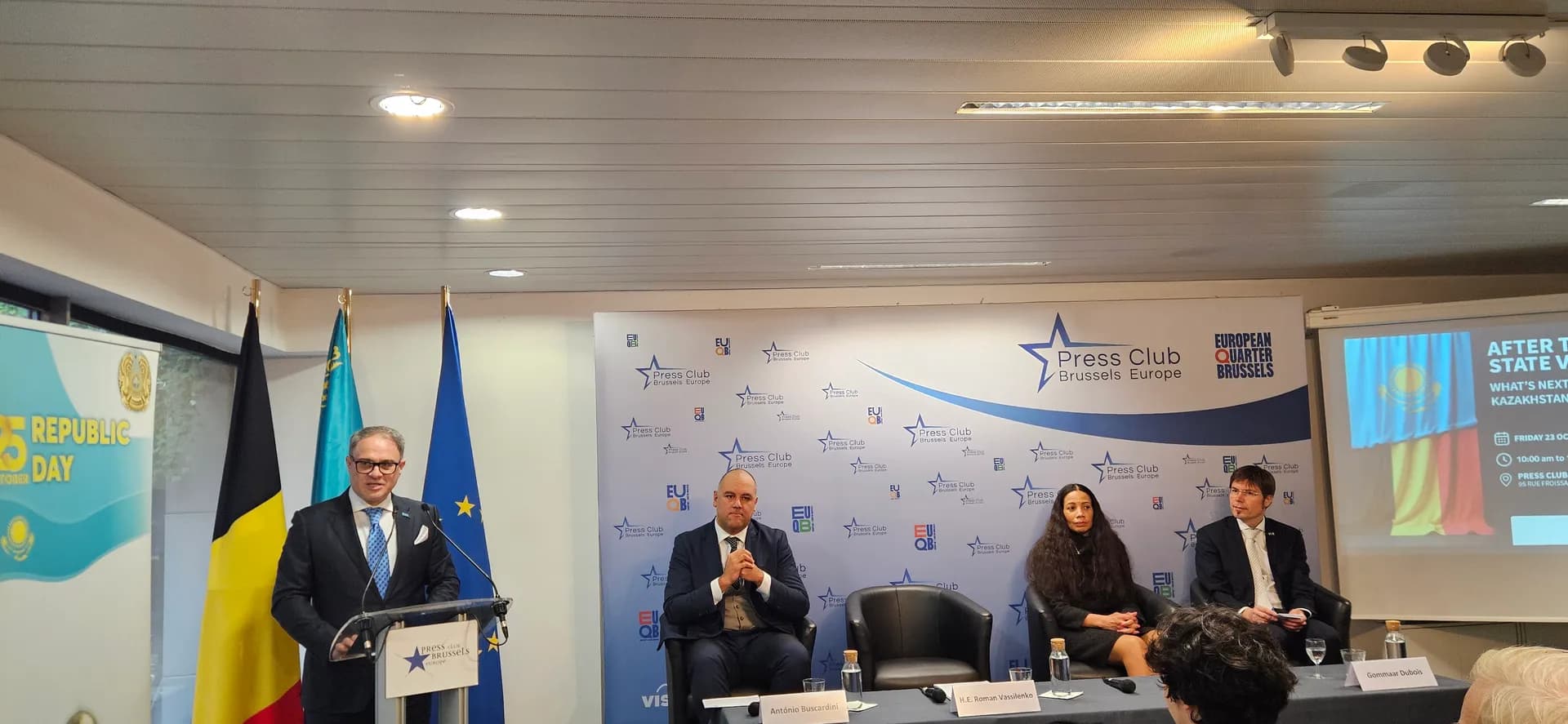
Belgium and Kazakhstan are looking to translate the momentum of the Belgian royal state visit into practical cooperation on investment, critical raw materials, transport and research. At the Press Club Brussels Europe on 23 October, Kazakh, Belgian and European representatives discussed the next steps in a relationship increasingly shaped by diversification and closer connections between Europe and Central Asia.
The briefing, “After the Belgian Royal State Visit”, brought together Kazakhstan’s Ambassador Roman Vassilenko, Gommar Dubois, Deputy Director at Belgium’s Ministry of Foreign Affairs, and Marilyn Josefson, Foreign Policy Adviser to the President of the European Council. While each offered a different perspective, their interventions converged on one priority: implementation.
Roman Vassilenko: Turning Diplomatic Trust into Practical Cooperation
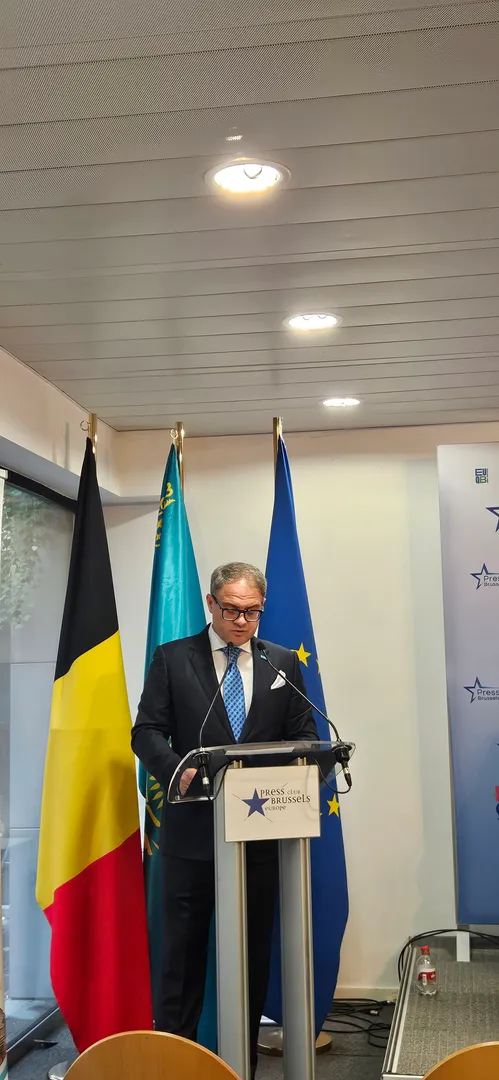
Ambassador Roman Vassilenko described King Philippe and Queen Mathilde’s visit to Kazakhstan on 12–14 October as a historic milestone: the first state visit by a Belgian monarch to Kazakhstan and Central Asia. Held at President Kassym-Jomart Tokayev’s invitation, the visit was intended to give the partnership fresh momentum and translate political trust into practical cooperation.
According to Vassilenko, 40 cooperation documents were signed, including 16 commercial agreements covering agriculture, logistics, industry, healthcare and advanced technologies. The two heads of state adopted a joint statement, while the foreign ministries signed a roadmap for 2027–2029 to guide their work.
“But the real work begins when the signing pens are put away,” the ambassador said, stressing that investment, research and opportunities for citizens would be the meaningful measures of success. He put bilateral trade at approximately €765 million in 2025, more than three times its level a decade earlier, with over 100 Belgian companies active in Kazakhstan.
Vassilenko identified five priority areas: critical raw materials; agriculture and food processing; transport and logistics; healthcare and medical technology; and education, science and innovation. In each, he emphasised the importance of moving beyond commercial exchanges towards partnerships that build expertise and productive capacity.
On critical raw materials, he highlighted the complementarity between Kazakhstan’s resources and Belgium’s capabilities in metallurgy, processing and recycling. The ambition, he explained, is to develop higher-value production, technology transfer and joint research rather than focus solely on exporting unprocessed resources. A similar approach applies to agriculture, where cooperation should expand trade while strengthening food-processing capacity within Kazakhstan.
Transport offered another practical connection. Vassilenko pointed to opportunities to link Antwerp-Bruges with the Caspian ports of Aktau and Kuryk, while citing five weekly cargo flights between Liège and Karaganda as an existing example of closer logistics ties. He cautioned that the wider Trans-Caspian route also requires harmonised customs procedures, digital documentation and predictable transit conditions. “A corridor is only as strong as its least efficient link,” he said.
In healthcare, he highlighted oncology, clinical research, specialist training and advanced cancer treatment. Academic partnerships, meanwhile, could support exchanges, doctoral programmes and research in engineering, artificial intelligence and critical raw materials. Vassilenko also reiterated Kazakhstan’s longer-term ambition to seek association with Horizon Europe.
Placing these developments in a wider context, the ambassador described Europe as central to Kazakhstan’s balanced and pragmatic foreign policy. Diversification, he argued, means more reliable markets, resilient transport routes and access to technology. He identified the EU as Kazakhstan’s largest trade and investment partner, putting bilateral trade at more than $45 billion in 2025.
Gommar Dubois: Diversification and Sustained Belgian Engagement
Gommar Dubois presented the royal visit as the culmination of a relationship developed over many years, rather than a stand-alone diplomatic event. He highlighted the composition of the Belgian delegation, which included more than 25 CEOs and 11 university rectors alongside the political delegation.
For Dubois, this participation demonstrated the breadth of the partnership. Beyond official ceremonies and signed documents, the visit created opportunities for Belgian companies to develop their own contacts in Astana and Almaty, while universities established foundations for longer-term academic cooperation.
He placed Belgium’s engagement within a more uncertain international environment, marked by Russia’s war against Ukraine and instability in the Middle East. Against that background, he argued, Belgium, Kazakhstan and the wider European Union share an interest in diversifying political, economic and academic partnerships.
Transport and logistics were a prominent part of his assessment. Dubois recalled the €10 billion financing package identified for Trans-Caspian transport connectivity and linked the strong presence of Belgian logistics companies during the visit to the corridor’s growing strategic importance. The relationship, he suggested, combines Belgium’s position as a European logistics gateway with Kazakhstan’s role in connecting Central Asia to international markets.
Academic cooperation was another important outcome. Dubois welcomed the agreements between universities and the growing potential for student exchanges. He also identified Kazakhstan as an alternative destination for certain language-related academic exchanges previously associated with Russia and Ukraine, illustrating how diversification extends beyond trade and diplomacy.
On the political side, he highlighted the foreign ministries’ 2027–2029 roadmap and a Benelux agreement facilitating travel for holders of Kazakh service passports. Such arrangements, he explained, support not only bilateral contacts with Belgium but also Kazakhstan’s engagement with European institutions in Brussels.
His assessment was that the royal visit had strengthened political, business and academic ties simultaneously. Sustaining that progress would require continued official engagement and practical support for the institutions and companies developing the relationship.
Marilyn Josefson: Connectivity at the Heart of the European Partnership
Marilyn Josefson framed EU–Kazakhstan cooperation around two defining priorities: diversification and connectivity. In an increasingly uncertain geopolitical environment, she argued, closer cooperation can help strengthen supply chains, open alternative trade routes and create long-term opportunities.
She situated this agenda within the EU–Central Asia strategic partnership established at the first regional summit in Samarkand in 2025, alongside the momentum generated by President Tokayev’s subsequent engagement in Brussels. High-level political exchanges, she said, had reinforced the framework for closer cooperation; the task now was to translate it into tangible progress.
Josefson outlined three interconnected dimensions of connectivity. The first was digital cooperation, including secure infrastructure, high-speed connections, artificial intelligence and research partnerships. She stressed the importance of developing technological platforms owned and managed by the partners’ own companies, linking innovation to competitiveness and greater technological capacity.
The second was energy. She highlighted Kazakhstan’s importance as an energy partner and the potential to diversify supplies while expanding cooperation in renewables, green hydrogen and critical raw materials. These areas, she argued, could support both energy security and the green transition while creating economic opportunities in Kazakhstan and Europe.
The third was transport. Describing the Trans-Caspian Transport Corridor as a Global Gateway flagship, Josefson emphasised the need for investment in railways, ports, logistics hubs and more efficient border crossings. Like Vassilenko, she stressed that harmonised procedures are essential if infrastructure investments are to produce more reliable trade connections.
Josefson also insisted that connectivity extends beyond physical infrastructure. Academic exchanges, research, tourism, cultural contacts and business partnerships can bring societies closer together. Joint ventures and private-sector investment, she said, would be essential to converting political ambition into concrete results.
Questions and Answers: Financing, Local Value Chains and the Next Steps
The audience discussion shifted the focus from broad priorities to delivery. Asked how Kazakhstan would follow up on the many opportunities created by the royal visit, Vassilenko explained that agreements and ideas raised by the heads of state were being translated into government instructions. He cited nuclear medicine as an example of an existing field of cooperation where further opportunities would now be explored.
Dubois outlined several avenues for continued Belgian engagement. These included preparations for further ministerial and parliamentary exchanges as the countries approach the 35th anniversary of diplomatic relations in 2027. He also said Belgian regional trade missions to Kazakhstan and Central Asia would become annual rather than biennial, while follow-up on critical raw materials would involve a roundtable and a visit by Belgium’s special envoy.
Investment figures received closer scrutiny during the discussion. Vassilenko said €2.5 billion of the €10 billion pledged at the January 2024 investors’ forum for Central Asian transport connectivity had reached contractual commitment. He distinguished this from the broader €12 billion Global Gateway package announced at the Samarkand summit, which also covers digital, water and energy projects. His remarks underlined the difference between political pledges, signed financing commitments and projects under implementation.
Asked whether minerals cooperation would include processing and production within Kazakhstan, Josefson said the EU’s approach is to support local value chains rather than simply extract resources for refining in Europe. Sustainability and recycling would be part of that approach, although she did not identify specific projects in the pipeline.
Student mobility emerged as another practical test of the partnership. Vassilenko said approximately 400 Kazakh students were studying in Belgium, while Dubois said Belgium was working towards facilitating the local issuance of student visas in the following year. Josefson added that youth cooperation would feature prominently in the next EU–Central Asia summit.
Looking ahead, Josefson pointed to planned connectivity, EU–Central Asia and Global Gateway summits in 2027 as opportunities to review progress and accelerate agreed deliverables. The next phase of the partnership, the discussion made clear, will depend on whether diplomatic momentum produces functioning transport links, stronger local industries and more accessible research and educational exchanges.
Related Topics
Follow EUReflect
See more of our reporting on Google
Mark EUReflect as a preferred source and our stories are ranked higher for you in Top Stories, Discover and Google News — and carry a “preferred” badge when they are cited in AI results.
Add EUReflect as a preferred source