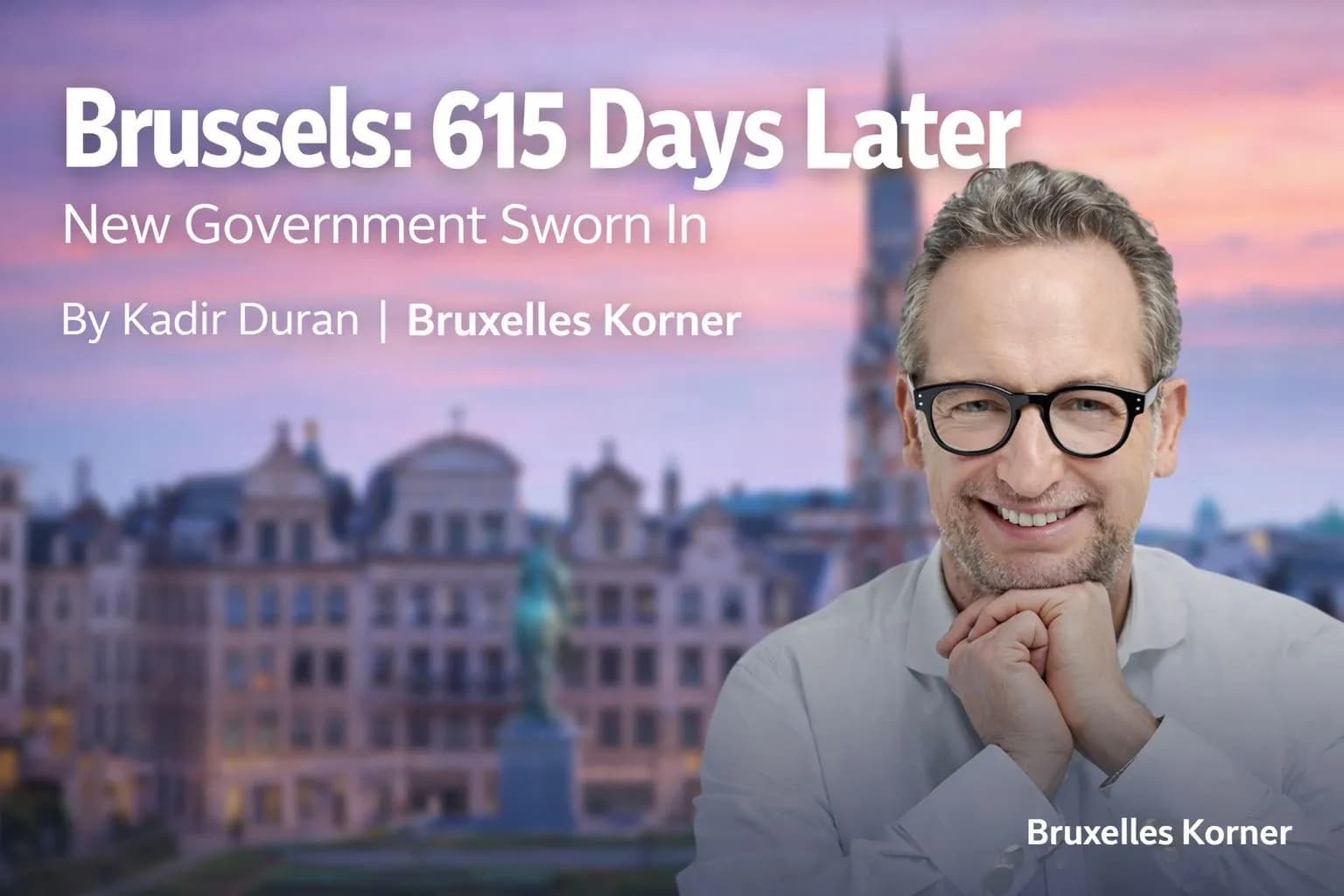
Brussels: 615 Days Later, the New Government Takes the Oath and Opens a New Political Chapter
Led by Boris Dilliès, the Brussels Government was sworn in after 615 days of political deadlock. The new coalition now faces major challenges, including a structural budget deficit, a housing crisis, and deep administrative reforms. The real test shifts from forming a government to governing effectively.
After 615 days of institutional paralysis, Brussels has officially regained a fully empowered government. On Saturday morning, inside the hemicycle of the Regional Parliament, the new Minister-President Boris Dilliès and the members of his executive took the oath of office, legally sealing the end of an exceptionally long political crisis.
The ceremony, held as early as 8 a.m., followed strict protocol requirements. It enabled the Minister-President to subsequently travel to the Royal Palace to take the oath before the King, a constitutional step essential for the government to fully assume its executive authority.
One by one, members of the new executive swore loyalty to the King, obedience to the Constitution, and compliance with the laws of the Belgian people, in a parliamentary chamber filled with observers, staff, and political supporters.
A New Executive Architecture with Complex Balances
Boris Dilliès is now the Minister-President of the Brussels-Capital Region.
In protocol order, several key figures formally assumed office:
• Elke Van den Brandt, notably in charge of Mobility and Public Works
• Ahmed Laaouej, responsible for Local Authorities, Social Action, and Equality
• Dirk De Smedt, overseeing Finance and Budget
• Laurent Hublet, in charge of Economy and Employment
At the level of State Secretaries, several structural appointments complete the government’s architecture:
• Audrey Henry, appointed State Secretary for Urban Planning and Public Cleanliness
• Karine Lalieux, responsible for Housing, Taxis, and Sports Infrastructure
• Ans Persoons, State Secretary for Heritage, Urban Renewal, and the Environment
These portfolios cover strategic sectors, particularly at a time marked by a housing crisis, environmental pressure, and accelerated urban transformation.
The CD&V Case: A Partner Without a Portfolio, but Not Without Influence
One notable political element concerns the position of CD&V. Although the party actively participated in negotiations and formally approved the coalition agreement internally, it will hold neither a ministerial post nor a State Secretary position.
However, its representative, Benjamin Dalle, will be regularly invited to attend government meetings.
This hybrid arrangement reflects a more nuanced political reality: indirect participation in executive decision-making without formal executive responsibility, allowing the party to exert influence while avoiding full institutional accountability.
Immediate Political Ripple Effect: Uccle Changes Mayor
The appointment of Boris Dilliès as Minister-President has triggered an immediate local consequence.
In Uccle, he will be succeeded by Valentine Delwart, who will assume the position of mayor.
This transition illustrates a structural feature of the Belgian political system: the constant circulation of mandates between municipal, regional, and federal levels, reinforcing interconnected networks of political influence.
⸻
The End of the Deadlock, the Beginning of the Credibility Test
While the oath-taking formally ends 615 days of political paralysis, it also marks the beginning of a more demanding phase: the actual exercise of power.
The new government inherits a Region facing major challenges:
• a structurally concerning budget deficit,
• an administration requiring deep structural reforms,
• increasing social and economic pressure,
• and public trust weakened by nearly two years of political inertia.
The symbolic sequence is now over. The political sequence has just begun.
In Brussels, after 615 days of waiting, the real judgment will no longer concern the ability to form a government—but the ability to govern.
Boris Dilliès is the new Minister-President of the Brussels Government
Boris Dilliès at the helm of Brussels: an experienced choice in a moment of institutional fragility
Brussels has officially turned the page on one of the longest political deadlocks in its recent history. This Saturday morning, in the hemicycle of the Brussels Parliament, the new Minister-President Boris Dilliès and the members of his government took the oath of office, bringing to an end 615 days of political vacuum marked by caretaker governance.
Beyond its institutional symbolism, this appointment also marks the return of the Reformist Movement (MR) to the leadership of the Brussels-Capital Region after more than two decades in regional opposition.
An experienced profile to restore stability
Boris Dilliès is no stranger to the Brussels political landscape. Mayor of Uccle for several years, he has established himself as an experienced administrator, close to the realities on the ground and familiar with the complex balances that define Brussels.
His trajectory reflects a consistent ability to operate in fragmented political environments, where stability depends more on consensus than on dominance.
At one point, he was widely seen as a natural candidate for the presidency of the Brussels MR. The party ultimately chose David Leisterh, betting on a new generation embodying energy and renewal. This decision reflected a forward-looking strategy but did not diminish Boris Dilliès’ political legitimacy, whose experience remains a central asset today.
His appointment as Minister-President therefore represents a form of strategic rebalancing within the Brussels MR.
Governing Brussels: the art of permanent compromise
Boris Dilliès’ primary strength likely lies in his capacity to build durable compromises. In Brussels, where majorities rely on complex coalitions and where linguistic, social, and territorial divides intersect, the role of Minister-President fundamentally requires mastery of consensus.
His profile aligns with this institutional necessity: less oriented toward confrontation than arbitration, less toward rupture than stabilization.
In a parliament marked by 615 days of paralysis, this ability could prove decisive in restoring continuity in public governance.
Uccle: succession opens a new zone of tension
But every political promotion inevitably creates a vacuum elsewhere. Boris Dilliès’ departure from the mayoralty of Uccle opens a new local chapter, with Valentine Delwart designated to succeed him.
This transition, although institutionally anticipated, could generate political questions and tensions at the municipal level. In Brussels, local balances are often as sensitive as regional ones, and successions are rarely mere administrative formalities.
An appointment that raises more questions than it answers
The oath-taking ceremony marks the end of an institutional crisis, but it also opens a far more demanding phase: that of political credibility.
Boris Dilliès currently benefits from political capital built on experience and territorial knowledge. However, this capital must now be converted into tangible results in a Region facing major budgetary, social, and institutional challenges.
His appointment appears coherent from the perspective of the Brussels MR. The remaining question is whether it will also prove effective for Brussels.
Brussels Government finalized: full lineup confirmed, final portfolios still pending
With the oath-taking completed, the Brussels-Capital Region now has a fully constituted government, bringing an end to 615 days of institutional paralysis and caretaker administration. The final appointments, confirmed this Saturday morning, clarify the political architecture that will shape the Region’s governance in the coming years and mark the operational beginning of a new executive cycle.
At the head of the government, Boris Dilliès (MR) assumes the role of Minister-President of Brussels. Beyond his coordinating authority over the executive, he will also directly oversee Security, a critical competence in a Region confronted with complex challenges ranging from urban safety to inter-agency coordination. His appointment symbolizes both institutional stabilization and the strategic return of the Reformist Movement (MR) to the leadership of the Brussels Region after more than two decades outside the regional executive.
Ahmed Laaouej (PS) becomes Minister for Social Action and Solidarity, with responsibility for Local Authorities, Equality, and Educational Support. He will also play a central role within the French Community Commission (COCOF), where he will oversee Social Cohesion, Culture, Social Affairs, and International Relations, reinforcing the PS’s influence in Brussels’ social and cultural policy framework.
Elke Van den Brandt (Groen) retains her strategic portfolios, including Mobility, Public Works, Road Safety, and Animal Welfare. Her continuity in these key sectors ensures policy stability in areas directly affecting urban infrastructure, environmental sustainability, and daily mobility across the capital.
Dirk De Smedt (Anders) continues as Minister of Finance and Budget, while also assuming responsibility for Public Administration and Digital Transition. These portfolios position him at the core of Brussels’ fiscal recovery and administrative modernization, particularly as the Region faces structural budgetary constraints and the need to improve efficiency.
Laurent Hublet (Les Engagés) takes charge of Economy, Digital Economy, and Employment, placing him at the center of Brussels’ economic revitalization strategy, technological development, and labor market activation.
Karine Lalieux (PS), appointed Secretary of State, will oversee Housing, Taxis, and Sports Infrastructure, while also managing key COCOF competences, including Childcare Facilities, Health, Public Administration, and Budget. Her role will be critical in addressing social infrastructure pressures and housing accessibility, both central issues in Brussels’ socio-economic landscape.
Audrey Henry (MR) becomes Secretary of State for Urban Planning, Territorial Development, and Public Cleanliness, portfolios directly linked to spatial planning, urban management, and the operational functioning of the Region.
Ans Persoons (Vooruit), also appointed Secretary of State, will oversee Environment, Climate, Urban Renewal, Heritage (Monuments and Sites), and the International Image of Brussels, combining ecological transition with the strategic positioning of Brussels as both a European capital and a global diplomatic hub.
Despite this extensive allocation of responsibilities, several strategic portfolios remain to be formally assigned within the MR. These include Tourism, Energy, Scientific Research, External Relations, the Fire and Emergency Medical Service (SIAMU), and bicultural matters. These final designations will complete the institutional structure of the government and clarify the internal balance of power within the coalition.
With the political framework now largely defined, Brussels enters a new phase. The institutional vacuum has ended, but the real test begins now. After nearly two years of paralysis, this government will be judged not on its formation, but on its capacity to deliver stability, restore fiscal credibility, and respond effectively to the structural challenges facing the Brussels-Capital Region.
Kadir Duran | Bruxelles Korner
Kadir Duran
Contributing writer at EUReflect.
Follow EUReflect
See more of our reporting on Google
Mark EUReflect as a preferred source and our stories are ranked higher for you in Top Stories, Discover and Google News — and carry a “preferred” badge when they are cited in AI results.
Add EUReflect as a preferred source