Bucharest Votes Again: Why Romania’s Capital Matters More Than Ever
After months of institutional uncertainty, Bucharest heads into a high-stakes mayoral race that will determine the direction of Romania’s most important city. With major challenges in mobility, pollution, governance, and political fragmentation, the outcome will shape both national politics and the capital’s emerging role as a regional hub.
Background: Political Turbulence and Institutional Vacuum
From late 2024 to mid-2025, Romania found itself at the centre of exceptional political turbulence and European media attention. The disputed 2024 presidential election, Călin Georgescu’s short-lived victory and its cancellation, months of institutional uncertainty, and the eventual election of former Bucharest mayor Nicușor Dan to the Cotroceni Palace all contributed to a climate of instability unprecedented since Romania’s accession to the EU.
Romania finally has a new president. But Bucharest, representing nearly 10% of the country’s population and around 25% of its GDP, has been left without a general mayor ever since Nicușor Dan took office as head of state. According to Romanian law, an election must be organized within 90 calendar days from the moment a mayor vacates their mandate, yet the government postponed the process, prioritizing the fight against inflation and the ongoing budgetary crisis.
Eventually, the authorities set December 7 as the date for Bucharest’s new mayoral election. The ruling PNL-PSD-USR-UDMR coalition, internally diverse and increasingly fragile, failed to field a common candidate. The vote will take place in a single round: whoever secures a relative majority becomes mayor. This rule turns the election into a high-stakes contest in a fragmented political landscape.
The Main Runners
Ciprian Ciucu (PNL, Liberal-Conservative)
Mayor of Bucharest’s 6th sector and president of the PNL’s Bucharest branch, Ciucu is widely portrayed as an efficient administrator who has delivered visible urban regeneration projects in his district. His communication strategy, particularly on social media, reinforces his reputation as a modern, pragmatic local leader. Reelected in 2024 with 72.89%, he is one of the most popular sectoral mayors. Politically, Ciucu is close to Prime Minister Ilie Bolojan, the reformist figure within the PNL. A victory for Ciucu would strengthen Bolojan’s camp nationally.
Daniel Băluță (PSD, Centre-Left)
Doctor by profession and current mayor of Bucharest’s 4th sector, Băluță enjoys a solid reputation due to his district’s development: cleaner public spaces, modernized avenues, and new infrastructure. His candidacy surprised many observers, who expected the PSD to nominate former general mayor Gabriela Firea. Băluță represents the PSD’s disciplined and administrative branch rather than its more political one.
Cătălin Drulă (USR, Liberal-Reformist)
Former Minister of Transport and now an MP, Drulă is widely perceived as the reformist candidate, having earned a reputation as a determined modernizer through his reforms on highways, railways, and the Bucharest metro. Although President Nicușor Dan has not officially endorsed him, several media outlets present Drulă as the candidate closest to the presidency’s reformist vision. His main challenge: no experience in local administration, a potential weakness in a city where voters often prioritise hands-on mayoral expertise.
Anca Alexandrescu (Independent, Supported by AUR, Radical Right)
A media figure running as an independent with the backing of AUR, Alexandrescu positions herself as the anti-system alternative. Her populist rhetoric targets decades of perceived mismanagement by traditional parties. Her independence allows her to reach beyond AUR’s relatively limited electorate in Bucharest, especially at a time when inflation and political fatigue make critical narratives more appealing.
Ana Ciceală (SENS, Green left)
A visible figure among Bucharest’s youth and from an extra-parliamentary party, Ciceală enters the race with a strong ecological agenda. Her programme prioritises pedestrianisation, expanded public transport (trams, trolleybuses, urban rail), and a structural shift toward sustainability. Not being associated with either the governing coalition or the parliamentary opposition reinforces her profile as a genuine outsider.
Other Runners
Seventeen candidates are officially running, including former MEP Vlad Gheorghe, but the five profiles above dominate current trends.
Bucharest’s Urban DNA: A City Frozen Between Eras
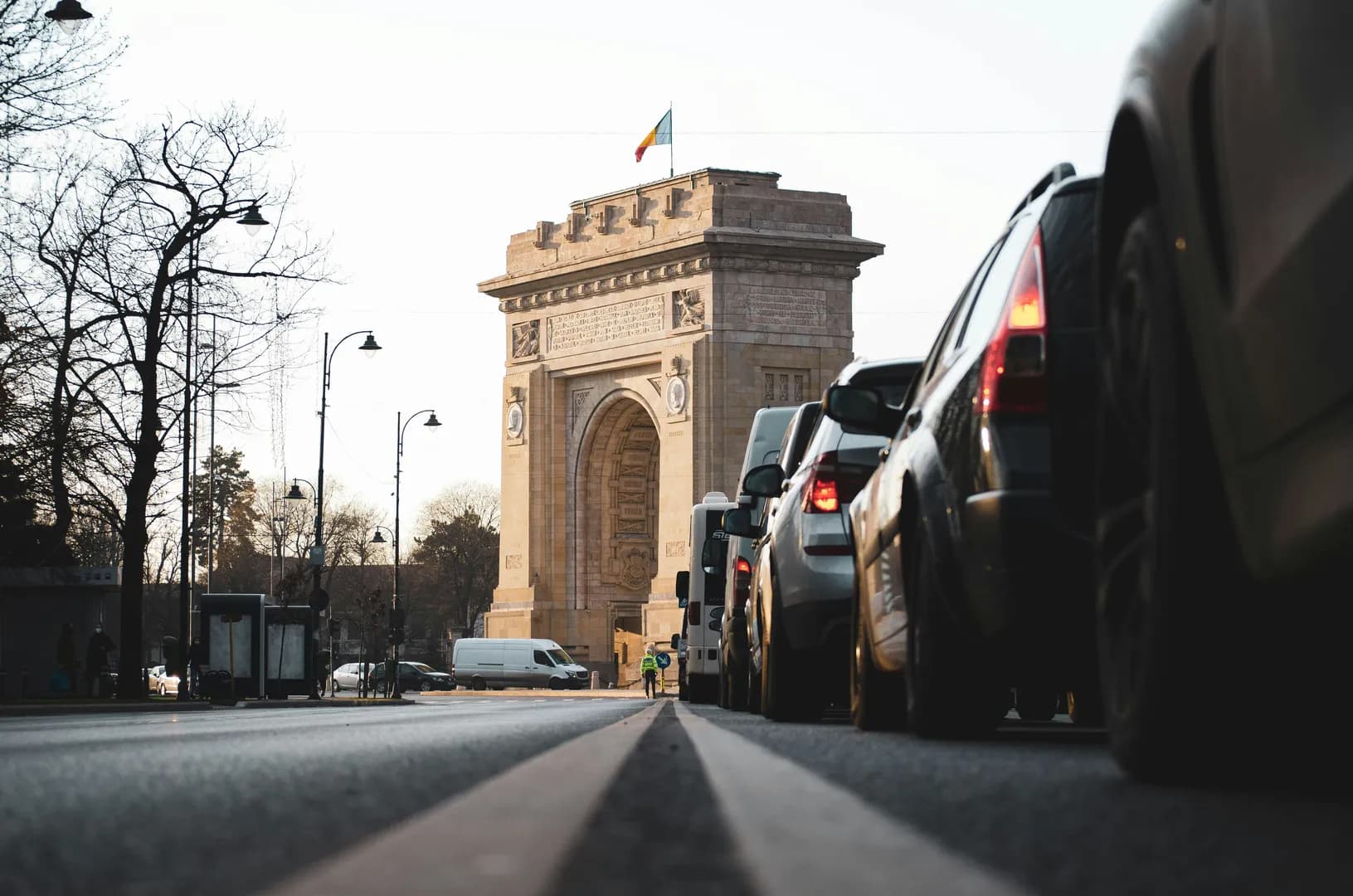
Bucharest, once known as the Little Paris, is a city that consistently surprises both first-time visitors and long-time residents. Walking down a single street often feels like crossing different decades: elegant Interwar Art Deco stands next to the massive brutalism of the communist era, which in turn blends into bold post-2000 modern architecture. All these layers coexist in a strangely harmonious yet undeniably chaotic urban mosaic, giving Bucharest its distinctive, almost cinematic atmosphere. Since 1989, successive mayors have launched modernisation projects, yet none has fully transformed the capital into what many in Romania’s political debate call a ‘European city,’ leaving its ‘Eurasian’ character to dominate.
A major structural challenge remains the administrative fragmentation between the General Mayorship and the six Sectoral Mayorships. Their overlapping competences often result in political rivalry and legal disputes rather than coordinated decision-making.
Nicușor Dan, elected in 2020 after two failed attempts, built a strong anti-establishment platform centred on fighting the “real-estate mafia,” modernising the thermofication network, and reforming urbanism. Tensions with sectoral mayors were frequent. The peak came in late 2024, when he organised a citywide referendum to clarify budget and competence distribution between the general municipality and the sectors. With over 60% approval, the referendum provided him both legal legitimacy and political capital, which he intended to use before unexpectedly becoming President of Romania in May 2025.
Key Issues at Stake in the 2025 Mayoral Election
Traffic and urban mobility remain among Bucharest’s most pressing challenges. The capital is still one of Europe’s most congested cities, with hundreds of thousands of commuters traveling to and from Ilfov County every morning and evening. Candidates propose different approaches: Ciprian Ciucu and Daniel Băluță have so far focused on metro and road expansion, as well as district-level upgrades within their own sectors, while Ana Ciceală and Cătălin Drulă advocate a shift toward alternative public transport infrastructure, ranging from tram and trolleybus networks to mobility reforms aligned with EU standards on sustainability, congestion reduction, and integrated urban transport planning.
Air pollution and public health are also central to the campaign. All candidates commit to delivering a greener city, yet their strategies diverge. Ciucu and Băluță emphasise incremental improvements through local infrastructure, such as the construction of parks and the development of a green belt around Bucharest, while Drulă pushes for systemic urban transformation consistent with European environmental standards, and Ciceală promotes a deep ecological transition that would redefine mobility and public space in the capital.
A further issue stems from the unimplemented 2024 local referendum, which clarified the division of competences between the General Mayorship and the sectoral administrations. Candidates advocating institutional reform, especially Drulă, use this delay to argue for a more coherent metropolitan governance model capable of addressing cross-sectoral challenges such as mobility, heating, urban planning, budget management, and investment.
At the national level, the stakes are equally high. The outcome of Bucharest’s election will influence party dynamics, reinforce or weaken the reformist bloc around President Nicușor Dan, shape the position of the separate reformist current led by Prime Minister Ilie Bolojan, and affect the stability of the governing coalition, as it may also impact the Social Democrats. It will also signal to European observers the direction Romania is taking at a time of institutional fragility. An opposition victory, particularly by Anca Alexandrescu, could further unsettle the political landscape, while an outsider victory such as Ana Ciceală’s bid could impact the legitimacy of the current “mainstream” parties.
Finally, Bucharest is emerging as a major regional metropolis, increasingly connected to Western Europe, the Middle East and East Asia through tourism, business, and transit routes. Its governance therefore extends beyond local administration: the next mayor will significantly affect Romania’s strategic posture in Southeastern Europe, making this election a matter of genuine European interest.
Conclusion: Why Europe Should Pay Attention
Bucharest’s upcoming election is far more than a local administrative exercise. It represents a decisive political moment: one that will test the strength of Romania’s reformist current, reveal the evolving balance between and within parties, and influence national politics well beyond 2025. At the same time, it will shape the trajectory of one of the EU’s fastest-growing capitals.
In a region marked by security shifts, demographic change, and rapid urban development, the governance of Bucharest carries implications that extend well beyond Romania. The city stands at a genuine crossroads: it may consolidate a reformist, technocratic path, revert to traditional administration, or open the door to a disruptive outsider. As Bucharest expands its role as a regional economic hub, the direction chosen will also affect investment flows and the city’s attractiveness to European and international companies, while reshaping national political dynamics that will inevitably be felt in European politics.
Whatever voters decide on December 7 will resonate far beyond the capital, giving Europe a clearer view of the political and social shifts shaping one of its most dynamic capitals.
Alex Niculescu
Contributing writer at EUReflect.
Follow EUReflect
See more of our reporting on Google
Mark EUReflect as a preferred source and our stories are ranked higher for you in Top Stories, Discover and Google News — and carry a “preferred” badge when they are cited in AI results.
Add EUReflect as a preferred source