Cairo–Beijing: A New South-South Partnership
Xi's first Egypt visit since 2016 comes as bilateral trade tops $19 billion, but Cairo seeks to address a structural imbalance by attracting Chinese factories to the Suez Canal zone.
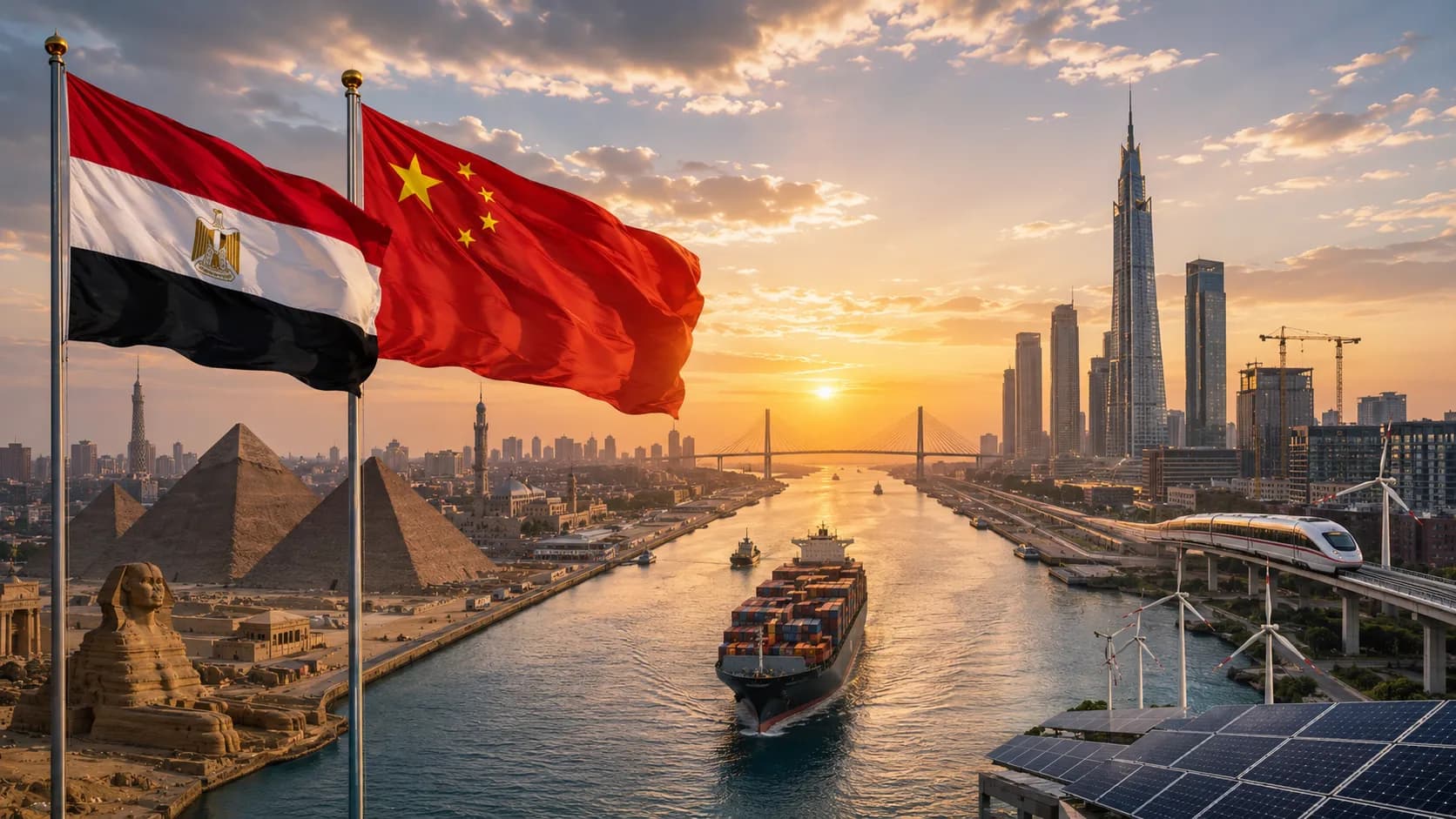
Chinese President Xi Jinping is scheduled to make an official visit to Egypt in the coming days for talks with President Abdel-Fattah El-Sisi, in the first visit of its kind since 2016, the Chinese Foreign Ministry and the Egyptian Presidency announced on Wednesday.
Chinese President Xi Jinping is set to visit Cairo from August 30 to September 3. The visit follows his participation in the Shanghai Cooperation Organization summit in Bishkek.
The meeting with Egyptian President Abdel-Fattah El-Sisi comes at a key moment. Both nations are preparing to mark 70 years of diplomatic relations in 2026
As both nations prepare to celebrate seventy years of official diplomatic relations in 2026. What began in 1956 as a pioneering partnership—when Egypt became the first Arab and African country to extend formal recognition to the People's Republic of China—has now evolved into a cornerstone of regional geometry and Global South politics.
As both leaders prepare to sit down in Cairo, the summit offers a clear vision for the next decade of the Egypt-China strategic partnership. Beyond the formal protocols, the visit reflects a practical convergence of national interests. By linking Chinese industrial technology with Egypt's strategic geography and regional influence, Cairo and Beijing are positioning their classic diplomatic partnership as a central anchor of global affairs for years to come.
The core agenda between President Egyptian President Abdel-Fattah El-Sisi and Xi centers on translating a historic political alignment into concrete economic depth. Over the past decade, bilateral trade between Cairo and Beijing has grown to surpass nineteen billion dollars annually, cementing China's position as Egypt's foremost commercial partner. Yet, behind these robust trade statistics lies a persistent structural imbalance that both leaders are eager to address. Egyptian exports represent only a fraction of total exchange, driving Cairo to seek a shift from standard commercial trade to structural industrial localization. Rather than simply importing manufactured goods, Egypt is pressing to host the factories that build them.
This push for local manufacturing finds its natural anchor in the Suez Canal Economic Zone, where Chinese industrial presence has expanded dramatically. Inside the TEDA industrial park at Ain Sokhna, over two hundred Chinese enterprises now operate across key sectors ranging from heavy machinery to advanced building materials. This industrial footprint is expanding into green tech, electric vehicle assembly, solar cell production, and large-scale industrial water treatment facilities. Beyond manufacturing, Chinese state enterprises have left an indelible mark on Egypt's modern landscape, having constructed the central business district and the towering Iconic Tower in the New Administrative Capital, along with the electric light rail transit system that connects greater Cairo to its administrative hubs. To facilitate this expanding commercial network without draining precious foreign reserves, both capitals are actively operationalizing central bank currency swap mechanisms, opening the door for increased settlement of trade in Yuan and Egyptian Pounds.
These deepening economic ties are backed by a rapidly growing defense and strategic relationship that reflects a mutual desire for maritime and regional stability. The historical reliance on hardware purchases has shifted toward sophisticated operational integration and joint technological development. The recent completion of the Eagles of Civilization joint air exercises highlighted this operational evolution, featuring complex aerial combat maneuvers and tactical coordination between Egyptian and Chinese pilots.
This military and economic alignment naturally extends into international diplomacy, where Cairo and Beijing find themselves on common ground within key multilateral organizations. Egypt's entry into BRICS as a full member, alongside its active role as a Dialogue Partner in the Shanghai Cooperation Organization, positions the country as a primary bridge connecting Eurasian security frameworks with North Africa and the Middle East. Both nations consistently champion a multipolar global order, advocating for greater representation for developing economies and a reform of global financial structures.
This shared diplomatic outlook becomes particularly critical when addressing the volatile geopolitical landscape of the Middle East. On the Palestinian issue, China's backing of a two-state solution and full United Nations membership for Palestine mirrors Cairo's core foreign policy stance, while Beijing explicitly endorses Egypt's primary role as a regional mediator. Meanwhile, ongoing instability in the Red Sea directly threatens the interests of both capitals. Disrupted maritime shipping corridors cut into Egypt's vital Suez Canal revenues while simultaneously delaying Chinese cargo streams bound for European markets. By aligning their efforts on Red Sea security and regional conflict de-escalation, both governments aim to safeguard maritime trade while maintaining strategic non-alignment.
In conclusion this state visit sets the roadmap for the next decade of Egypt-China relations. By bringing together trade, infrastructure projects, joint defense training, and shared diplomatic goals, Cairo and Beijing aim to build a stable partnership. The visit reinforces Egypt's role as China's central partner in North Africa and the Arab world.
Amr Yehia
Contributing writer at EUReflect.
Follow EUReflect
See more of our reporting on Google
Mark EUReflect as a preferred source and our stories are ranked higher for you in Top Stories, Discover and Google News — and carry a “preferred” badge when they are cited in AI results.
Add EUReflect as a preferred source