EU Business Summit in Brussels
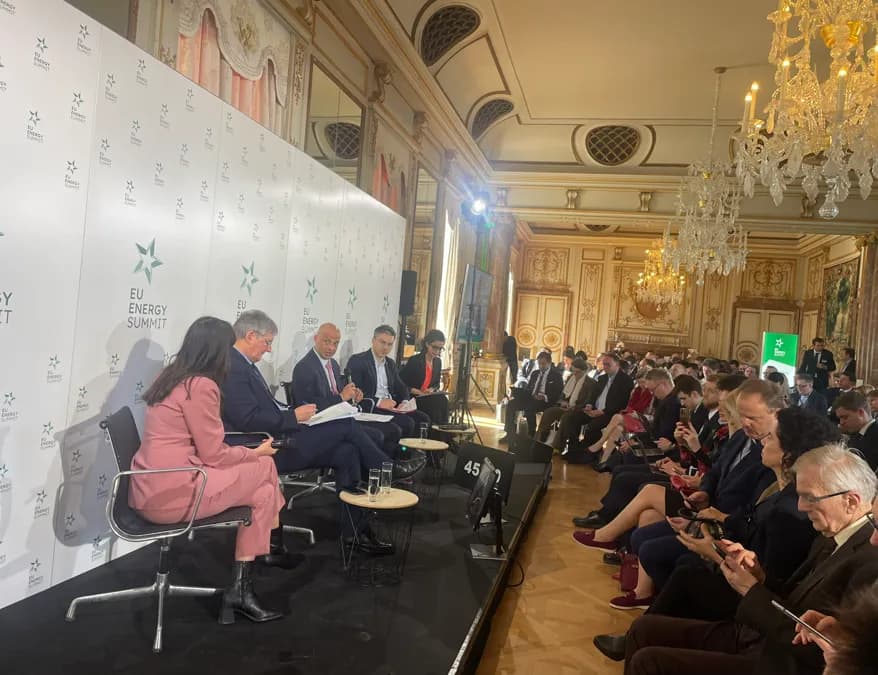
The EU Energy Summit 2026 took place on March 4-5, 2026, at the Egmont Palace in Brussels, focusing on reinforcing Europe's leadership in clean technologies, competitiveness, and climate neutrality. Key discussions focused on implementing strategies for a net-zero economy, strengthening energy infrastructure, and securing raw materials.
As Europe moves deeper into the second half of the decade, the energy transition is no longer defined by targets and declarations, but by delivery, investment, and system resilience. At a high-level gathering of European policymakers, industry leaders, regulators, and international partners, one message emerged clearly: the real test for Europe is now implementation—at scale, at speed, and under growing geopolitical pressure.
The discussions reflected a shared understanding that Europe’s energy and industrial strategy has entered a decisive moment. Climate ambition remains intact, but it must now be matched with competitiveness, security, and social stability in an increasingly fragmented global landscape.
From Climate Ambition to Industrial Delivery
Opening exchanges set the tone by underlining a fundamental shift in Europe’s approach. The question is no longer whether Europe will decarbonise, but whether it can do so while preserving its industrial base and strategic autonomy. Speakers stressed that the energy transition must strengthen Europe’s economy rather than expose new vulnerabilities, particularly in the face of volatile markets, global competition, and geopolitical uncertainty.
Energy independence was framed not as isolation, but as resilience: diversified supply, robust infrastructure, and integrated markets capable of absorbing shocks. Participants highlighted that Europe’s credibility as a climate leader now depends on its capacity to translate frameworks into bankable projects and measurable results.
Digital Growth Meets Energy Reality: The Data Centre Challenge
As Europe consolidates its position in the global digital economy, data centres have become a strategic backbone—not only for cloud services, but for artificial intelligence, industrial optimisation, and public services. Yet their rapid expansion raises critical questions about energy consumption, water use, and grid capacity.
Discussions on sustainable data centres focused on how AI-driven growth can be aligned with Europe’s decarbonisation objectives. Solutions ranged from energy-efficient cooling and water reuse to smarter grid integration and demand-side flexibility. Speakers also underlined the importance of EU legislation in providing clear, predictable frameworks that enable innovation while ensuring sustainability.
The message was clear: Europe’s digital leadership must be built on energy systems that are both clean and resilient.
Energy Infrastructure as a Security Asset
One of the strongest themes of the day was the changing nature of energy infrastructure. Pipelines, grids, terminals, and data centres are no longer just regulated assets—they are strategic targets in an era of cyber threats, hybrid warfare, and geopolitical instability.
Experts from the energy, defence, and security communities discussed how Europe can better protect its energy backbone through risk mapping, resilience standards, and closer cooperation between public authorities and private operators. The need for dual-use technologies, cyber preparedness, and cross-border coordination was repeatedly emphasised.
Energy security, participants agreed, is now inseparable from Europe’s broader security architecture.
Cities at the Frontline of Climate Neutrality
European cities are where climate ambition meets everyday reality. As centres of energy demand, mobility, buildings, and public services, they are essential to achieving climate neutrality.
The EU Mission on Climate-Neutral and Smart Cities was highlighted as a key instrument to translate European objectives into integrated local pathways. Climate City Contracts, investment frameworks, and innovation-driven experimentation are enabling cities to act as laboratories for the wider transition.
Speakers stressed that lessons from leading cities must be scaled up and replicated across Europe to ensure that local success feeds into system-wide transformation.
Competitiveness, Innovation, and the Clean Energy Transition
Throughout the discussions, competitiveness emerged as a central concern. Europe’s industrial future depends on its ability to decarbonise affordably while keeping investment, production, and innovation within its borders.
Participants underlined the need for faster infrastructure build-out, clearer investment signals, and stronger cross-border coordination. Electrification, renewable integration, hydrogen and CO₂ networks, and storage solutions were all identified as critical enablers.
At the same time, regulatory complexity remains a major obstacle—particularly for SMEs and cleantech scaleups. Calls for regulatory simplification, faster permitting, and more predictable State aid frameworks reflected a shared desire to unlock private capital without undermining competition.
Grids, Electrification, and System Integration
Electrification was repeatedly described as the backbone of Europe’s decarbonisation strategy. Yet many electricity grids were not designed for the scale and speed now required.
Discussions on grid infrastructure focused on investment needs, interconnections, smarter planning, and flexibility tools. Speakers warned that delays in grid upgrades could derail industrial projects and slow down the transition. System integration—connecting generation, storage, demand, and cross-border flows—was presented as essential to maintaining affordability and reliability.
Water, Circularity, and Resource Resilience
In a world of tightening resources and climate stress, water and waste streams are becoming strategic assets. Circular economy models were highlighted as essential for stabilising costs, securing inputs, and strengthening Europe’s industrial resilience.
The water–energy nexus received particular attention, with speakers emphasising the role of efficient water management, reuse, and recovery in supporting both energy production and clean technology deployment. Circularity, it was argued, is no longer a niche sustainability issue, but a core pillar of competitiveness.
Europe’s Strategic Energy Future
High-level interventions reinforced the idea that Europe faces a historic opportunity. By accelerating the clean energy transition, the EU can reduce external dependencies, enhance technological leadership, and shape global sustainability standards.
Yet ambition alone is not enough. Success will depend on delivery: coordinated infrastructure investment, resilient networks, secure digital systems, and a governance framework capable of aligning public policy with private capital.
As Europe moves from plans to projects, the energy transition is no longer just a climate imperative—it is a strategic choice about Europe’s place in the world. The challenge ahead is to ensure that delivery matches ambition, and that Europe’s clean energy future is also a competitive, secure, and inclusive one.
EUReflect News
Site Administrator
Follow EUReflect
See more of our reporting on Google
Mark EUReflect as a preferred source and our stories are ranked higher for you in Top Stories, Discover and Google News — and carry a “preferred” badge when they are cited in AI results.
Add EUReflect as a preferred source