EU Raises Concerns Over the US-China Summit Held in China
The US-China summit held in China has increased strategic concerns within the European Union. The EU fears that possible agreements between Washington and Beijing on technology, trade, and security could weaken Europe’s global influence and strategic autonomy.
Introduction
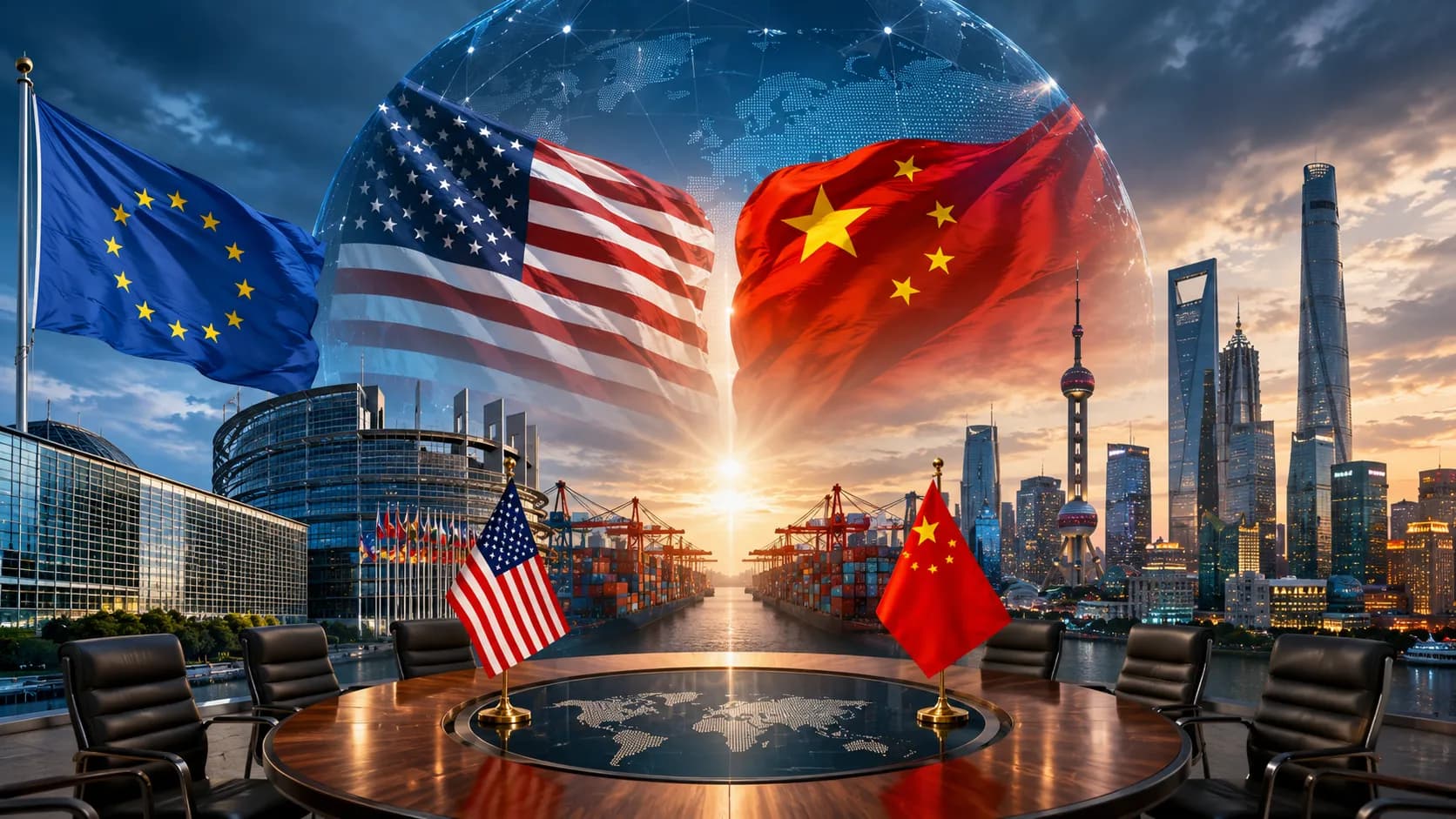
The high-level US-China summit held in China has attracted significant international attention not only because of its implications for relations between Washington and Beijing, but also due to its potential impact on the future of global power balances. Within European Union circles, the outcomes of the summit are being approached with caution and strategic concern. European diplomatic and economic actors believe that any new strategic understanding between the United States and China could directly influence Europe’s global economic competitiveness, technological autonomy, and security policies.
According to assessments in Brussels, the intensifying rivalry between the US and China in recent years has increasingly forced Europe to pursue a delicate balancing strategy between the two major powers. Decisions emerging from the summit could potentially reshape Europe’s geopolitical and economic position.
Europe’s Pursuit of Strategic Autonomy
In recent years, the European Union has increasingly placed the concept of “strategic autonomy” at the center of its foreign and economic policies. The Russia-Ukraine war, energy crises, and disruptions in global supply chains have pushed Europe to reconsider its dependencies on both the United States and China.
Against this backdrop, the US-China summit has intensified concerns within Europe about being excluded from key global decision-making mechanisms. EU officials fear that emerging diplomatic and economic arrangements between Washington and Beijing could narrow Europe’s room for maneuver in international markets.
Germany and France, in particular, argue that the EU should avoid becoming entirely dependent on US policy preferences, while also emphasizing that a complete economic disengagement from China could seriously damage European economies.
Technology Competition and Economic Balance
Technology and artificial intelligence competition were among the most closely watched topics of the summit. In recent years, US restrictions on semiconductor exports to China and broader technology sanctions have had substantial impacts on global markets, while Europe has also faced growing economic pressure in this process.
The European Union is attempting to reduce strategic dependencies on China while simultaneously seeking to avoid a scenario in which American technology giants further consolidate global dominance. Competition in sectors such as electric vehicles, green energy technologies, artificial intelligence systems, and critical minerals is expected to directly affect European industry.
According to European experts, a reduction in economic tensions between the United States and China could create new opportunities for European companies in global markets. However, there are also concerns that large-scale bilateral agreements between Washington and Beijing could marginalize Europe economically and politically.
Security and Geopolitical Risks Closely Monitored
Another major issue closely followed by the EU is the security dimension of the summit. Topics such as the Taiwan issue, tensions in the South China Sea, the Russia-Ukraine war, and Indo-Pacific strategies are viewed as critically important for European security.
Some European diplomats believe that Washington’s increasing strategic focus on the Asia-Pacific region could gradually reduce American commitment to European security in the long term. Ongoing debates within NATO regarding burden-sharing have further intensified these concerns.
At the same time, China’s growing diplomatic influence and its expanding relations with countries in the Global South are making Europe’s efforts to maintain its role and influence within the international system even more important.
Conclusion
The US-China summit held in China is being viewed as a major development not only for relations between the two superpowers, but also for the future strategic positioning of the European Union. While the EU seeks to protect its economic interests, it also aims to maintain its ambition of becoming an independent and influential global actor.
In the coming years, the trajectory of US-China relations is expected to continue shaping Europe’s foreign policy strategies, technology investments, and security policies.
Sources
European Council on Foreign Relations (ECFR)
European Commission Reports
NATO Strategic Concept Documents
Council on Foreign Relations (CFR)
Reuters
Bloomberg
Financial Times
The Diplomat
Chatham House
Carnegie Europe
Botakoz Unbayeva
Contributing writer at EUReflect.
Follow EUReflect
See more of our reporting on Google
Mark EUReflect as a preferred source and our stories are ranked higher for you in Top Stories, Discover and Google News — and carry a “preferred” badge when they are cited in AI results.
Add EUReflect as a preferred source