EU Recalibrates Its US Strategy
Brussels keeps €93bn in retaliatory tariffs suspended but ready, as it seeks to balance trade ties with strategic autonomy.
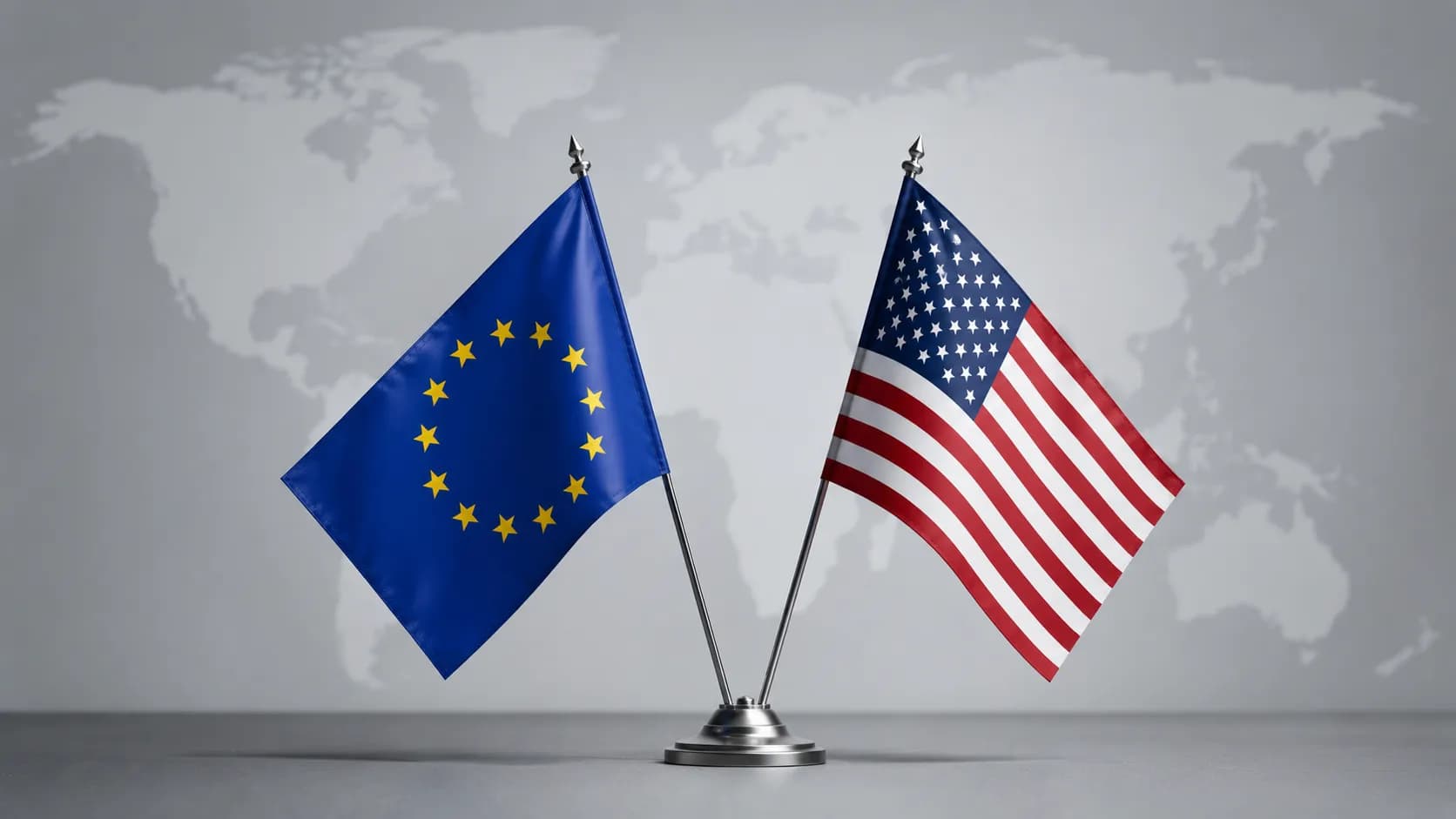
The European Union's relationship with the United States is entering a more transactional era.
Washington remains Europe's most important security partner and its largest trade and investment relationship. But developments in 2026 are forcing Brussels to rethink how much it can depend on the United States economically, militarily and strategically.
The emerging EU policy is not based on breaking with Washington. Instead, Europe is trying to preserve the transatlantic alliance while developing greater capacity to defend its own interests when American and European priorities diverge.
That balancing act is becoming one of the central questions of European foreign policy.
Trade: Cooperation With a Defensive Option
Economic relations remain enormous.
EU-US trade in goods and services reached approximately €1.8 trillion in 2025, equivalent to around €4.9 billion crossing the Atlantic every day. The two economies therefore remain deeply interconnected.
But tariff disputes have fundamentally changed the political atmosphere surrounding that relationship.
The trade arrangement reached between European Commission President Ursula von der Leyen and US President Donald Trump in July 2025 created a framework intended to prevent a larger transatlantic trade conflict.
Europe has since moved ahead with implementation.
From July 1, 2026, the EU eliminated tariffs on US industrial goods and improved market access for certain American agricultural and seafood products.
Brussels is therefore choosing negotiation over confrontation.
But it has not abandoned its defensive instruments.
The European Commission announced on July 31 that EU countermeasures covering approximately €93 billion of American imports would remain suspended without a fixed end date.
The important detail is that the measures have not disappeared.
Brussels explicitly retains the ability to reactivate them if Washington fails to respect its commitments or European economic interests are threatened.
Europe's message is increasingly clear: maintain open transatlantic trade, but keep economic retaliation available.
Defence Is Becoming the Bigger Question
The more fundamental transformation is taking place in security.
The United States is pushing European NATO members to assume greater responsibility for defending their own continent.
That pressure intensified this week.
The Pentagon is conducting a six-month review of America's military deployments across Europe. Around 80,000 US troops are currently stationed on the continent, but European governments are concerned that Washington could eventually reduce its presence.
US Under Secretary of Defense for Policy Elbridge Colby told NATO ambassadors in Brussels on August 27 that Washington wants a transition toward a more European-led conventional defence of the continent.
The review is expected to produce several options for the US Defense Secretary by November.
For the EU, the strategic implications are significant.
Europe can no longer assume that the scale and structure of the American military presence will remain permanently unchanged.
Europe Is Preparing to Carry More of the Burden
Washington's pressure is accelerating a transformation that had already begun after Russia's invasion of Ukraine.
European governments are increasing defence expenditure, expanding ammunition production, investing in drones and missile defence and strengthening military-industrial cooperation.
But Brussels faces a difficult strategic choice.
Europe needs stronger defence capabilities without weakening NATO.
The emerging formula is therefore greater European military autonomy inside the Atlantic alliance rather than independence from it.
Under this model, the United States would remain essential for nuclear deterrence, intelligence and high-end military capabilities, while European countries would assume greater responsibility for conventional defence.
This is increasingly compatible with Washington's own expectations.
Ukraine Tests the Partnership
Ukraine remains another important test of EU-US relations.
Europe continues to regard Ukrainian security as directly connected to European security.
On August 24, the European Commission approved €6.1 billion in new defence procurement for Ukraine, including air and missile defence systems, missiles, ammunition and radars.
The package forms part of the wider €90 billion Ukraine Support Loan.
The decision demonstrates Europe's effort to build a more sustainable European financial and industrial framework for supporting Kyiv.
This becomes particularly important if American political or military priorities gradually move toward other regions.
For Brussels, maintaining Ukraine's defence is therefore increasingly connected to Europe's wider objective of developing greater strategic responsibility.
Washington's Tariffs Keep Europe Cautious
Trade tensions have not completely disappeared either.
The Trump administration continues using tariffs as an instrument of industrial and national-security policy.
On August 13, Washington announced new tariffs on imported drones and components. Qualifying products from the European Union face a 15% tariff, while some products from other countries face substantially higher rates.
The White House argues that the measures are necessary to strengthen American manufacturing and protect national security.
For Europe, however, such policies reinforce concerns that even close allies can be affected by Washington's industrial strategy.
This is pushing Brussels toward its own economic-security policies, including stronger European manufacturing, diversified supply chains and greater protection of strategic industries.
Energy Ties Are Growing
Not every part of the relationship is becoming more difficult.
Energy has become an increasingly important pillar of transatlantic cooperation.
Following Europe's effort to reduce dependence on Russian energy, the United States emerged as an essential supplier of oil and liquefied natural gas.
The European Commission describes the EU as the largest buyer of American natural gas and oil.
This gives the relationship a strategic dimension beyond traditional trade.
American energy contributes to European energy security, while the European market provides US producers with one of the world's largest and wealthiest customers.
Brussels Wants Strategic Insurance
The broader direction of EU policy toward Washington can therefore be described as strategic insurance.
Europe does not want to choose between the United States and European autonomy.
It wants both.
The United States remains indispensable to European security. American investment, technology, energy and trade remain deeply connected to the European economy.
But Brussels increasingly recognizes that US policy can change rapidly between administrations.
Tariffs can return.
Military deployments can change.
American strategic attention can shift toward Asia.
And Washington's definition of its national interest does not always correspond with Europe's.
The EU is therefore attempting to reduce the risks associated with excessive dependence.
From Dependence to Partnership
The transformation does not mean that the transatlantic relationship is collapsing.
In economic terms, it remains extraordinarily strong.
EU and US companies held more than €4.8 trillion in investments in each other's markets in 2024, while the two economies account for roughly 30% of global trade in goods and services and approximately 43% of global GDP.
The change is political.
For decades, Europe's relationship with Washington was built partly around an assumption that American economic and military leadership would provide long-term strategic stability.
In 2026, Brussels is increasingly replacing that assumption with a different principle:
Cooperate with the United States where interests converge, negotiate where they differ, retain economic leverage when necessary and build enough European capacity to operate independently when circumstances demand it.
That does not represent the end of Atlanticism.
It represents an attempt to transform the relationship from European dependence into a more balanced partnership.
And if Washington continues asking Europe to take greater responsibility for its own defence, the United States itself may ultimately accelerate the emergence of the more strategically autonomous Europe that American governments once viewed with caution.
Ahmet Balakan
Contributing writer at EUReflect.
Follow EUReflect
See more of our reporting on Google
Mark EUReflect as a preferred source and our stories are ranked higher for you in Top Stories, Discover and Google News — and carry a “preferred” badge when they are cited in AI results.
Add EUReflect as a preferred source