EU–Brazil: A New Industrial Chapter
The EU–Brazil Industrial Partnership Forum explored how closer cooperation in clean energy, critical minerals and innovation can strengthen competitiveness and build more resilient value chains.
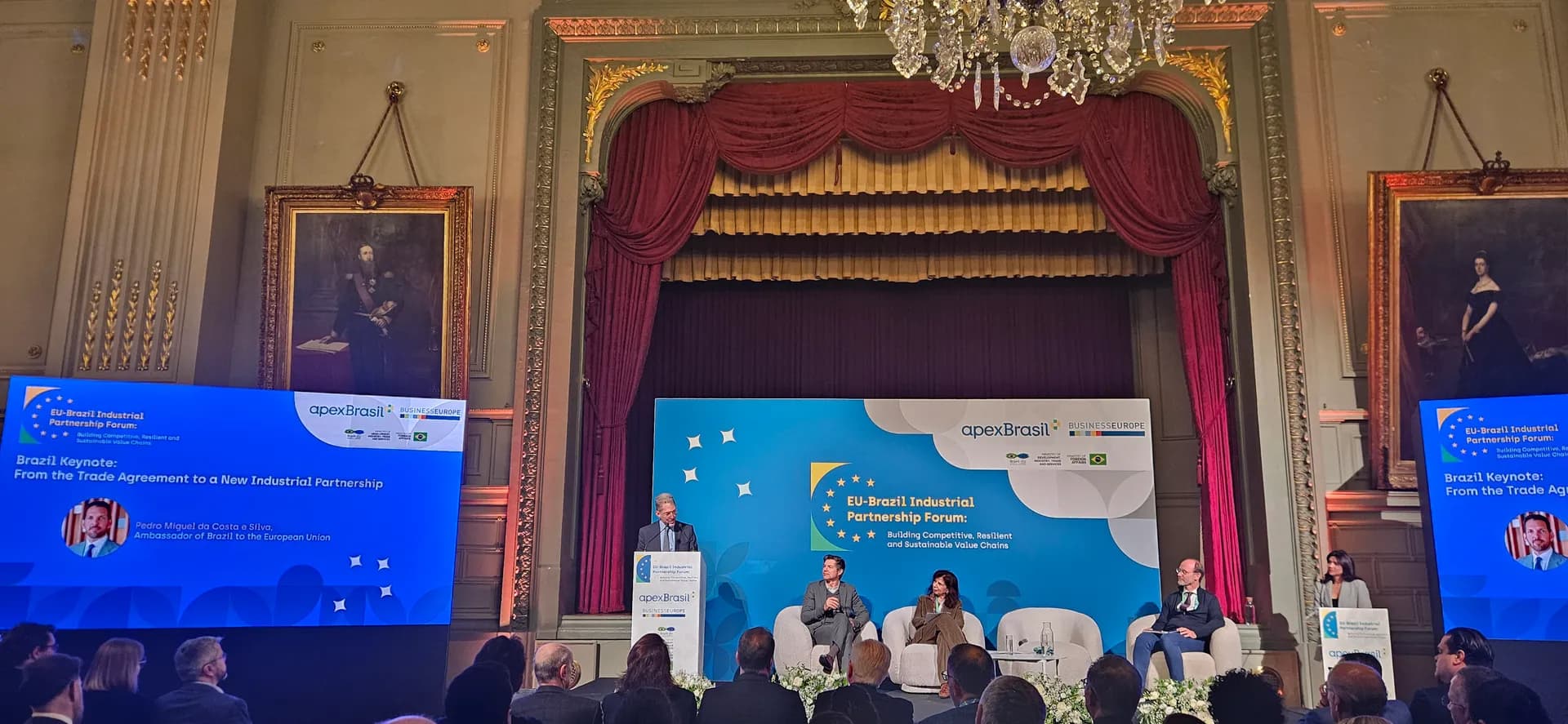
EU–Brazil Industrial Partnership Forum: Turning Shared Ambitions into Industrial Cooperation
At the EU–Brazil Industrial Partnership Forum on 15 October 2026, policymakers and business representatives explored how closer ties could strengthen industrial competitiveness, accelerate decarbonisation and build more resilient value chains.
How can Brazil and the European Union move beyond trade to develop a stronger industrial partnership? This question guided the EU–Brazil Industrial Partnership Forum, organised by ApexBrasil and BusinessEurope under the theme “Building competitive, resilient and sustainable value chains”. Across three panels, speakers examined how investment, clean energy and technological cooperation could connect the two economies more closely—and deliver benefits on both sides of the Atlantic.
While the EU–Mercosur agreement provided the broader framework, the discussions focused on what must happen beyond negotiations: developing projects, connecting research teams, addressing investment barriers and creating opportunities for businesses. A recurring message emerged throughout the morning: the partnership’s long-term value will depend not only on increasing trade, but on strengthening the capacity to produce and innovate together.
A partnership built on trust and shared interests
Opening the forum, Laudemir Müller, President of ApexBrasil, stressed that Brazil’s appeal extends beyond its natural resources. He highlighted the country’s industrial capabilities and renewable energy potential, while emphasising its ambition to attract investment that generates technology, employment and higher-value production. Rather than remaining primarily a supplier of raw materials, Brazil wants to take a greater role in the industries built around them.
Luisa Santos, Deputy Director General of BusinessEurope, framed the relationship around trust, reliability and predictability—qualities she identified as particularly important for companies operating in an uncertain international environment. She described the agreement as a platform for deeper partnerships, while stressing the importance of demonstrating concrete benefits and maintaining momentum towards full ratification.
In his keynote address, Pedro Miguel da Costa e Silva, Brazil’s Ambassador to the European Union, argued that the relationship should draw on the wider strategic partnership between the two sides. Alongside trade and investment, he pointed to research, education, technology and sustainable development as areas that can support closer industrial ties. He also underlined the importance of equivalence and non-discrimination, distinguishing cooperation between different regulatory systems from an expectation that both partners adopt identical rules.
Bernd Biervert, Head of Cabinet of European Trade Commissioner Maroš Šefčovič, delivered a practical message to the business community: identify opportunities, use the agreement and communicate the difficulties encountered. Feedback on customs procedures, market access and the use of trade preferences, he explained, is essential to ensuring that commitments translate into results.
From trade to production: strengthening industrial connections
Moderated by Mariele Lais Christ, Head of Industry and Service Department at ApexBrasil, the first panel explored how existing commercial ties could develop into more integrated value chains. The discussion brought together perspectives from electrical equipment, biodiversity-based ingredients, industrial technology and chemicals.
Wilmar Henning, Managing Director of WEG Germany, drew on the company’s expansion in Europe to illustrate the two-way nature of industrial investment. His account highlighted the role of technical training, long-term investment and local teams in building an international manufacturing presence. The relationship, his intervention showed, is not simply one of European companies investing in Brazil: Brazilian businesses also contribute to industrial activity and employment in Europe.
Raphael Lopes, General Director of Beraca, examined how industrial development can connect biodiversity, community livelihoods and conservation. He described an operating model linking local communities with the market for natural ingredients, particularly in cosmetics. His intervention raised a broader issue for sustainable value chains: how to increase the commercial value of natural resources while supporting the people and ecosystems on which production depends.
Christian Hoffmann, Global Head of Geopolitics and International Relations at Siemens, focused on the connections between digitalisation, competitiveness and decarbonisation. He highlighted technological capabilities developed in Brazil, including software development and engineering, and discussed opportunities to strengthen cooperation in industrial artificial intelligence and sustainable infrastructure. His emphasis was on combining expertise across the two regions rather than treating technology transfer as a one-way process.
Philipp Sauer, Director of Trade & Customs Policy at Cefic, stressed the importance of tariff reductions for the chemicals sector. Looking beyond market access, he also pointed to opportunities associated with biomaterials and the sector’s links to a wide range of downstream industries. His contribution illustrated how changes in trade conditions can influence investment and competitiveness across interconnected production networks.
Clean energy and critical minerals: adding value locally
The second panel, moderated by Maria Paula Velloso, Business Director at ApexBrasil, addressed sustainable energy and critical raw materials. At its centre was a question that recurred throughout the forum: how can Brazil help meet demand for lower-carbon supplies while also developing its own industrial base?
Bart Biebuyck, CEO of Green Energy Park, argued that Brazil’s renewable energy resources could support energy-intensive production and create opportunities for cooperation with European industry. He connected this approach to local value creation, describing the potential to process resources in Brazil rather than exporting them solely for transformation elsewhere. However, he also identified electricity-market arrangements and access to the grid as important challenges for hydrogen development.
Luciana Brum, Head of External Affairs at Vale, highlighted conditions needed to unlock investment in the minerals sector. These included more effective licensing processes, stronger infrastructure and a stable business environment. She also stressed the importance of shared value: developing mineral resources should generate benefits for Brazilian society, not only for the companies involved.
Ulrich Lange, Head of Business Field Natural Resources at TÜV Nord, presented findings from a GIZ-commissioned study on opportunities for cooperation in critical raw materials. He explained that the potential extends beyond securing alternative supplies for European buyers. Developing processing and other downstream activities in Brazil could also create opportunities for machinery manufacturers, engineering firms and technology providers. Such projects, he emphasised, require local expertise alongside international capabilities.
Raquel Lages, Head of EU Policy and Advocacy at UNICA, brought the discussion to transport decarbonisation through Brazil’s experience with ethanol. She highlighted the combination of sustained public policy, technological development and private investment behind the industry’s growth. Her argument was not that Europe should simply reproduce Brazil’s model, but that it could draw lessons from it, including the role sustainable fuels can play alongside electrification.
Innovation and technology: connecting expertise across borders
Moderated by Eleonora Catella, Deputy Director of International Relations at BusinessEurope, the final panel examined how research, skills and industrial partnerships can bring new technologies closer to the market. Speakers drew on experience in aerospace, clean energy and agriculture.
João Pedro Taborda, Vice President for Government Affairs at Embraer, described how European research partnerships help advance technologies that are not yet ready for commercial application. He highlighted the role of teams in Europe in connecting research institutions and industrial partners with specialists in Brazil. These relationships, he explained, can evolve from early technological cooperation into more mature projects and commercial opportunities.
Julien Feugier, Senior Director for Trade & Public Funding at Airbus, outlined the breadth of the group’s activities in Brazil, spanning commercial aviation, space, defence and helicopters. He also highlighted Brazilian engineering talent and the importance of continued skills development. His contribution underlined that innovation relies not only on equipment and investment, but on the people able to develop, integrate and use new technologies.
Gustavo Gardini, representing the Morro Pintado project, presented plans to connect renewable electricity generation in Brazil with hydrogen, green ammonia and maritime logistics. He described cooperation involving Brazilian project development and European industrial technologies, while outlining the next steps towards commercial agreements and an investment decision. The project illustrated both the scale of the ambition and the work still required to turn it into an operating industrial chain.
Stephan Schraff, Head Public Affairs at Bayer, focused on sustainable agriculture, biotechnology and collaboration with Brazilian producers and scientific institutions. He presented Brazil as a place where innovation is developed and tested, not merely a market in which it is deployed. His examples suggested that knowledge generated through Brazilian partnerships could also inform responses to agricultural and climate-related challenges in Europe.
Moving from complementarity to delivery
Closing the forum, Ambassador Roberto Jaguaribe, Senior Fellow at CEBRI, placed the discussions within the wider strategic relationship between Europe and Brazil. He called for stronger engagement and argued that the significance of closer ties goes beyond immediate trade gains, touching on the partners’ broader economic and geopolitical interests.
Throughout the morning, speakers identified substantial areas of complementarity. Yet they also made clear that potential alone is insufficient. Predictable rules, infrastructure, research links, skilled workers and viable investment projects will determine whether that potential becomes lasting industrial capacity. The task ahead is one of delivery: turning shared interests into partnerships that create value in both Brazil and Europe.
Related Topics
Follow EUReflect
See more of our reporting on Google
Mark EUReflect as a preferred source and our stories are ranked higher for you in Top Stories, Discover and Google News — and carry a “preferred” badge when they are cited in AI results.
Add EUReflect as a preferred source