Arabian Travel Market 2026: Dubai Positions Tourism as a Platform for International Cooperation
The 33rd edition of the Arabian Travel Market (ATM) is being held at Dubai World Trade Centre from 14 to 17 September 2026 under the theme “Travel 2040: Driving New Frontiers Through Innovation and Technology.” The event brings together tourism authorities, airlines, hotels, travel agencies, technology companies, investors and policymakers from across the Middle East and beyond. More than a major tourism trade show, ATM 2026 serves as a platform for governments and international organisations to discuss resilience, cooperation and the future of mobility in the face of geopolitical, technological and environmental challenges.
A global meeting point for the travel industry
Arabian Travel Market describes itself as a gateway connecting travel professionals from the Middle East, Africa, Eastern Europe, Asia-Pacific and other international markets. The 2026 edition is expected to attract more than 55,000 visitors, while its exhibition floor includes more than 2,800 exhibitors and over 6,600 buyers. The organisers also report 57,869 confirmed meetings, underlining the event’s commercial importance.
The scale of the event reflects Dubai’s wider role as a meeting point between regions. Tourism ministers, national destination organisations and private-sector representatives use ATM not only to promote destinations, but also to negotiate partnerships, exchange expertise and discuss common responses to changing travel patterns.
In this context, tourism functions as a form of economic diplomacy. National pavilions are places where countries present their cultural identity and investment opportunities, while bilateral meetings allow governments and industry leaders to explore cooperation in aviation, hospitality, events, infrastructure and sustainable development.
Opening day: resilience and multilateral cooperation
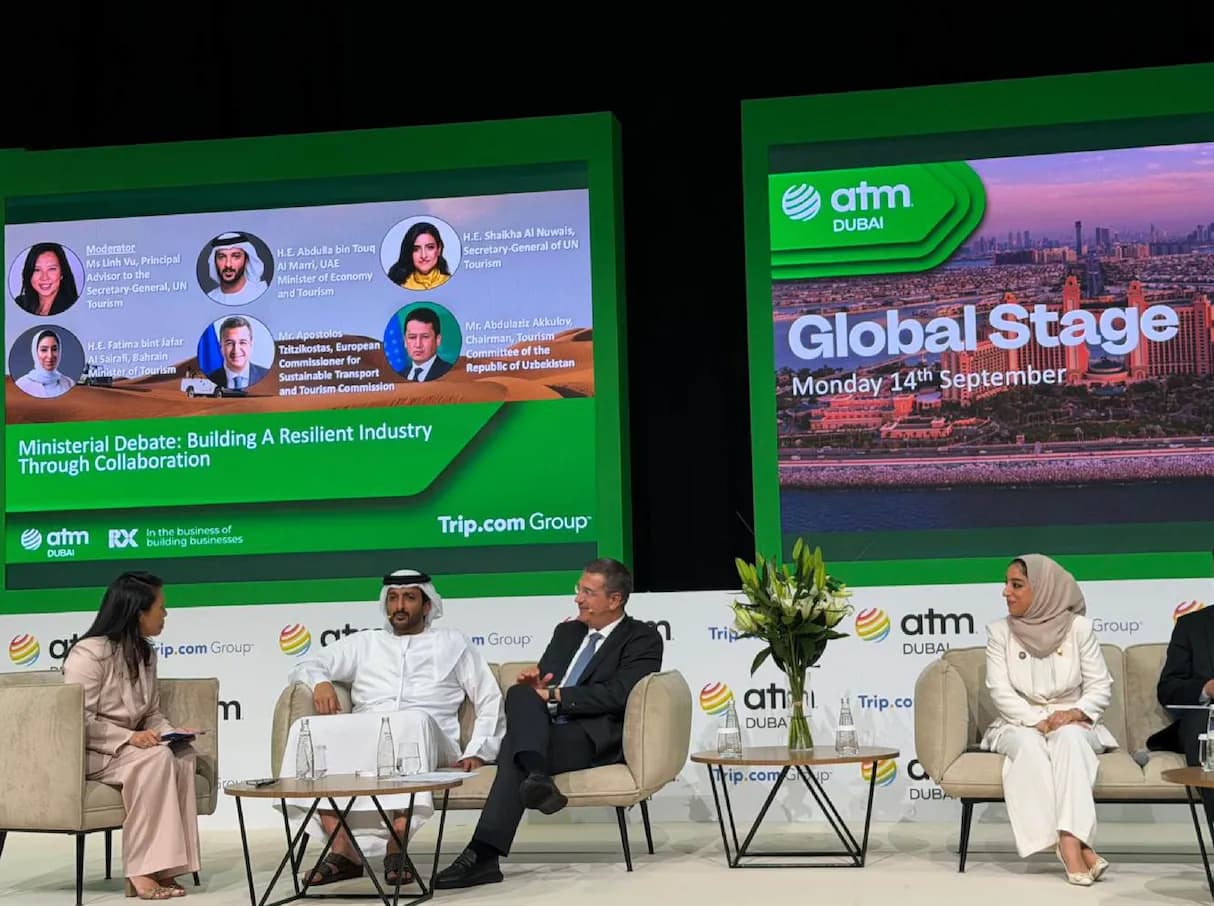
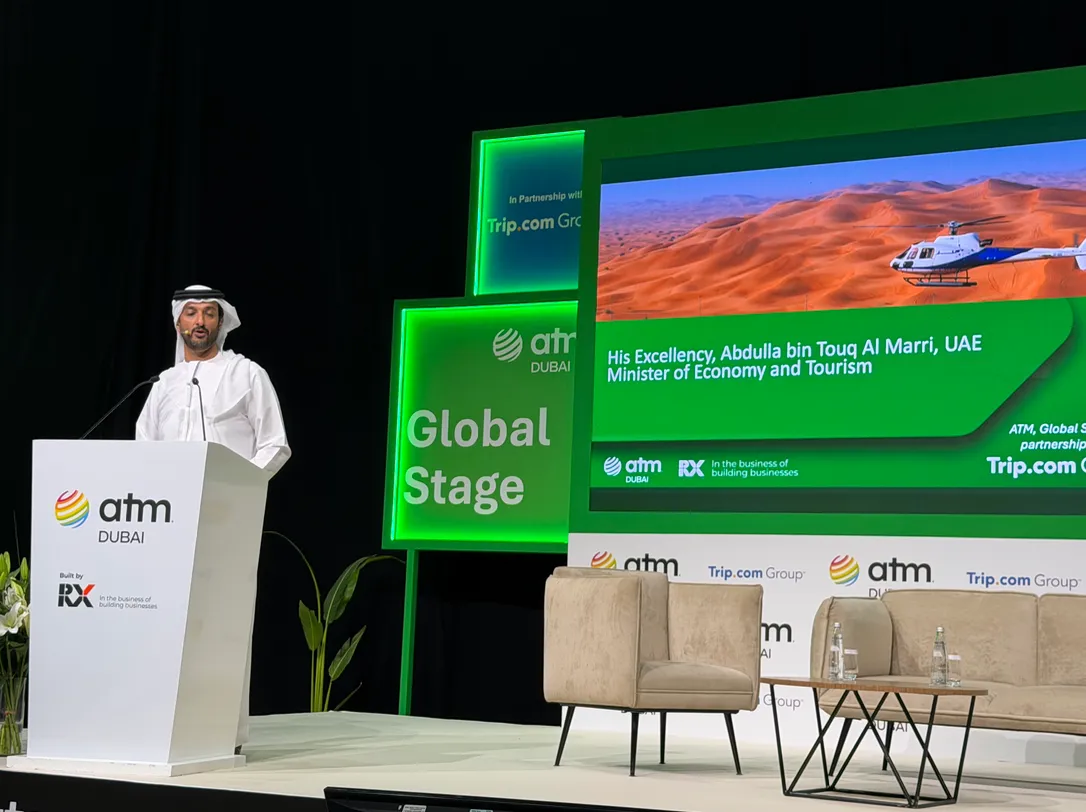
The event opened on 14 September with a strong focus on preparedness and collaboration. Abdulla bin Touq Al Marri, UAE Minister of Economy and Tourism, and Shaikha Al Nuwais, Secretary-General of UN Tourism, delivered welcome addresses on the Global Stage. Their interventions were followed by a ministerial debate involving representatives from the UAE, Bahrain, the European Union and Uzbekistan.
The discussion examined how tourism destinations can remain resilient during periods of geopolitical uncertainty. For the UAE, the message was that resilience depends not only on emergency responses, but also on the long-term foundations built through infrastructure, connectivity, public-private cooperation and international partnerships.
Shaikha Al Nuwais stressed the importance of preparing before a crisis occurs. In her view, countries that manage difficult situations effectively are those that establish relationships, exchange information and build trust in advance. This approach reflects an increasingly important idea in international tourism: cooperation is not simply a diplomatic principle, but also an operational necessity.
The European Union was represented by Apostolos Tzitzikostas, Commissioner for Sustainable Transport and Tourism. He reaffirmed the EU’s support for its partners in the Gulf and highlighted the importance of maintaining cooperation as tourism flows recover. Fatima Jaafar Al Sairafi, Bahrain’s Minister of Tourism, also underlined the economic weight of tourism in the Gulf, where the sector contributes more than 11% of regional GDP according to her remarks at the event.
The Global Stage hosted seven sessions on the first day, including discussions on the future of live experiences and the development of technology-driven luxury tourism in the Middle East. These sessions showed that the sector’s recovery is being discussed alongside a broader transformation in the way travellers discover, book and experience destinations.
Dubai’s political and institutional message
On the opening day, Sheikh Mohammed bin Rashid Al Maktoum, Vice President and Prime Minister of the UAE and Ruler of Dubai, visited ATM 2026. During his tour, he viewed national and international pavilions, including those representing the UAE, Dubai, Qatar, Bahrain, Kuwait, Spain and major hospitality groups.
His visit reinforced the event’s importance within Dubai’s development strategy. According to the UAE’s official news agency, Sheikh Mohammed described ATM as a platform that brings together decision-makers, investors, innovators and industry leaders to create new opportunities for growth.
The presence of senior political figures gives the exhibition a significance that goes beyond commercial networking. It demonstrates that tourism is closely linked to national competitiveness, international visibility and economic diversification. For Dubai, the sector is also a way to project an image of openness, modernity and global connectivity.
Technology takes centre stage
One of the main innovations of ATM 2026 is the launch of ATM Travel Tech, a dedicated exhibition focused on the technologies transforming the travel industry. More than 180 exhibitors from 30 countries are presenting solutions involving artificial intelligence, virtual and augmented reality, robotics, financial technology and green technologies.
The Future Stage opened with a keynote address by Dr Marwan Alzarouni, CEO of AI at the Dubai Department of Economy and Tourism. Discussions examined how artificial intelligence is moving beyond chatbots and personalised recommendations to influence the deeper systems supporting tourism.
Among the subjects explored are AI-assisted travel discovery, conversational search, autonomous itinerary planning and the changing relationship between technology and professional expertise. The debate is particularly relevant for governments and tourism authorities, which must balance innovation with questions of trust, data protection, accessibility and human oversight.
The technological agenda also illustrates a broader shift in tourism diplomacy. Destinations are increasingly competing not only through monuments, beaches or hotels, but also through digital infrastructure and the quality of the visitor journey. Visa services, airport procedures, smart mobility and personalised travel platforms are becoming part of a country’s international image.
The UAE presents a unified tourism identity
On 16 September, the UAE Ministry of Economy and Tourism announced the launch of “Visit UAE,” described as the country’s first unified federal tourism identity. The initiative aims to present the seven emirates as one integrated destination while preserving the individual characteristics of Abu Dhabi, Dubai, Sharjah, Ajman, Umm Al Quwain, Ras Al Khaimah and Fujairah.
The ministry also introduced the “UAE Grand Tour” platform. Developed in cooperation with Rocket International, the platform offers itineraries covering more than one emirate, with programmes lasting up to 14 days. Visitors can explore cultural, family, nature-based and adventure experiences, while travel agencies and tour operators can use the platform to build and book integrated packages.
From a diplomatic and economic perspective, this initiative is significant because it presents the UAE as a single, coherent tourism proposition. It encourages longer stays, promotes cooperation between emirates and supports the distribution of tourism revenues across the country.
The ministry also announced plans to promote the “World’s Coolest Winter” campaign internationally. Previously focused largely on domestic tourism, the campaign is expected to target international markets by highlighting the UAE’s winter festivals, desert and coastal experiences, cultural attractions and urban lifestyle.
Industry discussions move from recovery to readiness
The second day of ATM placed greater emphasis on competitiveness, talent and the capacity of the travel industry to adapt. At an executive roundtable entitled “From Rebound to Readiness: Shaping What’s Next Across the Travel Ecosystem,” industry leaders argued that technology alone would not guarantee success. Strong customer understanding, qualified personnel and the ability to respond quickly to market changes will remain essential.
This perspective is important because the future of tourism will not be determined solely by artificial intelligence or new digital platforms. The industry must also address workforce development, service quality, sustainability and the changing expectations of travellers who increasingly seek personalised and meaningful experiences.
The discussions also highlighted the importance of partnerships between governments and businesses. Tourism authorities can create the regulatory and infrastructural conditions for growth, while airlines, hotels, technology companies and travel agencies provide the services that transform national strategies into practical experiences.
The final day of ATM
The final day of ATM 2026 will continue the programme of business meetings, destination presentations and conference sessions. The exhibition will remain open from 10:00 to 17:00 on Thursday, 17 September, giving exhibitors and buyers a final opportunity to conclude agreements, establish partnerships and exchange contacts.
The closing phase is expected to focus on translating the discussions of the previous days into concrete initiatives. Key issues will include:
The application of artificial intelligence throughout the travel journey.
Cooperation between governments, airlines, hotels and technology companies.
Sustainable tourism and long-term destination resilience.
Smart mobility and the integration of transport networks.
New forms of cultural, luxury, business and experiential tourism.
The role of international partnerships in restoring confidence and expanding visitor flows.
As the event concludes, the most important outcome will not necessarily be a single announcement. Its broader impact will be measured through the partnerships formed, the investment opportunities identified and the strategies developed between destinations and private-sector actors.
A tourism event with diplomatic implications
Arabian Travel Market 2026 demonstrates that tourism has become an important instrument of international cooperation. The event brings together countries that may differ in their political systems, economic priorities and regional interests, but that share a common need to maintain connectivity, attract visitors and build confidence.
Dubai’s role as host is central to this process. The emirate is using ATM to showcase its infrastructure, promote technological innovation and reinforce its position as a hub linking Europe, Asia, Africa and the Middle East. At the same time, the UAE is presenting tourism as part of a wider national project based on economic diversification, international openness and strategic partnerships.
Under the banner of “Travel 2040,” ATM 2026 therefore looks beyond the immediate recovery of the travel sector. It asks how tourism can become more resilient, more connected and more technologically advanced over the next decade. In Dubai, the answer is being shaped through a combination of political engagement, commercial diplomacy and innovation.
Related Topics
EUReflect News
Site Administrator
Follow EUReflect
See more of our reporting on Google
Mark EUReflect as a preferred source and our stories are ranked higher for you in Top Stories, Discover and Google News — and carry a “preferred” badge when they are cited in AI results.
Add EUReflect as a preferred source