France Turns Up the Heat on Israel
France’s Foreign Minister warns that new sanctions targeting Israeli settlers and their supporters could land within days, as Western nations unite in condemning the surge of violence and illegal settlement expansion across the occupied West Bank.
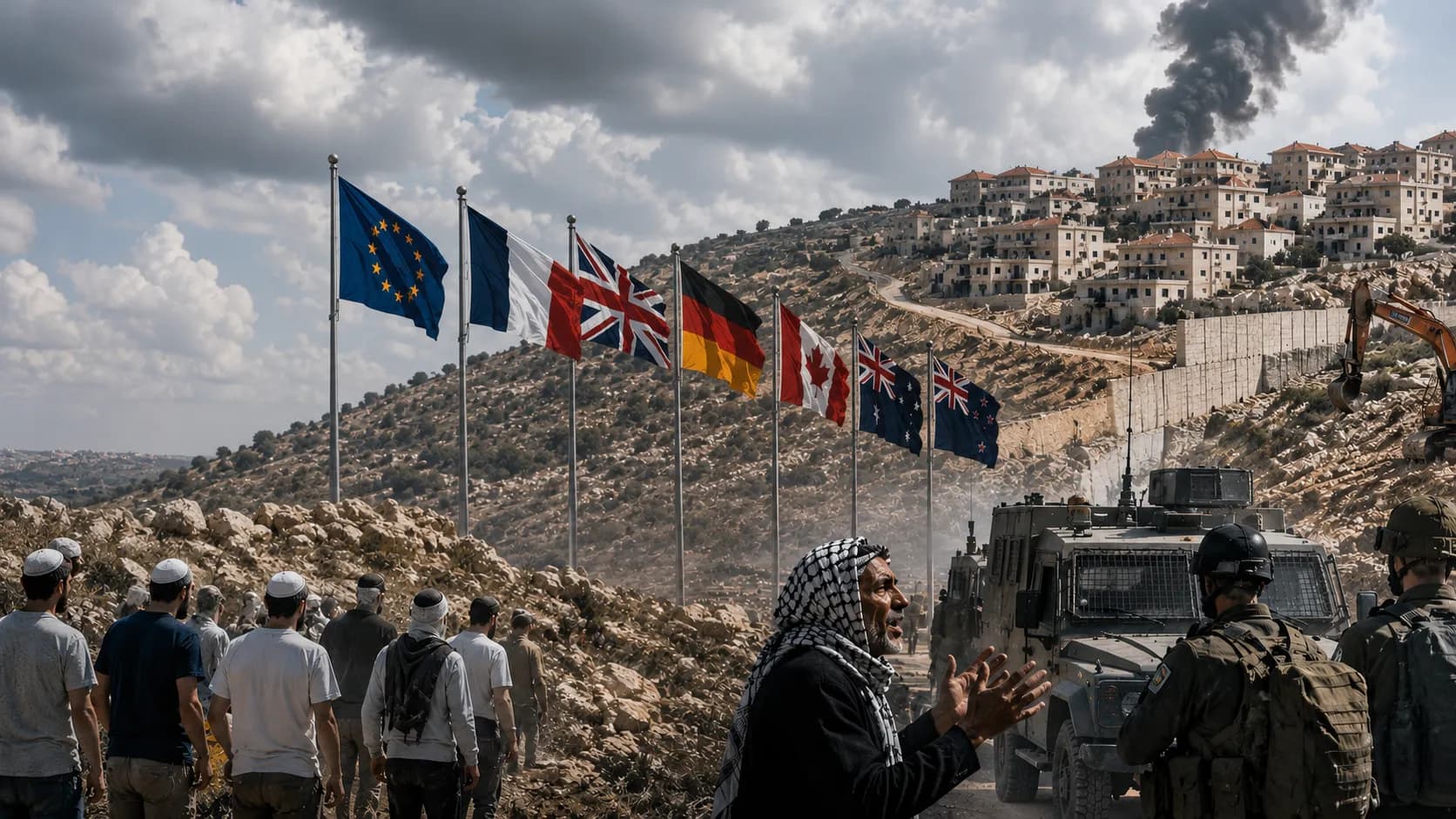
France has signalled that additional sanctions against Israeli settlers in the occupied West Bank are imminent, with French Foreign Minister Jean-Noël Barrot stating on Sunday, June 7, 2026 that further punitive measures could be imposed within days. The announcement comes amid a significant escalation of illegal settlement activity and a marked surge in settler violence directed at Palestinian civilians — developments that have triggered a coordinated diplomatic response from several major Western nations.
The French foreign minister's remarks, delivered in separate interviews on Public Senat television and RTL radio, represent the most direct and public indication yet that European powers are prepared to act unilaterally — beyond the European Union's collective framework — to hold accountable those responsible for the deteriorating humanitarian and security situation in the West Bank. Barrot declined to name the specific countries that could join France in imposing further restrictive measures, but his statements carry significant diplomatic weight given ongoing multilateral consultations.
I. European Sanctions Framework and France's Position
The European Union took a significant step in late May 2026 by imposing a fresh package of sanctions on Israeli settlers and the organisations that support and enable their activities in the occupied West Bank. Those measures marked a rare instance of coordinated EU action targeting Israeli nationals and entities, and were widely interpreted as a response to growing frustration among European capitals regarding the Israeli government's settlement expansion policy and its failure to prevent or adequately prosecute settler violence.
Barrot made clear that France is not content to rest with those initial measures. "We could go further," the minister stated, adding that additional sanctions targeting individuals linked to West Bank violence could follow within the coming days. According to Reuters, France has been actively working with several European partner countries to coordinate national-level sanctions — measures that would operate independently of the EU framework, thereby allowing for faster implementation and a broader scope of designations.
The minister was explicit about the reasoning behind France's posture: not only should those directly responsible for acts of violence face accountability, but also the companies, entities, and organisations in Israel that provide material and financial support to extremist settler groups. Barrot described this network as providing settlers "with the means to drive Palestinians from their land, burn their crops and destroy their public buildings" — language that reflects deep moral outrage and a desire to address the systemic infrastructure enabling the violence.
II. The Deteriorating Situation in the Occupied West Bank
The diplomatic pressure being applied by France and its allies is a direct response to what numerous governments and international bodies have described as a serious and accelerating deterioration in conditions across the occupied West Bank. Over recent months, Palestinian communities have faced an uptick in incidents of settler violence that has drawn international condemnation — incidents that range from property destruction and agricultural sabotage to direct physical assaults on civilians.
The expansion of Israeli settlements — widely regarded as illegal under international law and repeatedly criticised by Western governments and the United Nations — has continued at pace under Prime Minister Benjamin Netanyahu's government. Diplomats speaking to Reuters have noted that the settlement expansion strategy appears deliberately designed to undermine the long-term viability of a Palestinian state, further complicating already fragile peace prospects. The construction of new settler infrastructure on Palestinian land has been accompanied, in many documented cases, by intimidation campaigns and acts of destruction perpetrated by settler groups operating with apparent impunity.
Barrot's statement encapsulated the gravity of the situation: "I am extremely concerned about the escalation of illegal settlement activity in the West Bank and the surge in violence by Israeli settlers against Palestinians." Such language from a senior minister of a permanent United Nations Security Council member underscores the degree to which the West Bank situation has become a significant and acute concern at the highest levels of European and Western foreign policy.
III. Multilateral Western Response and Diplomatic Implications
France's bilateral and multilateral diplomatic efforts are part of a broader Western push to hold the Israeli government accountable for the situation in the West Bank. On May 22, 2026, seven major Western nations — the United Kingdom, Italy, France, Germany, Canada, Australia, and New Zealand — issued a joint statement calling on Israel to immediately halt the expansion of settlements and to take concrete, enforceable measures to curb growing settler violence. The statement warned that the situation had deteriorated significantly in recent months.
This coordinated diplomatic messaging reflects a hardening of attitudes among Israel's traditional Western allies — a shift driven not only by the violence in the West Bank, but also by broader frustrations over the Netanyahu government's conduct and domestic politics. Barrot referenced this dynamic explicitly, characterising the previous sanctions as a means of "calling on the Israeli government to face up to its responsibilities," and noting that the settler violence, in his view, "also undermines the authority of the state to some extent" — an observation that points to concerns about the rule of law within Israel itself.
The potential for coordinated national sanctions by multiple European countries, acting alongside but independently of the EU framework, represents a meaningful escalation in diplomatic pressure. While sanctions alone are unlikely to fundamentally alter Israeli government policy in the short term, they carry symbolic and reputational weight, and signal to the Netanyahu administration that continued settlement expansion and failure to address settler violence will have tangible consequences for Israel's standing with its Western partners.
Conclusion
The statements made by French Foreign Minister Jean-Noël Barrot on June 7, 2026 serve as a clear and pointed warning to the Israeli government that the international community's patience regarding settlement expansion and settler violence is nearing exhaustion. With further sanctions likely to be announced within days, and with multiple Western nations coordinating pressure both through the EU and through independent national channels, the diplomatic landscape surrounding Israel's West Bank policies is shifting in a direction that carries significant consequences.
Ultimately, the effectiveness of these measures will depend on the breadth of international participation and the willingness of Western governments to sustain pressure over time. What is evident from France's posture is that the era of largely unchallenged settlement expansion — conducted without meaningful diplomatic cost — may be drawing to a close. The coming days and weeks will be critical in determining whether these signals translate into substantive and lasting policy change.
Alvara Merrick
Contributing writer at EUReflect.
Follow EUReflect
See more of our reporting on Google
Mark EUReflect as a preferred source and our stories are ranked higher for you in Top Stories, Discover and Google News — and carry a “preferred” badge when they are cited in AI results.
Add EUReflect as a preferred source