Inside Burkina Faso’s Deepening Crisis: Civilian Abuses and the End of Political Pluralism
3 April 2026 Burkina Faso’s military authorities stand accused of overseeing grave abuses against civilians while simultaneously dismantling the country’s political pluralism, creating a closed and increasingly violent landscape for ordinary people.
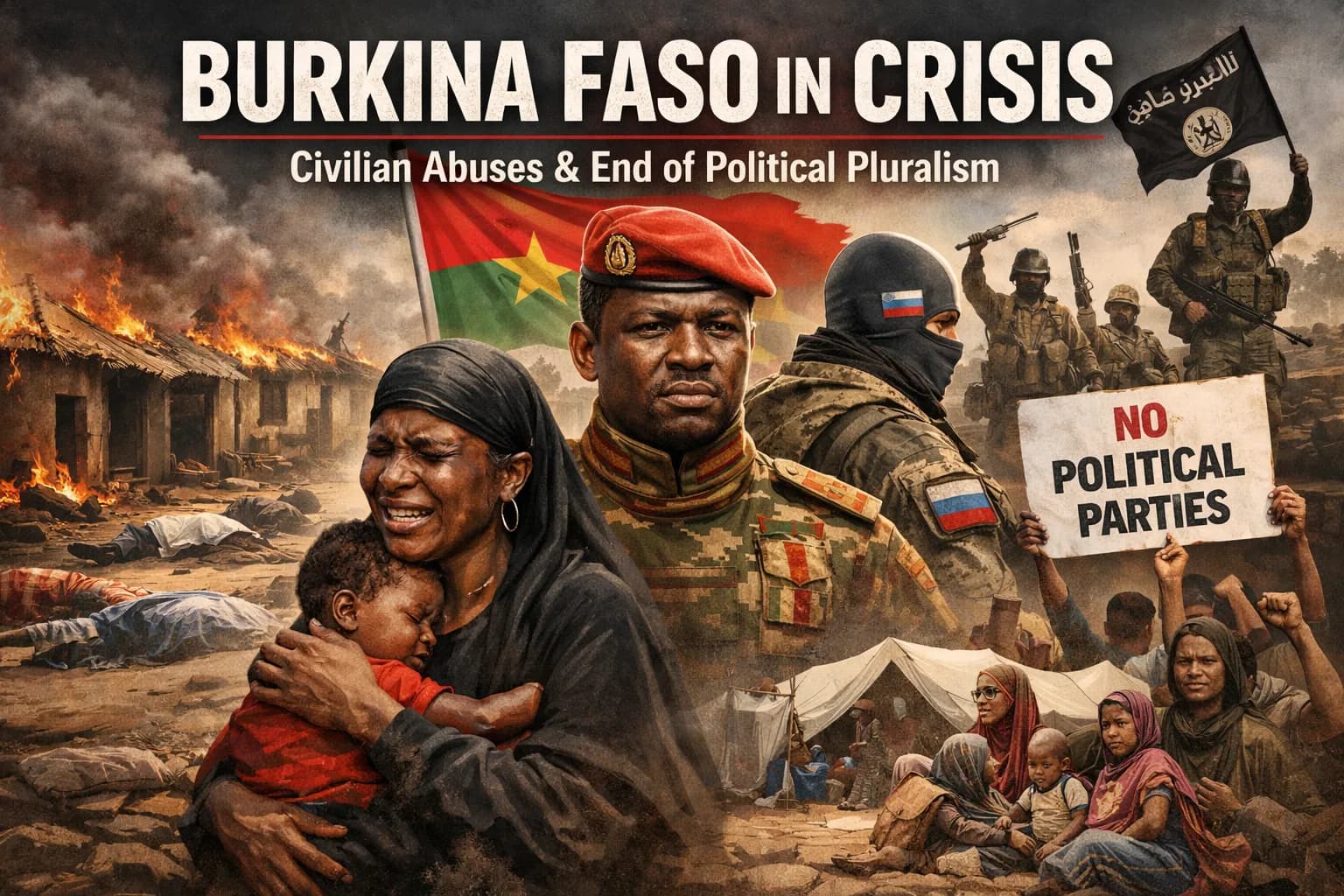
A major report by Human Rights Watch says that Burkina Faso’s armed forces, their allied militias and an armed group linked to Al Qaeda have killed more than one thousand eight hundred civilians since 2023, while forcing tens of thousands from their homes. The organisation concludes that these killings, along with mass displacement and other abuses, amount to war crimes and crimes against humanity that could implicate senior leaders on all sides of the conflict.
Researchers documented fifty seven serious incidents involving the national army, government allied Volunteers for the Defence of the Homeland militias and the Islamist group known as Jamaat Nusrat al Islam wal Muslimin after the current junta seized power in late 2022. The findings draw on more than four hundred and fifty interviews in Burkina Faso and neighbouring states, as well as analysis of satellite imagery, videos, photographs and official documents to corroborate survivor testimony and identify responsible units and commanders.
In one of the deadliest documented episodes, Burkinabe soldiers and allied fighters are reported to have killed more than four hundred civilians in about sixteen villages near the northern town of Djibo during a December 2023 operation. A woman who survived told Human Rights Watch that her two daughters died instantly when militia members opened fire, while she and her infant son were badly wounded, recalling that one fighter ordered his colleagues to make sure no one was left alive before they departed.
Targeted communities and shared responsibility T
The report describes a pattern in which security forces and their auxiliaries frequently target Fulani communities, whom the authorities often accuse of supporting armed groups, amounting in the organisation’s view to ethnic cleansing. At the same time, Jamaat Nusrat al Islam wal Muslimin has itself carried out large scale killings, including an attack in August 2024 in the central town of Barsalogho in which at least one hundred and thirty-three civilians, among them many children, were killed after being accused of backing pro government militias.
Human Rights Watch reflects, that all parties are responsible for deliberate attacks on civilians, destruction of civilian property, looting and forced displacement, and that impunity prevails across the board. Civilians interviewed for the report said they felt trapped between jihadist groups that threaten them for any perceived ties to the state and security forces that treat entire communities as collaborators of insurgents.
Political landscape closed
While violence against civilians escalates, the junta has taken a dramatic step to eliminate organised political opposition. In January 2026 Burkina Faso’s military led government issued a decree that dissolves all political parties and abolishes the legal framework that previously governed their activities. The decision was approved by the council of ministers and follows earlier measures that had already forced parties to suspend operations after the coup.
Interior Minister Emile Zerbo said the move is part of a project to rebuild the state after what he described as abuses and dysfunction in the previous multiparty system. Officials argued that the proliferation of parties, more than one hundred of which were registered before the coup with fifteen represented in parliament, had fuelled division and undermined social cohesion. Under the decree, every party and political formation is dissolved, and its assets are transferred to the state, while new legislation is planned to cancel rules on party finance and the status of the opposition leader.
The country is currently ruled by Captain Ibrahim Traore, who came to power in a September 2022 coup that unseated a previous set of military leaders, who had themselves overthrown elected president Roch Marc Kabore only eight months earlier.
Analysts quoted by Al Jazeera note that the ban on parties is a major setback for democracy and further consolidates Traore’s influence, especially following constitutional changes that gave him an expanded role within the judiciary.
Security pretext and human cost
The junta justifies its concentration of power as necessary to confront insurgencies linked to Al Qaeda and the Islamic State group that have plagued Burkina Faso and its neighbours for years, killing thousands and displacing millions. Yet the Human Rights Watch report portrays a security response that itself relies heavily on unlawful killings and collective punishment, including operations in which soldiers and allied volunteers allegedly shot villagers at close range and left bodies in courtyards and fields.
According to the organisation, Burkinabe forces and their auxiliaries are responsible for most civilian deaths it documented since 2023, with more than one thousand two hundred fatalities attributed to them compared with several hundred caused by Islamist fighters over the same period. The report describes repeated failure by the authorities to acknowledge abuses or hold perpetrators to account, while restricting media and civil society scrutiny, including by blocking online access to Human Rights Watch and international broadcasters in 2024.
Russian Influence in Burkina
Faso Burkina Faso has increasingly turned to Russia as a key security and political partner since the 2022 coup that brought Captain Ibrahim Traoré to power. This relationship has deepened significantly, with the junta seeking russian military support to combat jihadist insurgencies that have destabilised the country for nearly a decade. Russian Wagner Group mercenaries, now rebranded under the Africa Corps banner, have been deployed to provide training, equipment, and direct combat assistance to Burkinabé forces and their Volunteers for the Defence of the Homeland militias. This partnership marks a clear pivot away from traditional Western allies like France, whose influence was expelled in 2023 amid accusations of neocolonialism. For Traoré's government, Russian backing offers both tactical advantages and ideological alignment, framing the relationship as one of mutual respect between sovereign nations resisting external interference. 4 The growing Russian presence carries significant implications for Burkina Faso's internal dynamics and regional stability. Moscow has supplied weapons, surveillance drones, and intelligence support, while also engaging in economic deals involving gold mining and infrastructure projects that bolster the junta's resource base. Critics argue this support enables the military regime's repressive policies, including the documented civilian abuses and political crackdowns, by providing diplomatic cover at the United Nations and shielding Ouagadougou from international sanctions. From a cultural perspective, Russian state media has gained traction through partnerships with local outlets, promoting narratives that portray Traoré as a pan-African strongman standing up to Western hegemony. This soft power offensive resonates with segments of Burkinabé youth disillusioned with former colonial powers, potentially entrenching authoritarian tendencies while complicating accountability for human rights violations.
Conclusion
Burkina Faso now stands at a dangerous crossroads, where the promise of security has given way to a cycle of violence and authoritarian control that threatens the very fabric of society. As the junta tightens its grip, ordinary citizens pay the highest price, caught between merciless insurgents and a military apparatus that has lost any claim to moral authority. Without urgent international pressure and a return to accountability, the country risks sliding further into isolation and despair.
The international community must act decisively, supporting independent investigations into these atrocities while conditioning aid on concrete steps toward political openness and civilian protection. For Burkina Faso's people, the path forward demands more than rhetoric; it requires a reckoning that places human rights above military expediency. Only then can the nation hope to break free from this dual nightmare of terror and tyranny, reclaiming the future, where safety and democracy are not mutually exclusive.
References: Human Rights Watch. (2026, April 2). Burkina Faso: Crimes against humanity by all sides. https://www.hrw.org/news/2026/04/02/burkina-faso-crimes-against-humanity-allsides Al Jazeera. (2026, April 2). Burkina Faso military, allies committing 'horrific' civilian abuses: HRW. https://www.aljazeera.com/news/2026/4/2/burkina-faso-militaryallies-committing-horrific-civilian-abuses-hrw Human Rights Watch. (2024). World report 2025: Burkina Faso. https://www.hrw.org/world-report/2025/country-chapters/burkina-faso Human Rights Watch. (2026, April 2). None can run away: War crimes and crimes against humanity in Burkina Faso [Video]. https://www.hrw.org/videophotos/video/2026/04/02/none-can-run-away-war-crimes-and-crimes-againsthumanity-burkina Human Rights Watch. (2026, February 4). Burkina Faso's junta pulls the plug on political life. https://www.hrw.org/news/2026/02/05/burkina-fasos-junta-pulls-plug-politicallife Chibelushi, W., & Négoce, N. (2026, January 30). Burkina Faso junta announces ban on all political parties. BBC. https://www.bbc.com/news/articles/cevnlv9my1no Associated Press. (2026, January 29). Burkina Faso's junta dissolves all political parties, saying they cause division. https://apnews.com/article/burkina-faso-political-partiespolitics-junta-19d83b07b9e7700cad650583d354bd4d Al Jazeera. (2024, April 25). Burkina Faso's army executed more than 200 civilians: Rights group. https://www.aljazeera.com/news/2024/4/25/burkina-fasos-army-executedmore-than-200-civilians-rights-group International Institute for Democracy and Electoral Assistance. (2025,). Burkina Faso - March 2025. The Global State of Democracy. https://www.idea.int/democracytracker/report/burkina-faso/march-2025 Human Rights Watch. (2025, September 15). Burkina Faso: Islamist armed groups massacre civilians. https://www.hrw.org/news/2025/09/15/burkina-faso-islamistarmed-groups-massacre-civilians IndepthNews. (n.d.). Burkina Faso forging stronger partnership with Russia. https://indepthnews.net/burkina-faso-forging-stronger-partnership-with-russia/
Dmytro Melnyk
Contributing writer at EUReflect.
Follow EUReflect
See more of our reporting on Google
Mark EUReflect as a preferred source and our stories are ranked higher for you in Top Stories, Discover and Google News — and carry a “preferred” badge when they are cited in AI results.
Add EUReflect as a preferred source