Pakistan Invests in Nuclear Fuel Security
The Rs60 million allocation for uranium exploration in Bannu Basin and Kohat Plateau is part of a broader strategy to tap into an estimated $7 trillion mineral wealth, though large-scale extraction will need foreign investment.
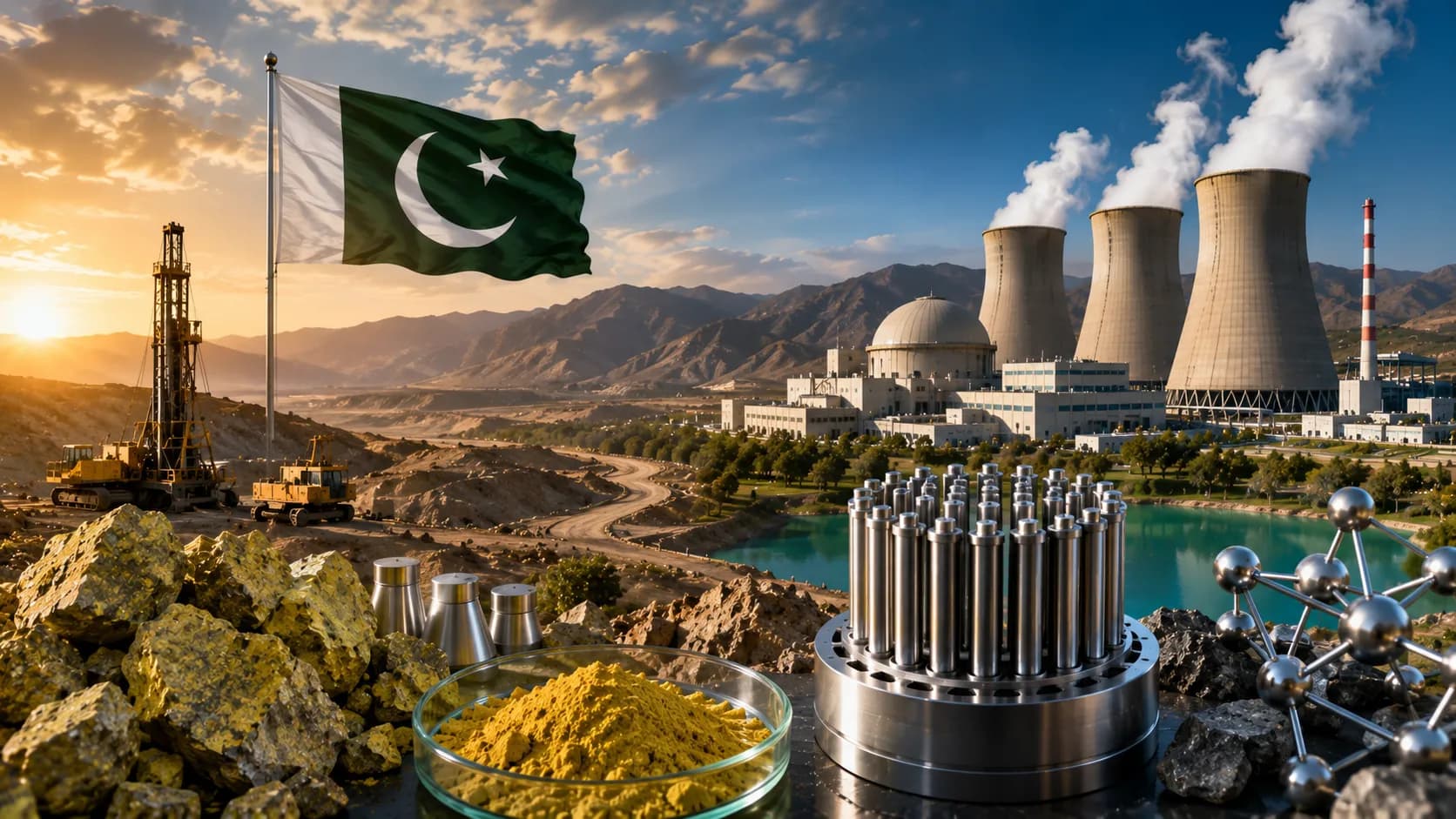
Pakistan is quietly strengthening the resource base behind its nuclear-energy programme as Islamabad expands uranium exploration, geological surveying and nuclear research while simultaneously building new generating capacity.
The strategy has gained additional importance in 2026 as Pakistan seeks greater energy security and attempts to develop its enormous but still underexplored mineral resources. Planning Minister Ahsan Iqbal said this week that Pakistan estimates its overall mineral endowment at more than $7 trillion, while acknowledging that large-scale extraction will require substantial foreign capital, geological verification and long-term investment.
Within this broader mining strategy, uranium occupies a particularly sensitive and strategically important position.
Pakistan Expands Uranium Exploration
The clearest evidence of Pakistan's investment in nuclear raw materials can be found in the federal development programme.
The government allocated Rs60 million for the detailed exploration of uranium resources in the Bannu Basin and Kohat Plateau, continuing Phase V of the programme. Another Rs50 million was allocated for the second phase of a wider reconnaissance survey of mineral resources.
These programmes are being conducted under the Pakistan Atomic Energy Commission and are intended to improve knowledge of domestic mineral resources relevant to the country's peaceful nuclear programme.
The investment remains relatively small compared with the billions being directed toward reactor construction, but its strategic importance is considerably greater than its budget suggests.
Uranium exploration can help Pakistan understand whether larger portions of its future nuclear-fuel requirements could eventually be supported by domestic resources.
Nuclear Electricity Is Growing
The exploration effort comes as Pakistan expands nuclear power generation.
The Pakistan Atomic Energy Commission currently operates six nuclear power plants with a combined capacity of about 3,530 MW, according to PAEC. Nuclear plants supplied approximately 18.3 percent of Pakistan's electricity in 2024.
The next major expansion is Chashma Unit 5, a 1,200 MW reactor being constructed with Chinese cooperation.
In March, the International Atomic Energy Agency's Board of Governors unanimously approved the safeguards agreement covering the new reactor. Pakistan expects C-5 to become operational around 2030.
The expansion creates an obvious long-term requirement: more reactors mean greater and more predictable demand for nuclear fuel.
China Remains Critical
Pakistan's push for domestic exploration should not be interpreted as complete nuclear-fuel independence.
Its civilian nuclear-energy programme remains closely connected to China.
The World Nuclear Association reports that enriched fuel for Pakistan's Chinese-designed pressurized-water reactors is imported from China. Pakistan's six operating reactors include four Chinese PWR units at Chashma and two large Chinese-designed units near Karachi.
An IAEA publication similarly notes that Pakistan relies on Chinese imports for fuel for the Chashma and Karachi plants, including enriched uranium and fabrication services.
Domestic uranium exploration therefore has a different immediate function: increasing geological knowledge, strengthening strategic resource options and gradually reducing vulnerabilities across the broader nuclear-fuel cycle.
Minerals Become a National Strategy
The nuclear-resource programme also fits into Pakistan's wider effort to transform mining into a major economic sector.
The government is establishing a National Mineral Data Centre to digitize geological information and identify commercially viable mineral blocks for investors. European investors were told in April that much of Pakistan's mineral potential remains insufficiently explored and requires proper geological verification before resources can become bankable projects.
Pakistan's Economic Survey also shows Islamabad working on geological mapping, mineral-data systems, investment facilitation and new exploration licenses as part of a broader effort to attract capital into critical raw materials.
This could eventually create synergies between conventional mining, critical-mineral development and strategic nuclear-resource exploration.
Energy Security Is the Main Driver
Pakistan's interest in nuclear raw materials is ultimately connected to a larger economic problem: energy security.
The country has historically faced electricity shortages, dependence on imported fuels and vulnerability to international energy prices.
Nuclear power provides Islamabad with relatively stable, large-scale and low-carbon electricity generation. The high capacity factors of Pakistan's existing reactors make the technology particularly attractive for supplying continuous baseload power.
Securing nuclear fuel therefore has implications beyond the nuclear industry itself.
It affects electricity prices, industrial competitiveness, foreign-exchange requirements and Pakistan's ability to reduce dependence on imported fossil fuels.
A Long-Term Nuclear Resource Strategy
Pakistan is not yet approaching complete independence in civilian nuclear fuel. China remains essential to its existing reactor fleet and future expansion.
But the direction of policy is becoming clearer.
Islamabad is simultaneously exploring domestic uranium resources, mapping mineral deposits, expanding nuclear research capabilities and constructing additional nuclear generating capacity.
The amounts currently devoted specifically to uranium exploration are modest. Yet their strategic significance lies in what they could enable over the longer term.
If Pakistan can identify commercially viable uranium deposits while developing its domestic nuclear-industrial capabilities, the country could gradually strengthen control over one of the most strategically important inputs into its energy system.
For Pakistan, the nuclear question is therefore increasingly about more than building reactors.
It is also about securing the resources needed to operate them for decades.
Ahmet Balakan
Contributing writer at EUReflect.
Follow EUReflect
See more of our reporting on Google
Mark EUReflect as a preferred source and our stories are ranked higher for you in Top Stories, Discover and Google News — and carry a “preferred” badge when they are cited in AI results.
Add EUReflect as a preferred source