Putin’s Long Rule Faces a New Test
Yabloko's exclusion from the ballot highlights how the war has narrowed legal opposition, leaving only Kremlin-approved parties in the vote.
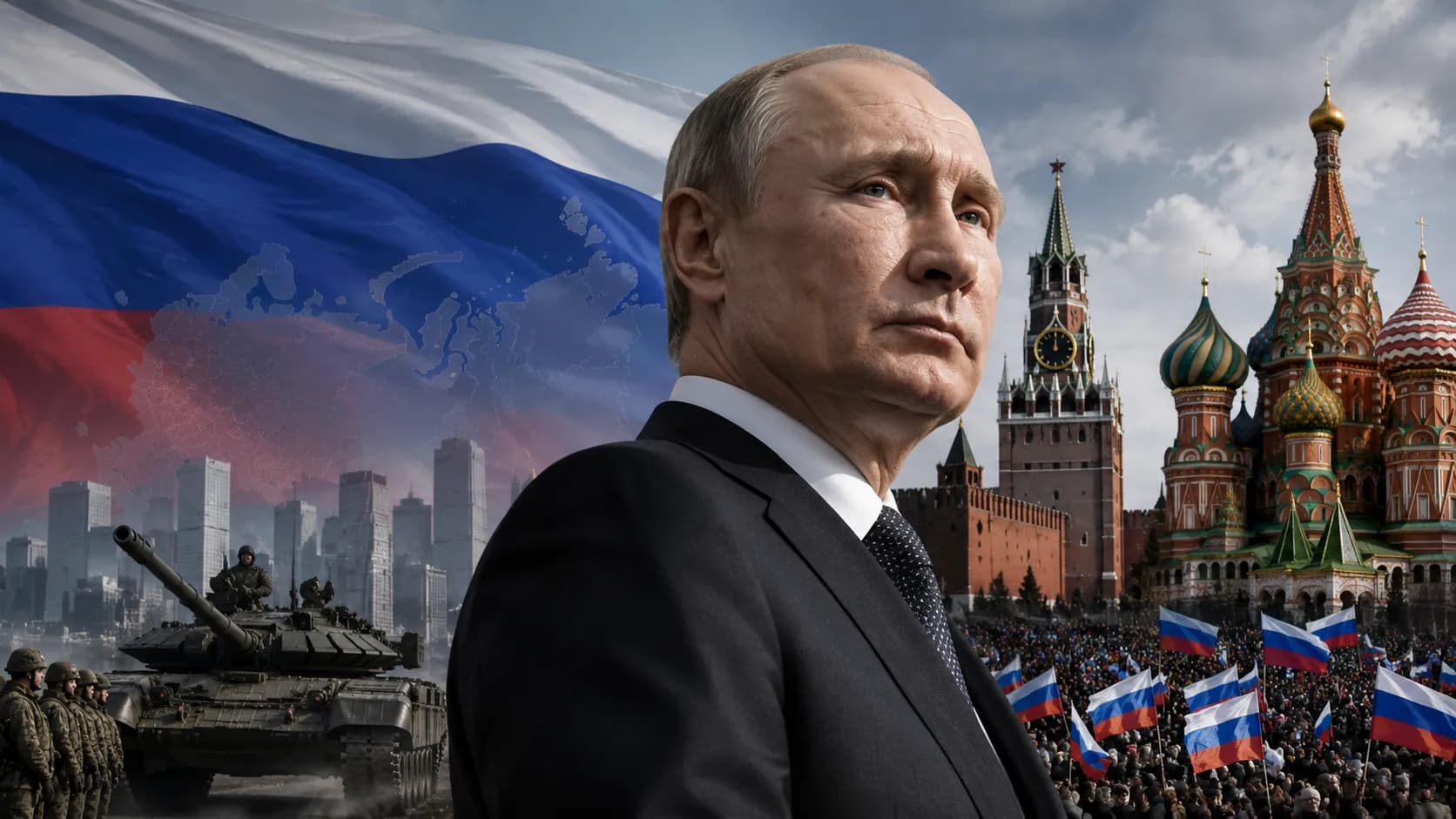
Vladimir Putin has dominated Russian politics for more than a quarter of a century, serving as president or prime minister since 1999. In 2026, however, the central question surrounding the Kremlin is gradually changing. It is no longer simply how Putin has remained in power for so long, but whether the highly centralized political system built around him can remain stable as Russia faces a prolonged war, economic pressure and an unresolved succession problem.
The approaching September 18–20 State Duma elections provide the latest test. Putin has presented the vote as evidence of the stability and maturity of the Russian state. Yet recent developments also demonstrate how tightly controlled political competition has become.
Putin Built a System, Not Just a Presidency
Putin's longevity cannot be explained by personal popularity alone.
Over more than two decades, Russia has developed what analysts commonly describe as a highly centralized or personalist political system. Presidential authority is reinforced by the security services, state bureaucracy, regional governors, state-controlled or aligned media, major corporations and the governing United Russia party.
Freedom House's 2026 assessment describes political power as concentrated around Putin, with courts, security institutions and the legislature providing few effective checks on presidential authority.
The Russian elite has also changed.
A recent Carnegie analysis argues that senior officials increasingly function as administrators inside Putin's system rather than independent political actors capable of developing their own power bases. Loyalty and implementation have become more important than political autonomy.
This helps explain Putin's durability: potential competitors exist inside the system, but few possess independent institutions through which they could challenge the president.
War Has Strengthened Centralization
The Ukraine war has accelerated this transformation.
Since 2022, national security has become increasingly central to domestic politics. The Kremlin presents the conflict as part of a wider confrontation with the West, allowing political stability, sovereignty and military security to become closely connected in official discourse.
United Russia's candidate list for September reflects this change. It includes Ukraine war veteran Vladislav Golovin and prominent war correspondent Yevgeny Poddubny alongside Foreign Minister Sergei Lavrov and Moscow Mayor Sergei Sobyanin.
The political message is significant.
The war is no longer merely a foreign-policy issue. It is increasingly becoming part of the identity and personnel structure of the Russian political establishment.
Opposition Space Is Narrowing Further
Perhaps the clearest indication of the current political environment is the treatment of Yabloko.
The liberal party, which opposed the invasion of Ukraine, has been excluded from the September parliamentary elections. Its vice president Lev Shlosberg was sentenced this month to more than 11 years in prison after being convicted over anti-war activities and statements.
Yabloko was unlikely to challenge United Russia for control of parliament. It received only 1.34 percent of the party-list vote in the 2021 Duma elections.
Its exclusion is therefore politically significant precisely because the party was relatively small.
Analysts argue that authorities appear increasingly unwilling to allow even limited electoral space in which dissatisfaction with the war could become publicly measurable.
Elections Still Matter to the Kremlin
Russian parliamentary elections are not expected to threaten Putin's position directly.
United Russia has dominated every national election it has contested and is again expected to retain control of the Duma.
But elections still perform an important function for the Kremlin: demonstrating legitimacy and elite discipline.
Putin said this week that September's election would demonstrate Russia's ability to withstand external threats and confirm the stability of the state.
Yet reports of changing electoral targets suggest that the Kremlin is also carefully managing expectations amid economic and wartime pressures.
The objective is therefore not simply victory. The government needs a result sufficiently strong to demonstrate public support while remaining credible enough to perform its legitimizing function.
The Economy Could Become the Greater Challenge
Political centralization has allowed Putin to absorb pressures that might have destabilized less consolidated governments.
But economic conditions matter.
Russia has adapted to Western sanctions partly by redirecting energy exports and expanding economic relations with China, India and other non-Western markets. At the same time, analysts continue to debate how long wartime spending, sanctions, labor shortages and other structural pressures can be sustained.
This creates an important distinction.
Putin does not necessarily need rapid economic growth to maintain political control.
But prolonged deterioration in living standards combined with war fatigue could gradually make maintaining that control more expensive politically and financially.
The Biggest Question Is What Comes After Putin
Ironically, Putin's success in concentrating power may eventually become one of the system's greatest vulnerabilities.
Russia has no clearly established political successor.
Nor has Putin created an obvious mechanism through which competing elite groups could peacefully determine who should inherit presidential authority.
Recent analyses increasingly identify succession as one of Russia's major long-term political risks. A system built around one dominant leader can remain remarkably stable while that leader controls it, but transferring that authority to another person can be considerably more difficult.
Putin's current presidential term runs until 2030, and constitutional changes adopted in 2020 leave him legally able to seek another term that could keep him in office until 2036.
The issue is therefore not necessarily immediate.
But every additional year of personalized rule makes institutional succession more important.
Putin’s Strength Is Also Russia’s Political Dilemma
After more than 25 years at the center of Russian power, Putin has constructed a system capable of surviving sanctions, international isolation, domestic opposition and prolonged war.
That durability should not be underestimated.
Yet the same system has become increasingly dependent on the political authority of one individual.
Russia's September parliamentary elections are unlikely to determine who governs the country. Instead, they will provide another indication of how effectively the Kremlin can maintain political legitimacy, manage war fatigue and incorporate a new generation into the existing power structure.
The paradox of Putin's Russia is therefore becoming clearer:
the longer Putin successfully dominates the political system, the harder it may become to imagine that system functioning without him.
Ahmet Balakan
Contributing writer at EUReflect.
Follow EUReflect
See more of our reporting on Google
Mark EUReflect as a preferred source and our stories are ranked higher for you in Top Stories, Discover and Google News — and carry a “preferred” badge when they are cited in AI results.
Add EUReflect as a preferred source