Six Days Alone on Everest
Nepali guide Dawa Sherpa survived six days alone on Mount Everest after running out of oxygen during his descent. Trapped in a crevasse, he survived by chewing ice and eating chocolate before escaping and reaching rescuers. His remarkable survival has stunned the climbing world.
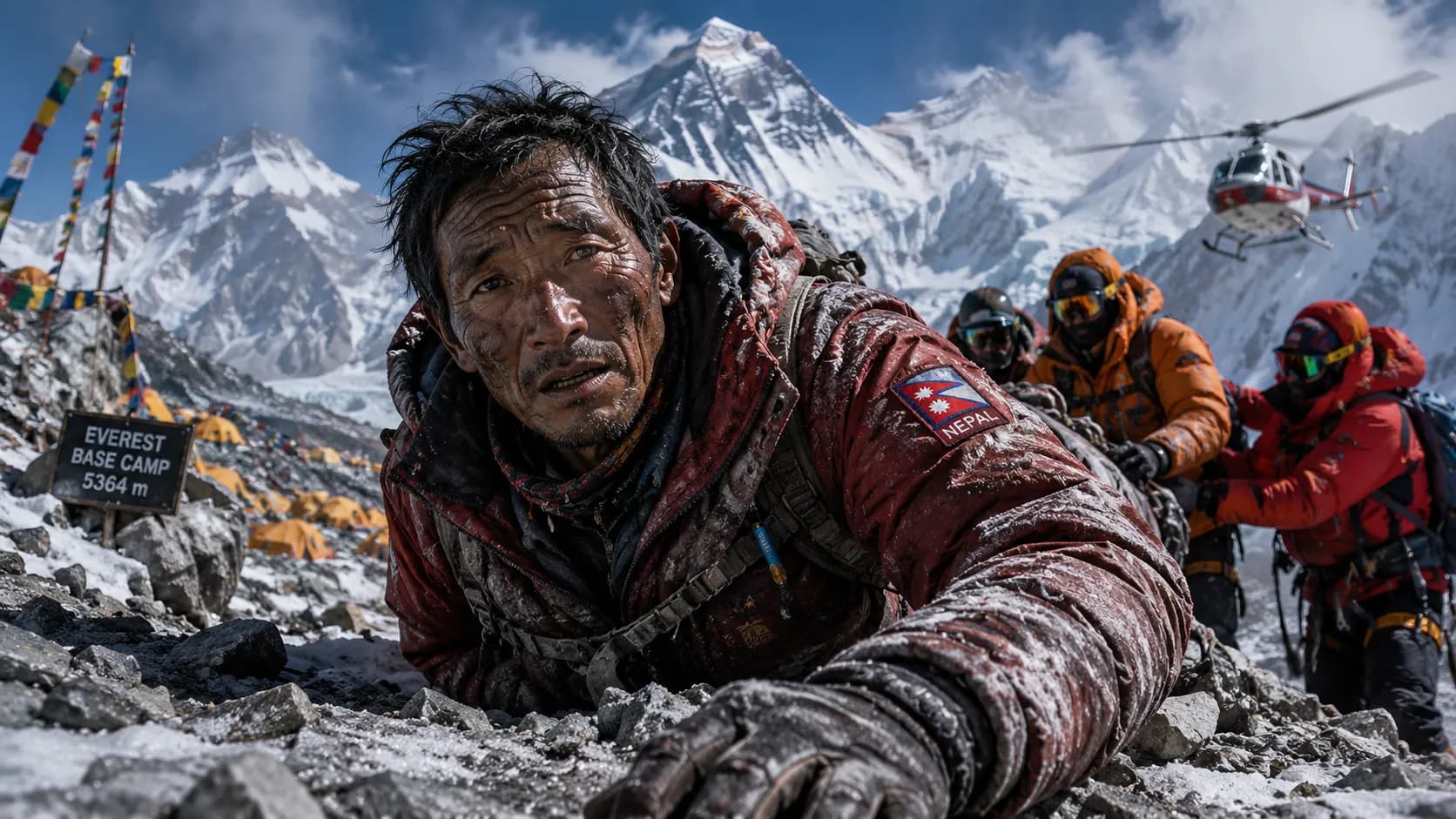
In a remarkable story of endurance, determination, and survival against overwhelming odds, Nepali mountain guide Dawa Sherpa has survived six days alone on Mount Everest after running out of supplemental oxygen during his descent. Initially believed to have died on the world’s highest mountain, the 57-year-old guide was eventually found alive, crawling toward safety near Everest Base Camp.
His extraordinary survival has stunned climbers, rescuers, and the global mountaineering community. While his family had already begun preparing for his funeral, Dawa Sherpa was fighting for his life high in the Himalayas, surviving on ice, a few pieces of chocolate, and an unwavering determination to return home.
A Desperate Fight for Survival in the Everest Death Zone
Dawa Sherpa’s ordeal began during his descent from Mount Everest when his oxygen supply was exhausted at an altitude of approximately 7,500 meters. In the thin air of the so-called “death zone,” where oxygen levels are insufficient to sustain human life for extended periods, even basic movement becomes extremely difficult.
According to Dawa Sherpa, the loss of oxygen left him unable to walk properly. For the first two days, he had no food and no reliable source of water. Desperate to survive, he began chewing ice despite the intense pain it caused to his teeth.
“I could not walk when the oxygen ran out,” he later explained. “For two days, I ate nothing. Then I started chewing ice.”
Eventually, he discovered several chocolate bars in his pocket, providing a small but critical source of energy. He also managed to collect and drink melted ice. These limited resources helped sustain him as he attempted to continue his descent through one of the most hostile environments on Earth.
The situation became even more dangerous when he reportedly fell into a deep crevasse. Trapped for nearly two and a half days, he had no apparent means of escape and little hope of survival.
Escape from a Crevasse and a Miracle Rescue
As conditions worsened, Dawa Sherpa faced what seemed to be an impossible situation. However, nature unexpectedly provided him with a chance to survive.
According to his account, an avalanche deposited snow into the crevasse where he was trapped. The accumulated snow created a platform that allowed him to climb upward and search for a way out.
“When I stepped on the snow and looked up, I thought I might be able to get out,” he recalled.
After escaping the crevasse, he discovered fixed climbing ropes nearby, which enabled him to continue descending the mountain. Despite extreme exhaustion, dehydration, frostbite, and injuries, he pushed forward.
Another avalanche threatened his progress, but he remained determined to reach safety. Throughout the night, he continued moving downhill through snow and difficult terrain.
Days after he had last been seen, a group of workers ascending the mountain to collect waste spotted him near the lower sections of the route. They immediately assisted him and helped bring him to safety.
He was later evacuated by helicopter to a hospital in Kathmandu, where doctors began treating him for dehydration, frostbite, and a fractured bone.
Medical specialists report that his condition has stabilized and that he is receiving comprehensive care in the intensive care unit.
Shock, Relief, and a Story That Inspired the Mountaineering World
News of Dawa Sherpa’s survival quickly spread throughout Nepal and the international climbing community. Many people had already accepted that he had perished on Everest.
His family had begun performing funeral preparations after being informed that a rescue operation was no longer possible. The sudden news that he had been found alive brought overwhelming relief and joy.
His wife, Damu Sherpa, described her disbelief when she saw him again.
“We were told he would never come home. I still cannot believe he returned alive,” she said. “I do not understand how he survived for so long without food or supplies.”
British climber Chris Thrall, one of the last people known to have seen Dawa Sherpa before his disappearance, also expressed amazement at the outcome. He recalled seeing the guide resting near Camp Three before continuing his own descent.
When reports later emerged that Dawa Sherpa had survived, Thrall initially believed the information was false.
“One moment I was grieving with his family, and the next I was seeing him alive. It is impossible to describe,” he said.
Mountaineering experts have described the incident as one of the most extraordinary survival stories in Everest’s modern history. Pemba Sherpa, chief executive of the expedition company involved in the search effort, called it a genuine “self-rescue” and a miracle.
The event has also renewed discussions about climber safety on Everest, particularly during increasingly crowded climbing seasons. More than 1,000 people reached the summit during the current season, making it one of the busiest years ever recorded on the mountain.
Conclusion
Dawa Sherpa’s survival is a powerful testament to human resilience and the will to live. Stranded in Everest’s deadly high-altitude environment, deprived of oxygen, trapped in a crevasse, and facing extreme weather conditions, he overcame challenges that would normally be considered unsurvivable.
His story has inspired people around the world and serves as a reminder of both the dangers of high-altitude mountaineering and the extraordinary strength that humans can display in the face of adversity. As he continues his recovery in Kathmandu, Dawa Sherpa’s six-day struggle for survival will likely be remembered as one of the most remarkable episodes in the history of Mount Everest.
Zhansaya Nurlanovna
Contributing writer at EUReflect.
Follow EUReflect
See more of our reporting on Google
Mark EUReflect as a preferred source and our stories are ranked higher for you in Top Stories, Discover and Google News — and carry a “preferred” badge when they are cited in AI results.
Add EUReflect as a preferred source