“THE FUTURE OF EUROPE RUNS THROUGH ITS SMALL STATES”
Professor Glenn Agung Hole—Honorary Professor in Kazakhstan and Visiting Professor in North Macedonia—argues that Europe’s long-term stability depends on its smallest and most strategically placed states. In this extended interview with EUReflect’s Derya Sy, he discusses the lessons from Astana, Norway’s blind spots, the strategic awakening of the Balkans, and why North Macedonia is becoming indispensable for European security, innovation, and academic diplomacy.
A EUReflect Long-Form Interview with Professor Glenn Agung Hole
Interview by Derya Sy, EUReflect
PART I — ASTANA: A SPEECH THAT CHANGED EVERYTHING
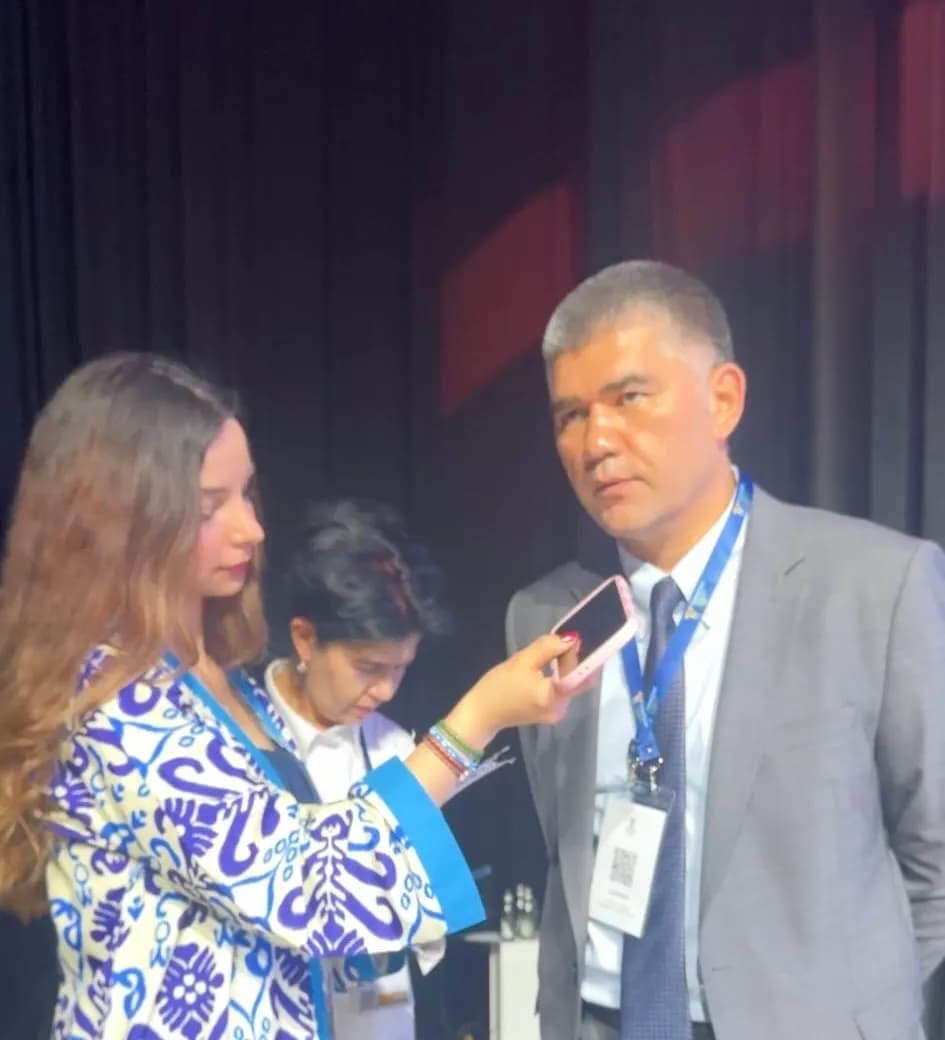
Derya Sy: Professor Hole, you’ve said your strategic interest in North Macedonia sharpened dramatically at the Astana International Forum. What happened there?
Hole:
The Astana International Forum was one of the most impressive geopolitical gatherings I have attended. Nearly 3,000 delegates, including numerous heads of state, ministers, diplomats, CEOs, and leading academic voices were present. Kazakhstan positioned itself as a global connector, and the forum reflected that ambition.
But the defining moment for me was hearing the President of North Macedonia deliver her keynote address. Her clarity, intelligence, and strategic insight were exceptional. She articulated something profound:
“Stability is not inherited; it must be built.”
Small states know this better than anyone. Large states often take peace for granted. Small states never do. Her emphasis on democratic resilience, regional cooperation, and multi-vector diplomacy resonated deeply with my own research and worldview.
Her speech made me realize that North Macedonia is not an overlooked Balkan state—it is a strategically vital country whose importance Europe has failed to appreciate. That moment changed the trajectory of my work for the rest of the year.
PULL QUOTE:
“Small states understand geopolitics more clearly than large ones—because they cannot afford mistakes.”
PART II — OSLO: A STRATEGIC SIGNAL EVERYONE MISSED
Derya Sy: Soon after Astana, you attended North Macedonia’s 34th independence celebration in Oslo. Norway’s Chief of Defence, General Eirik Kristoffersen, spoke. Why was that significant?
Hole:
It was far more significant than most people realized.
General Eirik Kristoffersen, Norway’s Chief of Defence, is not a ceremonial figure. He is a soldier with deep operational experience in the Balkans. When he attends the independence day of North Macedonia—surrounded by NATO ambassadors—that is not symbolic diplomacy.
It is a message.
Kristoffersen understands the Balkans intimately. He knows that instability in this region is never confined; it reverberates across Europe. His presence demonstrated Norway’s recognition of the country’s importance inside NATO.
It also exposed a blind spot in Norwegian society:
Our defence sector understands the Balkans far better than our academia and public discourse.
PULL QUOTE:
“When Norway’s Chief of Defence attends your national day, it is not a courtesy call—it is a strategic message.”
PART III — SKOPJE: STRATEGIC MEETINGS WITH GOVERNMENT AND ACADEMIA
Derya Sy: Your visit to Skopje was full of high-level meetings. Can you walk us through them?
Hole:
Absolutely. My visit to Skopje brought together three arenas: government, academia, and innovation ecosystems.And the level of professionalism exceeded my expectations.
1. Bilateral Meeting with the Ministry of Education and Science
I held a formal meeting with the Ministry of Education and Science of the Republic of North Macedonia, represented by:
Deputy Minister Prof. Dr. Lulzim Aliu
Deputy Minister Aliu and I discussed:
entrepreneurship education
structured mentorship models
innovation ecosystems
academic-industry collaboration
and strategic implications of the Draghi Report for Europe
We agreed to explore:
Erasmus+ cooperation
academic exchange programmes
development of shared innovation and mentorship projects
long-term bilateral academic partnerships
This meeting laid the foundation for a more structured collaboration between Norway and North Macedonia in research, education, and innovation.
2. High-Level Meetings at Mother Teresa University (MTU)
At Mother Teresa University, I met with the full leadership team:
Rector Full Prof. Dr. Bekim Fetaji
Pro-Rector Prof. Dr. Diturije Ismaili
Pro-Rector Prof. Dr. Fati Iseni
Secretary General Mr. Pishtar Lutfiu
Senate Member Prof. Dr. Argëtim Saliu
Dr. Sc. Arbnor Rushiti
Blerim Gjoni
Bujar Shala
We discussed:
the role of entrepreneurship in national development
applied research and innovation
creating a National Centre for Entrepreneurship and Mentorship
strengthening North Macedonia’s integration into European research networks
fostering Norway–North Macedonia academic and innovation bridges
The tone was proactive, ambitious, and strategic. There is a hunger for meaningful collaboration—not symbolic partnerships, but deep, structural ones.
3. Public Lecture at Mother Teresa University
I delivered a lecture titled:
“Entrepreneurship, Innovation and Growth: Stability and Well-Being in a Changing World.”
Rector Fetaji opened the event, highlighting:
MTU’s commitment to internationalisation
the importance of external expertise
the value of bridging academic knowledge and industry practice
The students were engaged, informed, and eager to participate. The discussions that followed demonstrated a strong academic culture and a clear desire to contribute to Europe’s innovation landscape.
INFO BOX — Key Meetings in Skopje
Government:
Deputy Minister Prof. Dr. Lulzim Aliu, Ministry of Education and Science
Mother Teresa University Leadership:
Rector Full Prof. Dr. Bekim Fetaji
Pro-Rector Prof. Dr. Diturije Ismaili
Pro-Rector Prof. Dr. Fati Iseni
Secretary General Mr. Pishtar Lutfiu
Senate Member Prof. Dr. Argëtim Saliu
Dr. Sc. Arbnor Rushiti
PART IV — NORTH MACEDONIA: EUROPE’S STRATEGIC HINGE
Derya Sy: What makes North Macedonia so central to Balkan and European geopolitics?
Hole:
North Macedonia is a small state with disproportionate strategic relevance.
Why?
1. It sits at the heart of the Balkans
whoever controls stability here shapes the region.
2. It avoided the worst of the Yugoslav Wars
but nearly fell into conflict in 2001.
3. The Ohrid Framework Agreement
is one of Europe’s few examples of successful peace mediation.
4. NATO membership
anchors the alliance in a historically unstable part of Europe.
5. Institutional reforms
have been faster and more decisive than in many EU member states.
And most importantly:
Instability in North Macedonia does not stay there—it spreads.
Migration, security, infrastructure, and trade all depend on Balkan stability.
PULL QUOTE:
“When the Balkans shake, the tremors reach Berlin, Brussels, Oslo—and beyond.”
PART V — NORTH MACEDONIA AS A RELIABLE NATO PARTNER
Derya Sy: You have repeatedly highlighted North Macedonia’s strategic value to NATO. What makes the country such a reliable partner?
Hole:
North Macedonia is one of NATO’s most consistent small-state contributors. The country joined the Alliance in 2020 after years of reforms, diplomatic perseverance, and substantial political effort. Despite limited financial resources, it has shown a commitment that exceeds many larger, wealthier states.
North Macedonia has contributed troops to:
the NATO-led mission in Afghanistan,
the training mission in Iraq,
and the long-standing KFOR peacekeeping mission in Kosovo.
These deployments are not symbolic; they demonstrate a political willingness to shoulder responsibility. The country has also worked systematically to align its defence forces with NATO standards, implementing reforms across procurement, cyber security, training systems, and readiness frameworks.
But perhaps more importantly, North Macedonia brings political reliability, something that is sometimes more valuable than raw military power. Larger states can fluctuate depending on domestic political tides, but smaller states like North Macedonia often show greater strategic consistency.
This is particularly important in Southeastern Europe, where the Alliance historically has had to compensate for instability, competing interests, and unresolved ethnic tensions. North Macedonia’s stable alignment with Western values and its persistent commitment to reforms make it a cornerstone of NATO’s southeastern flank.
To put it simply:
North Macedonia is a small state, but a dependable one.
Alliances rely on dependability.
PART VI — THE EU’S FAILURE TO HONOUR ITS PROMISES
Derya Sy: The EU has asked a lot from North Macedonia over the years. Has the EU failed the country?
Hole:
Yes—unquestionably.
North Macedonia did something almost unimaginable: it changed its constitutional name to resolve its long-running dispute with Greece. The Prespa Agreement was hailed as a triumph of diplomacy over nationalism. It required political courage that few European leaders today are willing to demonstrate.
The EU promised that resolving the name dispute would unlock the path toward EU membership negotiations. Instead, after fulfilling its side of the bargain, North Macedonia saw the goalposts moved yet again—this time by Bulgaria.
Imagine working for decades to resolve disputes, strengthen your institutions, reform your judiciary, and modernize your country, only to be told afterward that the conditions have changed.
This has several dangerous consequences:
It undermines trust in the EU’s credibility.
It strengthens anti-European sentiment and opens room for nationalist narratives.
It creates fertile ground for external influence from Russia, China, and Turkey.
It punishes reformers and weakens pro-European political actors.
It signals to all Balkan states that reform does not guarantee reward.
Europe often forgets that small states pay close attention to how they are treated. The EU’s inconsistency—especially toward North Macedonia—damages not only Skopje’s strategic direction, but also the EU’s moral authority.
North Macedonia has done everything Europe asked.
Europe has not delivered on what it promised.
PART VII — NORWEGIAN ACADEMIA: THE ABSENT ACTOR
Derya Sy: You have been openly critical of Norwegian academia’s lack of engagement with Southeastern Europe. Why?
Hole:
Because our absence is both strategically irresponsible and intellectually indefensible.
Norwegian academia invests heavily in partnerships with the US, Western Europe, and selected parts of Asia. Yet we consistently ignore one of the most geopolitically sensitive regions in Europe: the Western Balkans.
This neglect has multiple consequences:
1. We lose influence.
Turkey, China, and Gulf nations invest aggressively in academic diplomacy in the region. They fund universities, scholarships, cultural centres, and research cooperation.
Norway does nothing comparable.
2. We miss important research opportunities.
North Macedonia and the Balkans offer unique case studies in conflict resolution, democratization, entrepreneurship ecosystems, and small-state strategy.
3. We weaken Europe’s stability.
Higher education plays a crucial role in preventing radicalization, building institutional capacity, and supporting democratic norms.
4. We undermine our own values.
Norway claims to support peace, democracy, and development. But our academic strategies show the opposite: an unwillingness to engage where it matters most.
Academic diplomacy is not abstract; it is power.
It shapes networks, strengthens reforms, and builds resilience.
My mission in Skopje is to demonstrate what meaningful academic engagement looks like—and why Norway urgently needs to invest in regions where ideas matter as much as infrastructure.
PART VIII — WHY SMALL STATES HOLD EUROPE TOGETHER
Derya Sy: Much of your work centres on the idea that small states stabilize Europe. Could you explain?
Hole:
Absolutely. Small states are often the “silent stabilizers” of international systems. Their actions are less dramatic, but more predictable—and predictability is the foundation of stability.
Small states matter because:
They rely on international law, not power politics.
They bind alliances together through consistent policy.
They innovate by necessity, not by luxury.
They understand risk and therefore avoid adventurism.
They mediate, de-escalate, and build bridges.
North Macedonia is a perfect example:
despite sitting in one of the most historically volatile regions in Europe, it has consistently chosen reform, compromise, and cooperation.
Europe’s geopolitical architecture is not held together by its largest states alone.
It is held together by the discipline, caution, and commitment of its smallest ones.
Small states rarely demand attention—but their absence would be catastrophic.
PULL QUOTE:
“Small states are stabilizers. Remove them, and Europe’s system begins to crack.”
PART IX — PARALLELS BETWEEN KAZAKHSTAN AND THE BALKANS
Derya Sy: You hold professorships in both Kazakhstan and North Macedonia. Do you see connections between these contexts?
Hole:
There are striking parallels—even though the regions differ culturally and historically.
Both Kazakhstan and North Macedonia are multi-vector small states.
They sit at geopolitical crossroads where major powers compete for influence.
Kazakhstan balances relations with:
Russia
China
the EU
the Muslim world
and the United States
North Macedonia balances:
the EU
NATO
regional dynamics
external influence from Turkey and other actors
Both depend on diplomacy as a survival strategy.
They cannot afford unilateralism.
Both invest in education, knowing that institutional capacity shapes long-term sovereignty.
Both show leadership often overlooked in the West.
Their geopolitical maturity—despite limited resources—is deeply impressive.
My work in Kazakhstan and North Macedonia has taught me the same lesson:
small states understand the fragility of the world better than anyone else.
PART X — A DIRECT WARNING TO EUROPE
Derya Sy: If you could address Europe’s policymakers directly, what would you say?
Hole:
My message is simple, but urgent:
Do not underestimate the strategic value of your smallest allies.
If Europe loses the Western Balkans—intellectually, economically, strategically—it will be because it underestimated the importance of engagement.
Europe today is facing:
demographic decline
innovation deficits
geopolitical fragmentation
external influence operations
instability on its borders
Small states like North Macedonia are the hinge points of resilience.
They are the connectors, the buffers, and the early-warning sensors.
If Europe disengages, other actors will fill the vacuum—Russia, China, Turkey, Gulf states, or nationalist extremism.
Europe cannot afford a geopolitical blind spot in the Balkans.
PULL QUOTE:
“If Europe disengages, others will fill the space—and they already are.”
PART XI — FINAL REFLECTIONS
Derya Sy: After Astana, Oslo, and Skopje, what stays with you the most?
Hole:
That stability is an active project—not a passive condition.
Astana reminded me that small states possess geopolitical wisdom often ignored by great powers.
Oslo showed me that Norway values North Macedonia far more in defence circles than in academia or public debate.
Skopje demonstrated a country determined to reform, to integrate with Europe, and to build meaningful partnerships.
If Europe is serious about stability, innovation, and democratic values, it must invest in small states—not as footnotes, but as strategic partners.
Because the truth is simple:
When small states succeed, Europe succeeds.When they fail, Europe pays the price.
Derya Soysal
Contributing writer at EUReflect.
Follow EUReflect
See more of our reporting on Google
Mark EUReflect as a preferred source and our stories are ranked higher for you in Top Stories, Discover and Google News — and carry a “preferred” badge when they are cited in AI results.
Add EUReflect as a preferred source