The New Geopolitics of the Arctic: Is the U.S. Eyeing Greenland Next?
Trump’s expansionist “America First” policy sought control over resources and strategic zones like Venezuela and Greenland, increasing rivalry in the Arctic, straining NATO, and fueling tensions with China and Russia instead of trust and cooperation.
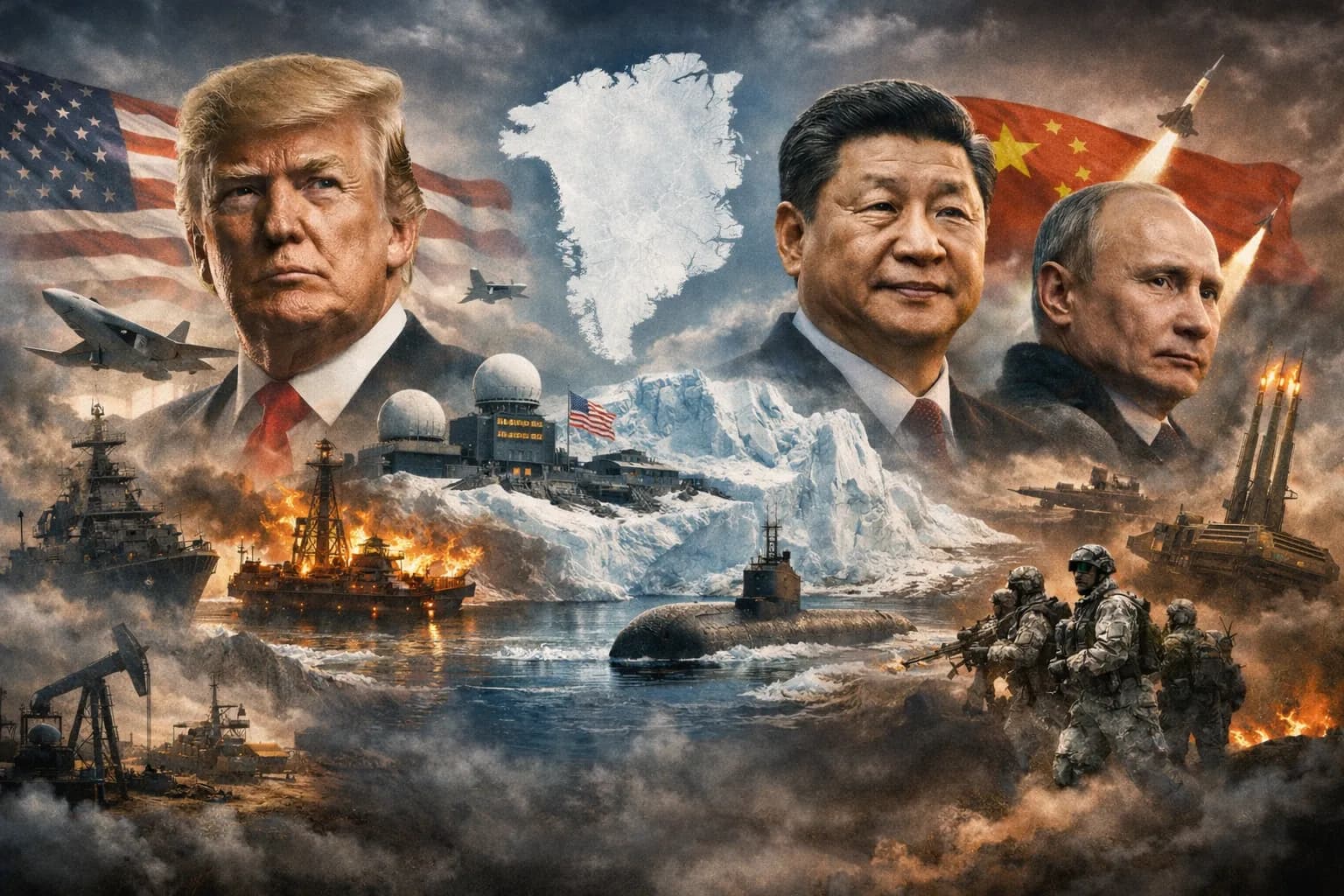
Trump proposed a form of expansionism that was characteristic of U.S. power that implied world powers have to take control of the places, resources, and sires of conflict to assert their power. Admittedly, he had an “America First” slogan, but in his eyes, U.S. supremacy would mean controlling and even stifling Americanism everywhere around the globe. Such a mentality grants power, as it were, and it is the opposite of trust and cooperation, which the world today needs to rely on to strengthen ties.
U.S. control of Venezuela is a typical example of this line of reasoning. Venezuela has the largest oil reserves globally, thus the U.S. has a great interest economically. He claimed that he was only interested in a democratic restoration, but the scenario of North Venezuela with oil, the U.S., and an eastward rising superpower, China, along with a westward superpower, Russia, would definitely change the dynamics in the area. It can be argued that democracy, in the sense that it was wanted by the U.S., was not being promoted. Getting resources was the impression most countries had of the U.S., and consequently, the fallout on America’s image was negative worldwide.
In this instance, we can observe the concluding outcome for the case of theextensivism of the military. Direct military action has only intensified military confrontations; therefore, the use of military power seems to create a climate of fear that will not generate peace, but the opposite of peaceis a fear that will generate the active resistance to that power and an enduring confrontation of a conflict with layers of a negative peace. Most Latin American countries became more careful with the hand of negotiations with the United States. This illustrates the idea that just because one has a gun does not mean that one can shoot politically.
However, geopolitically,Greenlandsits between North America and Europe, making it a crucial point for military and shipping routes, especially as Arctic ice melts and new sea lanes open. Economically, Greenland holds vast untapped reserves of rare earth minerals, oil, gas, and other valuable resources, attracting interest from countries looking to secure critical materials for technology and energy. Additionally, its proximity to the Arctic enhances its significance in global security and surveillance, as nations compete for influence in the rapidly changing polar region. As a result, Greenland is emerging as a focal point of geostrategic competition between the United States, China, Russia, and European powers, with implications for both global trade and military strategy.
The united statesis quite interested in these shipping routes and the valuable resources since it competesagainst the other world powers. However, having the desire to purchase Greenland or other similar areas neglects the wishes of the people, and will antagonize allies such as Denmark.
When examines global power China has to be taken into consideration as China holds a large majority of the worlds rare earth metals and is extending its influence but not through military means, but through the influence of advanced trade. China also refers to itself as a near arctic state. They also have an interest in the shipping routes and resources of the arctic. However, China has gone about this in a more planned and patient manner as they have focused their attention towards forming relationships rather than making aggressive demands. This is a complete juxtaposition to the style of trade that Trump is trying to use, as it is very aggressive and expansionist in its nature.
Russia's activity is even more brazen in the Arctic where they have set up new military posts and are patrolling more frequently. Trump's interest in Greenland is a new justification for further militarization of the Arctic. Rather than reducing threats, expansionism drives rival powers to further militarize. This makes a conflict more likely.
This also creates problems for NATO which is the Western military alliance. Trump’s pressure on Greenland puts strain on the alliance because Denmark is a NATO member and Trump is using pressure on Greenland militarily and unilaterally. This is a problem because for NATO to function, there needs to be trust and cooperation. If allies are feeling threatened and insecure, it weakens NATO. Weakening NATO is exactly what rivals like Russia want because they are looking to break Western unity.
There is also a problem with expansionism and the global order. After the world wars, it became the norm to have unchanging borders. When powerful countries talk about annexing land, the implication is that the rules are for the weak, which makes it more likely for outsiders to become violent.
Thus, due to climate change, the ice is melting, and resources in this area are likely to be explored to support economies, artificial intelligence, technology, and other sectors. Looking toward the future, it is unlikely that the United States will annex Greenland because Denmark has strong defense cooperation with the United States. However, one cannot deny that the Arctic is becoming an area of competition among greatpowers, in this way, the future seems uncertain.
Uroosa Khan
Contributing writer at EUReflect.
Follow EUReflect
See more of our reporting on Google
Mark EUReflect as a preferred source and our stories are ranked higher for you in Top Stories, Discover and Google News — and carry a “preferred” badge when they are cited in AI results.
Add EUReflect as a preferred source