Trump Declares Iran Mission "Nearing Completion"
Written by Hashim Aslam. On Wednesday evening, April 1, 2026, President Trump addressed the nation from the White House to provide a major update on the military conflict known as Operation Epic Fury. During his speech, the President declared that the U.S. mission in Iran is "nearing completion" and suggested that the fighting would come to an end very soon. He told the American people that the U.S. military has been incredibly successful, claiming that Iran’s navy and missile programs have been almost entirely destroyed. Trump emphasized that the U.S. is using high-tech satellites to watch Iran’s nuclear sites around the clock, warning that any attempt to move nuclear materials would result in immediate and heavy missile strikes.
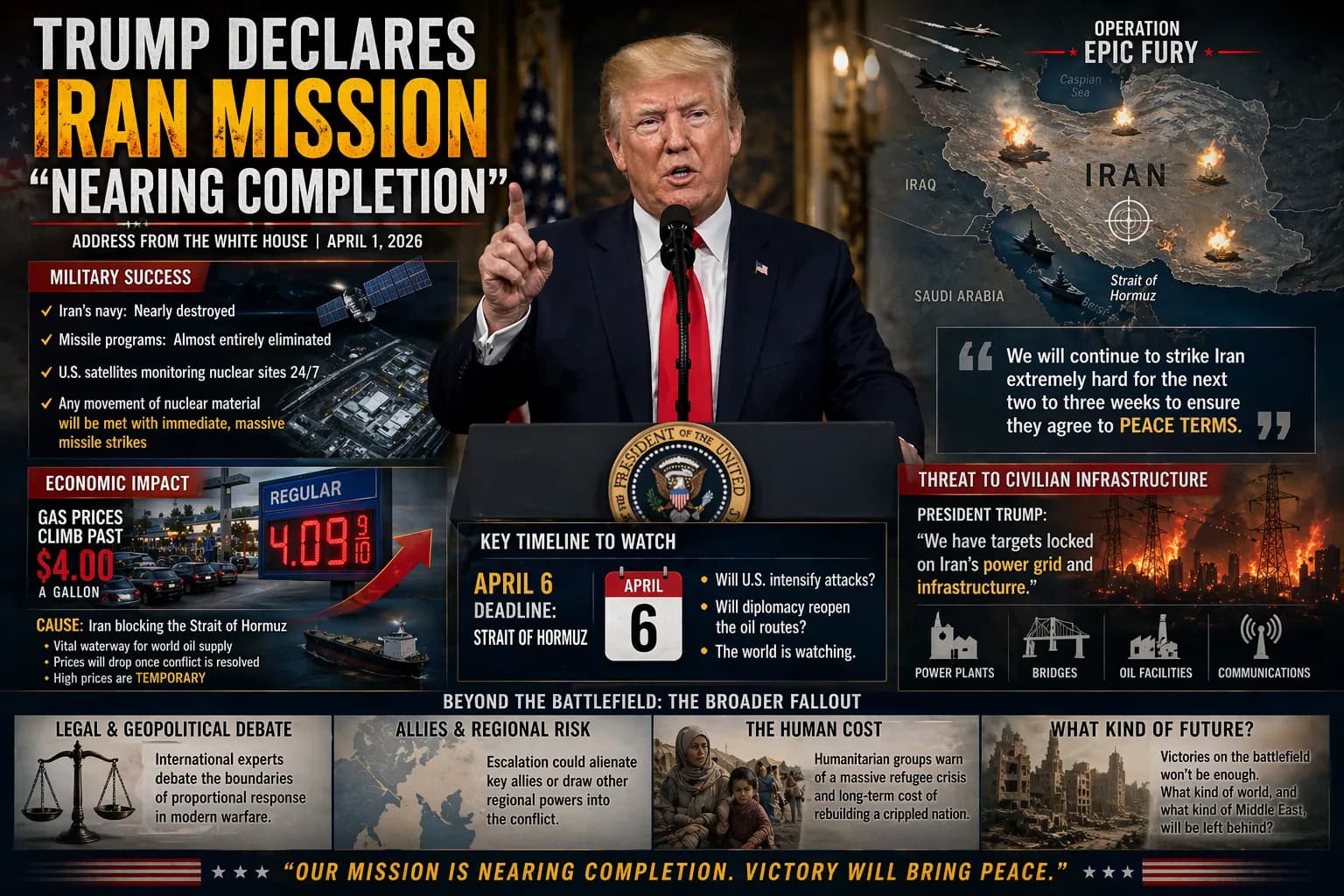
A significant portion of the address was dedicated to the economic impact of the war, specifically the rising cost of gasoline. With prices at the pump climbing past $4.00 a gallon, the President explained that the increase is a direct result of Iran blocking the Strait of Hormuz, a vital waterway for the world’s oil supply. He promised that these high prices are only temporary and will drop once the conflict is resolved. However, he also noted that the U.S. military would continue to strike Iran "extremely hard" for the next two to three weeks to ensure that the Iranian government agrees to peace terms, creating a somewhat confusing timeline for when the war will actually stop.
Looking ahead to tomorrow, the primary topic of conversation will be the April 6 deadline regarding the Strait of Hormuz. Because this waterway is so important for global energy, the world will be watching to see if the U.S. intensifies its attacks or if a diplomatic solution is reached to reopen the oil routes. Experts and citizens alike will likely spend the day debating the President's ‘two-week’ window and looking for signs of a real peace deal. While the President mentioned that secret discussions are happening, the lack of specific details means that tomorrow's news will be filled with questions about the true status of negotiations and how much longer Americans will have to deal with the high costs of the conflict.
Beyond the immediate tactical and economic concerns, the broader geopolitical fallout of the speech is expected to be a dominant theme in the analysis throughout April 2026. By threatening to target Iran’s civilian power grid and infrastructure, the President has sparked an intense debate among international legal experts regarding the boundaries of proportional response in modern warfare. While his supporters view this as a necessary move to force a quick surrender and save American lives, critics worry that such an escalation could alienate key allies or inadvertently draw other regional powers into the fray. Furthermore, the focus will likely shift to the “human element” of the campaign, as the U.S. prepares for its most intense bombing window leading up to the April 6 deadline, humanitarian organizations are sounding the alarm about the potential for a massive refugee crisis and the long-term cost of rebuilding a crippled nation. The headlines in the coming days will not just be about military victory, but about what kind of world, and what kind of Middle East, will be left behind once the smoke finally clears.
EUReflect News
Site Administrator
Follow EUReflect
See more of our reporting on Google
Mark EUReflect as a preferred source and our stories are ranked higher for you in Top Stories, Discover and Google News — and carry a “preferred” badge when they are cited in AI results.
Add EUReflect as a preferred source