When the War Stops Making the News: The Silent Battle of War Journalists
In contemporary warfare, the battle for truth is fought not only on the front line, but also in the information space. At Truth Under Fire: War Journalism and Disinformation, journalists and media professionals reflected on the risks, ethical dilemmas, and political pressures surrounding the coverage of the war in Ukraine.
Truth Under Fire: War Journalism Facing Disinformation
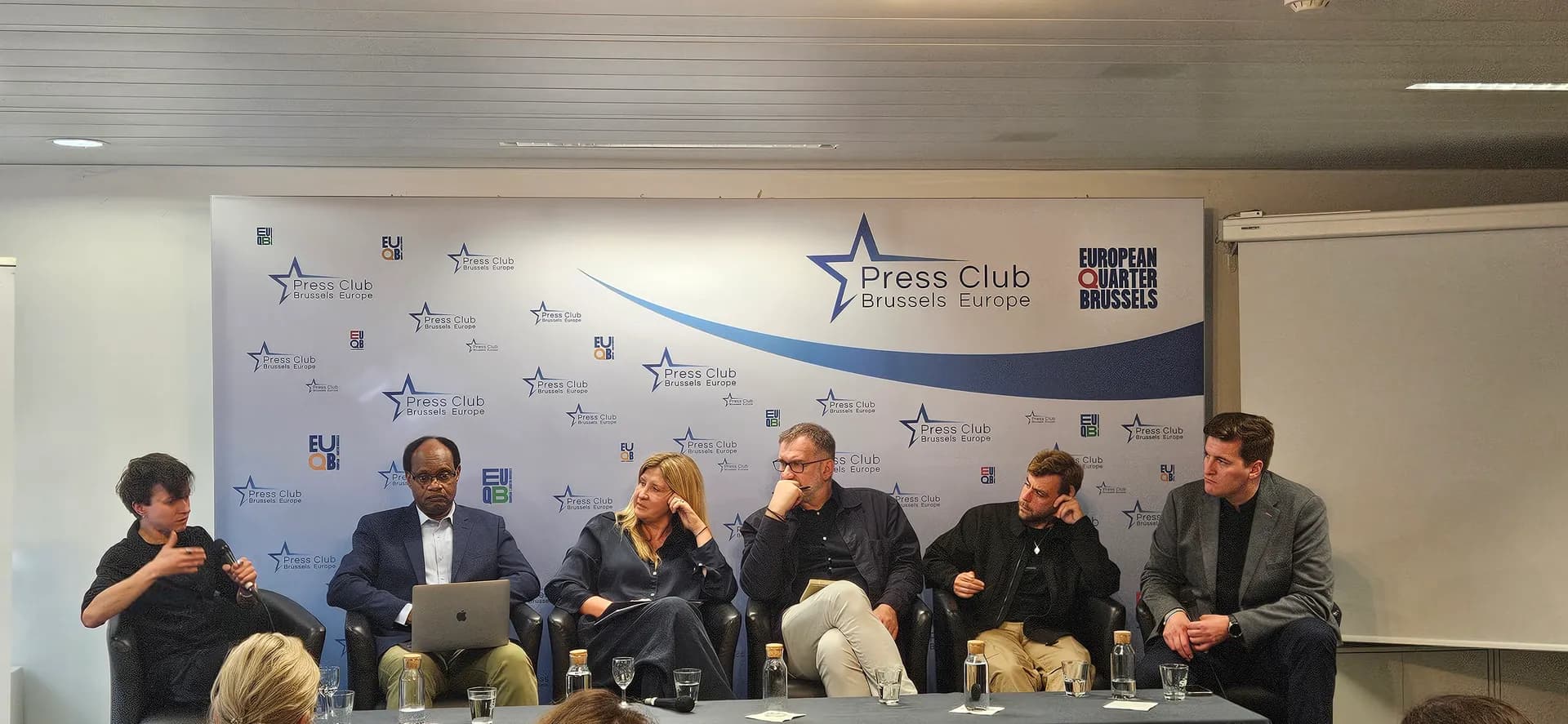
At the Press Club Brussels Europe, the conference Truth Under Fire: War Journalism and Disinformation brought together several journalists and media professionals directly confronted with the realities of the conflict in Ukraine: Arnaud De Decker (photojournalist and international reporter), Agata Grzybowska (photojournalist / RATS Agency), Magdalena Rigamonti (journalist, Onet / Press Club Polska), Ernest Sagaga (journalist, Secretary-General of the ACP Press Clubs Federation), and Jarosław Włodarczyk (journalist, Press Club Polska / Secretary General of the International Association of Press Clubs). The discussion was moderated by Alex Cadier (journalist and television correspondent).
Since the start of the war in Ukraine in 2022, Polish journalists and photographers have been among the largest groups of foreign media present on the ground. Their geographical proximity to Ukraine has allowed them to work closest to the front lines, in destroyed villages and cities, and alongside civilian populations living daily with the consequences of the conflict.
Through their testimonies, the speakers returned to the difficulties, risks, and ethical dilemmas they face in the exercise of their profession. Covering a war is not merely a matter of reporting what is seen. It also requires determining what can be published, what must be verified, and, at times, what should not be disclosed.
Between the Duty to Inform and the Imperative of Security
Arnaud De Decker explains that the work of a war journalist is constantly caught in a tension between the duty to inform and the imperatives of security. His account of the incident at a restaurant (Ria Lounge in Kramatorsk, Ukraine), struck by a Russian missile on 27 June 2023, illustrates the difficulty of deciding how far an information can be published when it may carry a military dimension.
“I knew it, because I was there just minutes before, a lot of soldiers. And until this date, it is not known how many people unofficially died there. So we have the official number of 13 civilians dead, and so many wounded. But we do not know how many soldiers died there. […] if I was the journalist saying, oh, I saw military people dead, of course, it’s not something you want to do as a freelance journalist. So you think one time, two times, three times. […] And then for me, in the particular case, I decided not to disclose whatsoever, and stick to the official line.”
Arnaud therefore knew that any military losses had not been made public. He ultimately chose not to disclose this information and to adhere to the officially released figures.
This decision can be viewed in light of the principles of international humanitarian law. Article 79 of Additional Protocol I to the Geneva Conventions provides that journalists engaged in dangerous professional missions in areas of armed conflict are to be considered civilians and protected as such, provided that they take no action adversely affecting their status as civilians.
However, this provision does not, in itself, create an obligation for the journalist to remain silent about information relating to military losses. Arnaud’s choice is primarily a professional and ethical decision, based on an assessment of the potential consequences of publication.
Revealing the presence of military personnel, their location, or the existence of losses that have not yet been officially communicated can, under certain circumstances, provide the adversary with information that may be exploited for military purposes. The journalist must therefore navigate a fundamental contradiction: the duty is to report the reality of the conflict, yet the work must not, even unintentionally, contribute to putting lives at risk.
When a New Crisis Erases the Previous One from the Media Agenda
Arnaud also highlights another major difficulty of war journalism: the capacity of international news to rapidly shift media attention from one conflict to another.
When a new major event occurs, media organisations may redirect their teams, resources, and coverage towards the new crisis. The previous event, however grave it remains, risks gradually disappearing from the media space.
This is what Arnaud describes in relation to the attack on Hroza, in the Kharkiv region, where 59 civilians were killed. Despite the scale of the tragedy, international media attention quickly shifted to the Middle East after the Hamas attack on Israel on 7 October 2023.
Arnaud recounts:
“59 bodies of civilians over the grass, the playground […] a tiny village of 350 inhabitants. […] I pitched this story again […] and the answer was, oh, thank you, Arnaud, for your proposal, but something else happened today. Hamas attacked Israel. So we will pass for this story, and in general, for the coming weeks. We will not need your reporting at all. […] the next three months after this, I saw all my colleagues from all TV stations, everyone leaving Donbass […] And so it was an ethical choice to stay there.”
His testimony underscores a paradox in the media treatment of conflicts: the reality of war continues on the ground while media attention can shift within a matter of hours.
For the populations still living under bombardment, a change in editorial priorities does not of course mean the end of the war. Yet when television crews and correspondents gradually leave an area, certain realities become mechanically less visible to the international public.
Arnaud’s decision to remain in the Donbas then takes on a particular dimension. It was no longer solely a matter of responding to an editorial request. According to his own account, it was also an ethical choice: to continue documenting a war that risked losing its place on the international media agenda.
From Disinformation to the Invisibilisation of Information
The question of disinformation is therefore not limited to the dissemination of false information. In contemporary conflicts, it must also be analysed through the competition of narratives, the saturation of the media space, and the capacity of events to temporarily erase other crises from public attention.
The war in Ukraine is particularly revealing in this respect. Since 2022, the conflict has become a space of military, political, and also informational confrontation. The states involved seek to impose their own narratives, while journalists strive to verify facts and document what is actually happening on the ground.
In this environment, the presence of the journalist remains essential. Images and testimonies gathered directly on site make it possible to confront official narratives with observable realities.
Yet this mission is becoming increasingly complex. The journalist must contend with propaganda, manipulated information, images taken out of context, and the rapid circulation of digital content. At the same time, consideration must be given to the potential consequences of what is published.
Arnaud De Decker’s testimony thus helps us understand that war journalism today stands at the intersection of several requirements: telling the truth, verifying facts, protecting sources and interlocutors, preserving one’s own security, and measuring the consequences of disseminating information.
It is precisely this tension that gives full meaning to the title of the conference, Truth Under Fire.
When truth is sought at the very heart of war, the journalist is not only confronted with the physical dangers of the field. They must also operate in an environment where information has become an integral component of the balance of power between the actors in the conflict.
In these circumstances, informing is never a neutral act. But it is precisely because information can be instrumentalised that the role of the independent journalist remains essential: to verify, contextualise, bear witness, and preserve a record of events when international attention has already moved elsewhere.
The Battle of Narratives: When Words Become Geopolitical Weapons
In war, words are never merely words. They can designate a responsible party, erase responsibility, highlight a victim, or, conversely, make a conflict more abstract. Speaking of “the war in Ukraine” and speaking of “Russia’s war against Ukraine” do not construct exactly the same narrative. In the first case, the conflict is presented as an event unfolding somewhere; in the second, the formulation explicitly identifies the aggressor and the state that is suffering the aggression.
For journalists on the ground, this lexical choice is therefore far from trivial. It participates directly in what international relations specialists call the battle of narratives: the competition between states, media, and political actors to impose their own interpretation of a conflict.
Narrative Battle and Lexical Choice — Magdalena
Journalist Magdalena Rigamonti returns precisely to this question and explains why her newsroom prefers a formulation that explicitly identifies Russia as the party at the origin of the war:
“We try to use sentence, not war in Ukraine, but Russian war against Ukraine. […] someone from one of diplomatic missions […] called us and said, why don’t you use an expression? […] War against Ukraine, not war in Ukraine. […] In Israel, there is a tradition that when they’ve got some bomb attacks, they name it not by oppressors, but by the victims. That’s opposite to what we do in Europe. So the words […] are also very important for these narratives.”
This remark reveals an essential mechanism of political communication in wartime: naming a conflict is already contributing to giving it meaning.
The vocabulary used by the media may appear purely descriptive, yet it influences the way the public perceives responsibilities. One formulation may place the emphasis on the territory, another on the aggressor, a third on the victims. The choice of words thus participates in the construction of a frame of interpretation — what one might call a framing of the war.
In this context, language itself becomes a terrain of geopolitical confrontation. States do not seek only to act on the military or diplomatic field; they also seek to define the reality in which their actions are interpreted.
This is particularly visible in the war in Ukraine, where Moscow, Kyiv, and their respective supporters seek to impose competing readings of the conflict. Official Russian terminology, notably the expression “special military operation,” perfectly illustrates this logic: the choice of term does not simply describe the event; it participates in the way it is to be understood by the population.
A War of Narratives That Is Also Being Fought in Africa
The narrative battle extends far beyond European borders.
Russia is also seeking to develop its political and informational influence among foreign public opinions, particularly on the African continent. This dimension is especially significant in a context where several European states have seen their influence diminish in certain regions of the Sahel, while Moscow has sought to strengthen its own.
Political and geopolitical narratives circulating in these spaces can then find an echo in Europe, particularly when they are taken up or adapted by Western political actors.
Arnaud De Decker’s testimony illustrates this transnational circulation of narratives. He reports a conversation with foreign prisoners of war and notes the evolution of their origins since 2023.
Arnaud — Non-Russian Prisoners of War
“2023, it was only Russian people, 100 %. And now […] Half of it is from Latin America, from a lot of Africans, a lot of Asians. […] one of the Togo guys said to me, next year, French people are going to vote for the president. If I was French, I would vote for Marine Le Pen because Marine Le Pen is a strong man, a strong woman, just like Putin. […] it’s a global struggle for the narrative. And I think that Western Europe, in this regard, is losing the battle in Africa, at least.”
This testimony gives a particularly concrete dimension to the notion of information warfare. Representations of Russia, the West, and their leaders are not produced in a single political space: they circulate from one continent to another, are transformed, and can be reinvested in very different national contexts.
In the Sahel and more broadly in Africa, Russian influence has notably relied on various political, media, and military relays. The establishment of structures linked to the Wagner Group in several African countries has contributed to this presence, but the informational dimension is equally important: the rejection of colonialism, the denunciation of former Western powers, and the presentation of Russia as an alternative to the West constitute recurring elements of certain pro-Russian narratives.
It would, however, be reductive to view African opinions as mere receptacles of Russian propaganda. African societies have their own historical trajectories, their own political frustrations, and their own strategic interests. Foreign influence works precisely when it meets already existing perceptions and resentments.
This is what makes the narrative battle particularly complex: a power cannot simply “impose” a narrative. It must find a political, historical, or emotional terrain on which that narrative can take root.
Arnaud’s statement — “it’s a global struggle for the narrative” — thus summarises one of the major stakes of contemporary geopolitics: power is no longer measured solely by the capacity to constrain, but also by the capacity to persuade, to seduce, and to influence.
When the State Controls the Words, It Also Controls the Framework of Debate
The narrative battle takes on an even more radical dimension when governments reduce the space available for independent media.
Controlling information does not only mean preventing certain information from circulating. It can also consist in controlling the words with which events may be described.
When a government prohibits certain terms, imposes official terminology, or reduces journalists’ capacity to contest the dominant discourse, it no longer merely controls what the population can know. It also contributes to determining how the population must interpret what it knows.
The Russian example is particularly revealing. Since the start of the full-scale invasion of Ukraine, the Russian authorities have officially used the expression “special military operation” to designate the conflict. This terminology forms part of a political framing strategy: the term “war” is avoided in official communication, even though the conflict constitutes, in fact, a large-scale international war. Russia has committed the most serious violation of international law, namely that of Article 2, paragraph 4 of the United Nations Charter, which prohibits the threat or use of force against the territorial integrity of a state.
In short, vocabulary is an instrument of power.
Shrinking Media Space and Control of the Narrative — Ernest
Ernest Sagaga describes this progressive contraction of the media space and the consequences it can have on societies’ capacity to produce alternative narratives:
“governments will always try to protect uncontrolled narratives. […] the space is shrinking, the media space is shrinking […] If there is nothing somewhere, there will be someone trying to fill it. […] when the war in Ukraine started, there was this law saying, you can’t talk about war. You have to say […] special military operation. […] I think we lose the argument when they force upon us a kind of narrative, and prevent us from challenging the narrative they want to impose on us.”
The phrase “If there is nothing somewhere, there will be someone trying to fill it” summarises a fundamental principle of information warfare: where independent information disappears, another narrative ends up occupying the space.
This phenomenon is particularly concerning in wartime contexts, because control of the narrative can become an instrument of domestic mobilisation. By imposing certain terms and marginalising competing narratives, a political power can contribute to constructing a collective perception of the conflict that legitimises its action and reduces the capacity for contestation.
War then becomes not only a military confrontation, but also a confrontation between several narrative realities.
The control of information is therefore not a secondary issue. It directly affects a society’s capacity to debate, to verify the claims of power, and to develop a contradictory understanding of events.
When the War Ceases to Interest: The Danger of Media Fatigue
But the battle for information is not fought solely against propaganda or censorship. It is also fought against a far more difficult adversary: public fatigue.
When a conflict lasts for several years, its exceptional character tends gradually to disappear from the media space. Audiences shift, newsrooms redirect their resources, and new international crises compete for public attention.
The journalist can then find themselves confronted with a paradoxical situation: the war continues, but interest in the war diminishes.
The testimony given during the conference directly illustrates this difficulty. Reports from Ukraine become harder to sell, not necessarily because the events have lost their importance, but because newsrooms consider that their audience is now less interested.
This situation raises an essential question for journalism: does the role of the media consist solely in covering what the public wants to watch, or also what it is necessary for the public to continue seeing?
For war journalists, the answer is clear: media attention should not alone determine the importance of an event.
A Realistic Final Note — Agata
Agata Grzybowska formulates this difficulty with great simplicity:
“I didn’t sell the story from the Ukraine, my last story from the Ukraine from the last year because I always heard this sentence. I’m sorry, the audience is not interested anymore about Ukraine. […] But what I believe, I believe that we have to do our work like ongoing, nonstop, nonstop, nonstop because maybe somewhere will be a little bit light that people just want to see and listen to the story.”
This statement is perhaps one of the strongest conclusions of the conference.
For media warfare has its own paradox: the longer a conflict lasts, the more difficult it becomes to maintain attention on it — even as its human and geopolitical consequences may continue to worsen.
The progressive disappearance of a war from the screens therefore never means its disappearance from the ground.
For the journalist, remaining, continuing to investigate, and continuing to tell the story then becomes a form of responsibility. It is no longer merely a matter of responding to media urgency, but of preserving an immediate memory of the conflict and of keeping open the possibility for the public to understand what is happening when the dominant news cycle has already turned the page.
The Real Battlefield: What Societies Believe They Know
The various testimonies heard at Truth Under Fire ultimately sketch the same reality: contemporary war is also won in minds.
The choice of a word, the control of a medium, the dissemination of a narrative, the circulation of an image, or the disappearance of a subject from the media agenda can alter the perception of a conflict as surely as a diplomatic or military operation can alter a balance of power.
In this battle, the journalist occupies a singular position. They must resist the pressure of official narratives without becoming an instrument of propaganda themselves; maintain public attention without yielding to spectacularisation; inform rapidly without sacrificing verification; and, above all, continue to document a reality when that reality ceases to be media-profitable.
The war of narratives is therefore not a secondary war. It participates directly in the way societies understand the world, designate their enemies, choose their alliances, and interpret power relations.
And it is perhaps here that one of the most important stakes of contemporary journalism lies: when weapons impose their reality on the ground, words still determine the way that reality will be understood by those who do not live it.
Related Topics
Follow EUReflect
See more of our reporting on Google
Mark EUReflect as a preferred source and our stories are ranked higher for you in Top Stories, Discover and Google News — and carry a “preferred” badge when they are cited in AI results.
Add EUReflect as a preferred source