UAE-Kazakhstan Strategic Partnership Why Kazakhstan Matters to the UAE in 2026
The UAE–Kazakhstan partnership is rapidly evolving into a strategic alliance focused on logistics, energy, AI, and regional connectivity. Backed by multi-billion-dollar investments, both countries aim to strengthen trade corridors, clean energy cooperation, and Eurasian economic integration.
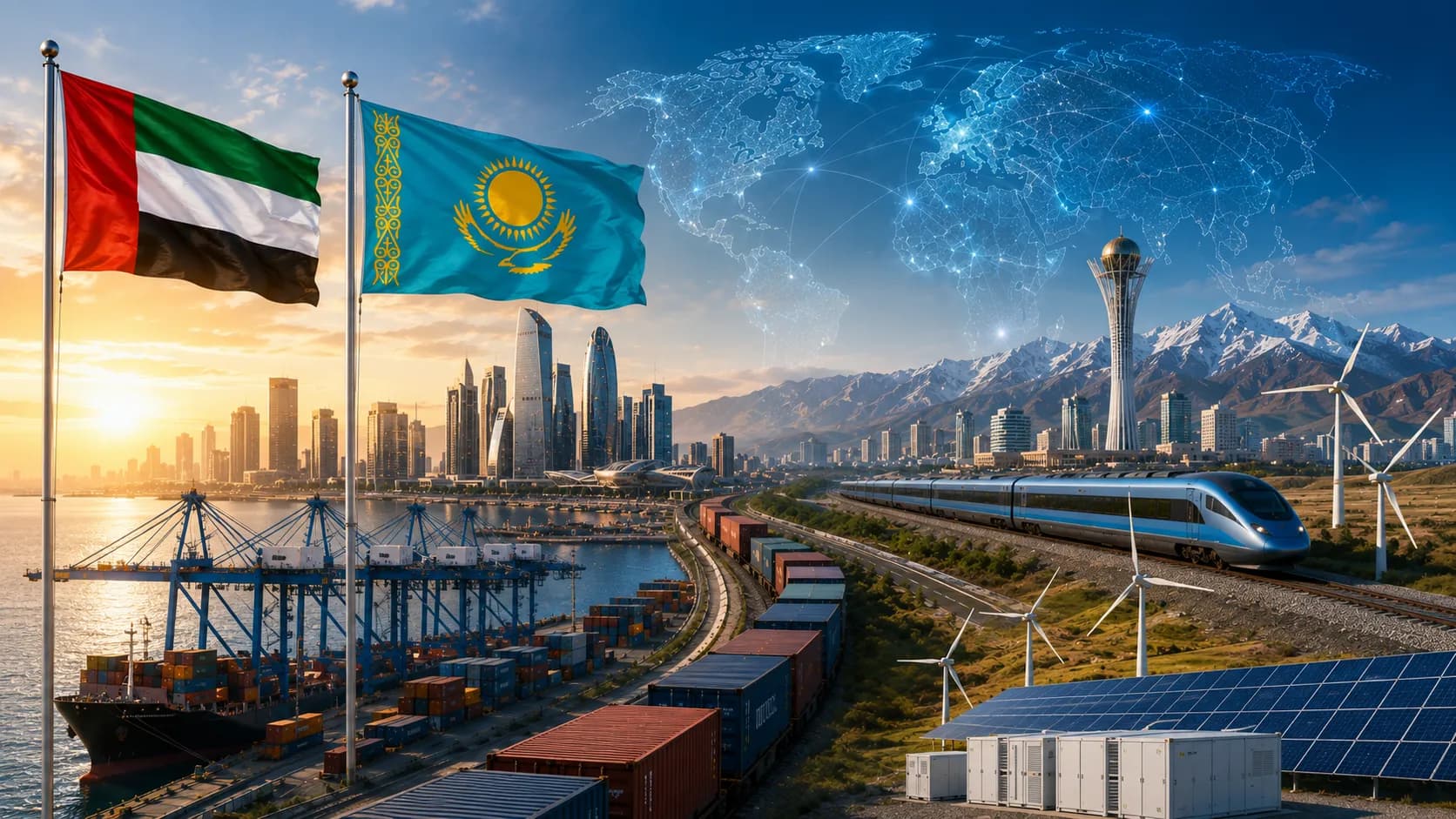
As global trade routes and investment priorities continue to shift, the partnership between the United Arab Emirates and Kazakhstan is becoming one of the UAE’s most strategically valuable relationships in Central Asia.
What makes this relationship important is not only the scale of investments, but the convergence of long-term interests in logistics, energy, technology, and regional connectivity. For the UAE, Kazakhstan increasingly represents a gateway into Eurasia at a time of growing geopolitical and economic realignment.
Since establishing diplomatic relations in 1992, ties between the two countries have steadily expanded beyond traditional diplomacy into a broader strategic partnership. High-level visits over the past two decades helped create the political foundation for deeper economic cooperation.
A major turning point came during the visit of Abu Dhabi Crown Prince Sheikh Khaled bin Mohamed bin Zayed Al Nahyan to Astana in May 2025. The visit resulted in more than 20 agreements worth over $5 billion across renewable energy, infrastructure, healthcare, finance, and digital transformation.
From an Emirati perspective, Kazakhstan offers several strategic advantages simultaneously: political stability, abundant natural resources, access to Central Asian markets, and an increasingly important position along emerging Eurasian transport corridors.
This is particularly important as the UAE seeks to strengthen its role as a global logistics and trade hub linking Asia, the Middle East, and Europe.
One of the most significant dimensions of the partnership is connectivity. Kazakhstan plays a central role in the Middle Corridor, also known as the Trans-Caspian International Transport Route, which is gaining importance as an alternative trade route between Asia and Europe.
Cooperation involving Abu Dhabi Ports Group and transport infrastructure projects allows the UAE to expand its commercial presence along a rapidly developing corridor stretching from China through Central Asia and the Caucasus toward European markets.
Energy cooperation has also become a defining pillar of bilateral relations. UAE-based Masdar is leading major renewable energy projects in Kazakhstan, including a landmark 1 GW wind farm in the Zhambyl Region supported by advanced battery energy storage systems.
For the UAE, these projects go beyond commercial returns. They reinforce Abu Dhabi’s broader ambition to position itself as a global leader in clean energy investment and energy transition diplomacy.
Artificial intelligence and digital infrastructure represent another fast-growing area of cooperation. UAE-linked companies such as Presight and AIQ are participating in smart city projects, supercomputing initiatives, data centers, and digital solutions for Kazakhstan’s energy sector.
This reflects a broader Emirati strategy: exporting technological expertise while building long-term influence in emerging markets.
Kazakhstan, meanwhile, benefits from investment inflows, technology transfer, infrastructure modernization, and stronger integration into international trade networks.
Financial cooperation is also expanding through growing ties between Abu Dhabi Global Market and the Astana International Financial Centre, strengthening cross-border investment and financial connectivity.
In my view, Kazakhstan is becoming one of the UAE’s most strategically compatible partners in Central Asia because it combines economic ambition with geopolitical balance. Unlike many regional markets, Kazakhstan maintains diversified international partnerships while continuing domestic modernization efforts.
The relationship also gained additional political significance in 2026 amid regional tensions affecting Gulf security. Kazakhstan’s diplomatic support for the UAE highlighted the growing level of political trust between both leaderships.
Challenges remain. Logistics bottlenecks in the Caspian region, implementation delays, and wider geopolitical uncertainties could slow parts of the cooperation agenda. Yet the overall trajectory remains strongly positive.
As Eurasia becomes increasingly important to global trade and energy flows, the UAE appears to view Kazakhstan not simply as an investment destination, but as a long-term strategic partner in shaping the region’s future economic geography.
Writer and researcher specializing in Central Asian and Azerbaijani affairs
Sources and References
Akorda – Official Website of the President of Kazakhstan
The Astana Times – Kazakhstan and UAE Sign Over $5 Billion in Agreements
The Astana Times – Crown Prince Visit and Strategic Projects
WAM – Kazakhstan Reaffirms Solidarity with the UAE
The Astana Times – AIFC Connect and UAE-Kazakhstan Financial Integration
Trading Economics – UAE Exports to Kazakhstan
Masdar – 1 GW Wind Farm Project in Kazakhstan
Presight AI – Smart City and Supercomputer Projects in Astana
Abdul Hamid Hamid Al-Kba
Contributing writer at EUReflect.
Follow EUReflect
See more of our reporting on Google
Mark EUReflect as a preferred source and our stories are ranked higher for you in Top Stories, Discover and Google News — and carry a “preferred” badge when they are cited in AI results.
Add EUReflect as a preferred source