Ukraine Between Hammer and Anvil: Trump’s 28-Point Controversial Peace Plan
The Trump-led 28-point peace plan pressures Ukraine to accept military limits and territorial concessions while Russia continues advancing and refuses to retreat without gains. Europe feels increasingly isolated but backs Ukraine’s sovereignty. Negotiations remain tense, and the article warns that an unbalanced deal could lock in long-term instability and permanently reshape global geopolitics.
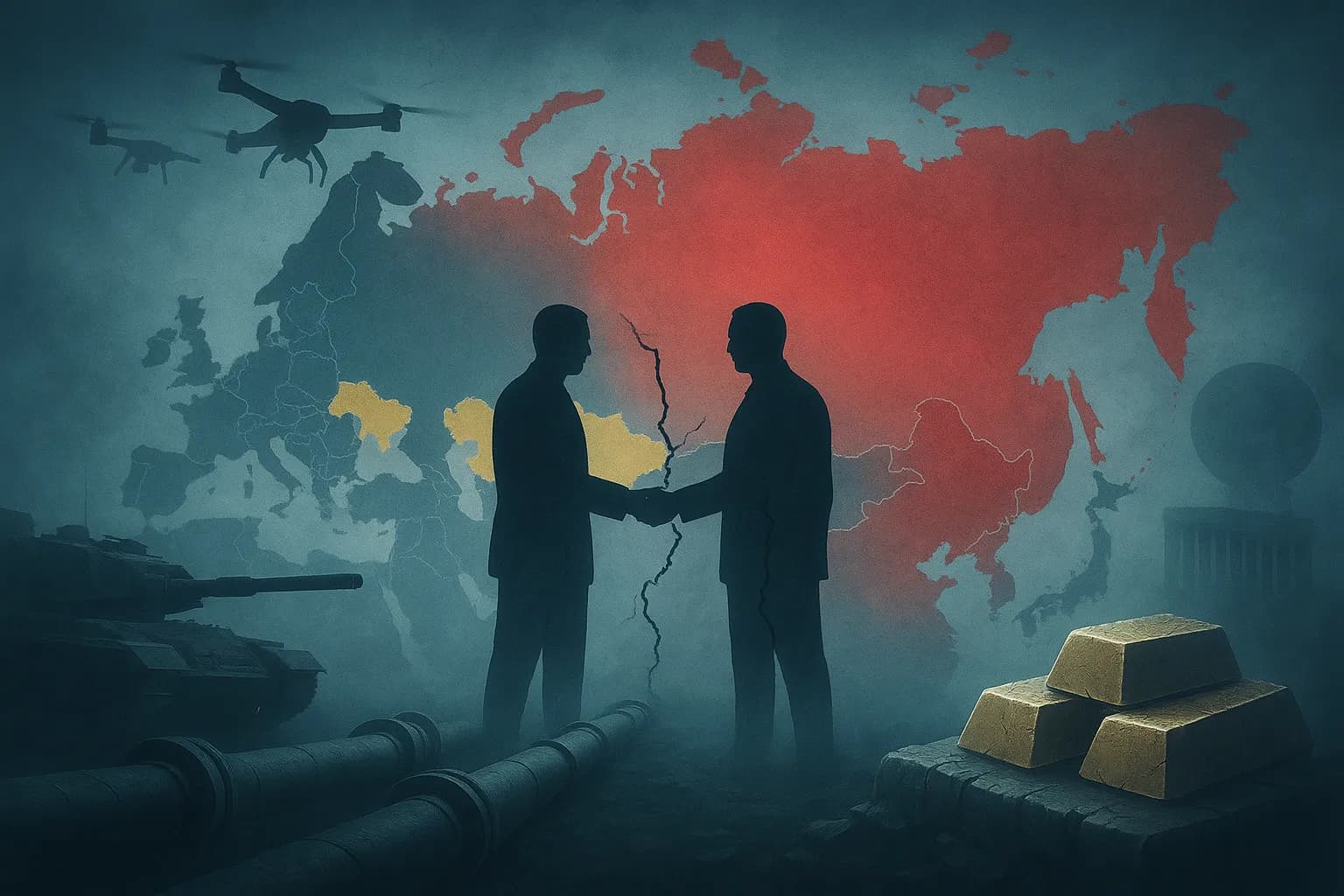
In this critical phase of the Ukraine-Russia War, regardless of the negotiations’ outcome, it is evident that things will never return to how they were in Ukraine, Russia, and on a global scale. Russia appears unlikely to withdraw without tangible gains from this conflict. Moscow’s strategic calculations are built on expanding territory and spheres of influence. Europe, meanwhile, is confronting the harsh reality of being left to its own devices amid the United States’ increasingly independent stance. This realization hits the continent like a splash of ice-cold water. The international arena has not been this uncertain and unpredictable for a long time. As power balances shift, old alliances tremble and new geopolitical fault lines emerge. These uncertainties herald permanent changes that will affect not just the parties involved but the entire world.
In the shadowed corridors of global diplomacy, amid the echoes of artillery fire still resounding from eastern Ukraine, a new chapter unfolds in the protracted story of the Russia-Ukraine War. As the dawn of December 2025 breaks, the world watches the whirlwind of negotiations aimed at brokering peace between Kyiv and Moscow, led by a U.S. administration under President Donald Trump. European leaders, in response to the emergence of the controversial 28-point peace plan, are rallying around Ukrainian President Volodymyr Zelenskiy to assert their influence. This moment, filled with tension, encompasses not only immediate issues like territorial integrity and sovereignty but also the broader historical trajectory of a conflict that has reshaped the post-Cold War order.
The plan, leaked during the intense pace of bilateral talks, ignited intercontinental debates. Its provisions, limiting the Ukrainian army, blocking NATO membership, and demanding territorial concessions, evoke past agreements in European history such as those from the 1938 Munich Agreement to the 2014-2015 Minsk Accords. Yet, with revisions emerging from weekend discussions in Florida and Paris, optimism and skepticism flicker side by side. This article evaluates the ongoing negotiations, intertwining recent developments with historical examples and offering a perspective on the strategies of key actors. It argues that the negotiations must balance short-term practical approaches with long-term security guarantees. Otherwise, the cycle of instability that has affected Eastern Europe for decades may persist. This cycle, reinforced by Russia’s consolidation of gains, could further deepen Europe’s isolation.
Historical Foundations: From Annexation to War of Attrition
To understand the context of these negotiations, it is useful to revisit the war’s origins. Although the conflict intensified with Russia’s full-scale invasion in February 2022, its roots extend back to 2014, when Moscow annexed Crimea and supported separatist movements in the Donbas region. These developments reflect the parties’ differing historical interpretations. Russia evaluates Ukraine’s independence in a specific context while viewing NATO’s expansion as a security concern. Ukraine and its Western allies, by contrast, characterize these actions as violations of sovereignty. The Minsk Agreements, mediated by Germany and France under the Normandy Format, aimed to manage the Donbas conflict through ceasefires and political arrangements. Progress, however, was limited due to differences in implementation among the parties, highlighting the challenge of building trust in negotiations. This difficulty persists today between Russia’s insistence on preserving gains and Europe’s efforts to balance security concerns.
The escalation in 2022 transformed the war into a prolonged struggle. Ukraine’s defense was bolstered by international support, while Russia mobilized its own resources. Early peace efforts, such as the March 2022 Istanbul talks, ended inconclusively due to divergences in positions. Russia proposed neutrality and territorial adjustments, while Ukraine sought security assurances. Subsequent initiatives, like Zelenskiy’s 10-point formula emphasizing territorial integrity and accountability, clashed with Moscow’s operational objectives. By mid-2025, battlefield dynamics had shifted. Russian forces, according to the Institute for the Study of War, secured 701 square kilometers in November alone, one of the significant advances in a year. This situation, combined with Ukraine’s internal dynamics such as corruption debates, has added new momentum to the negotiations. It influences both sides’ strategic calculations: Russia’s determination not to leave empty-handed and Europe’s necessity to forge its own path amid the U.S.’s changing stance.
The U.S. approach reflects its diplomatic style from previous periods: direct and transaction-oriented. Historical parallels remind us of the importance of cautious progress. The 1995 Dayton Accords ended the Bosnian War but left long-term challenges. Similarly, arrangements in the Ukraine context should be designed by drawing lessons from past experiences, considering both Russia’s security concerns and Ukraine’s sovereignty demands. Otherwise, the uncertainty in the international arena could intensify further.
Current Diplomatic Storm: Talks, Leaks, and Revisions
Diplomatic activities have accelerated in recent weeks. On November 30, 2025, U.S. and Ukrainian delegations met in Florida, led by Secretary of State Marco Rubio and Ukraine’s Rustem Umerov. Rubio described the talks as productive and noted progress in revising the 28-point plan. The original draft, shaped by U.S.-Russian discussions, included various conditions. Ukraine would open certain territories to negotiation, limit its army, and reconsider NATO goals. Sanctions on Russia would be addressed in stages, with frozen assets used for specific purposes. These elements reflect the parties’ economic interests, but Russia’s tendency to preserve gains deepens Europe’s sense of isolation. Russia’s muted response suggests they believe time is on their side. The Kremlin, stating it is monitoring details, shows an openness to negotiations.
Zelenskiy addressed the nation, discussing options. After Florida, he used positive expressions about the revised plan but noted some issues remain unresolved. On December 1 in Paris, meeting with Emmanuel Macron, Zelenskiy emphasized sovereignty and security guarantees. The pair held a conference call with European leaders, demonstrating the continent’s involvement in the process. This involvement makes Europe’s reality of standing alone amid the U.S.’s independent stances even more evident. Zelenskiy stated that the territorial issue is the most difficult and emphasized that Russia must not be rewarded for the war. Macron supported this by saying only Ukraine decides. EU foreign policy chief Kaja Kallas expressed fear that pressure is being directed at the victim Ukraine and that the week could be a turning point. German leader Merz stated there would be no dictated peace, emphasizing that Europe must decide together with Ukraine.
Meanwhile, Steve Witkoff, accompanied by Jared Kushner, is heading to Moscow. The Kremlin stated it is monitoring the plan details, noted infrastructure attacks, and reported on-field developments. Russia’s response reflects openness to negotiations. In Putin’s Security Council speech, he emphasized that the plan came from the U.S., that they are showing flexibility, have support from the Global South, and cited the Kupyansk example to underline inevitable advances. This reflects the plan’s revised form after Alaska. Zelenskiy’s “difficult choice” quote intensifies the pressure in this context. Trump’s accusation of ingratitude toward Zelenskiy also casts a shadow over Witkoff’s meeting with Putin.
On the ground, events continue. The Dnipro attack and Black Sea targeting show the fragility of talks, as in similar conflicts. This heightens the war’s lasting effects and international uncertainty.
Evaluating the Plan and Broader Implications
The 28-point plan can be examined as a mix of realism and long-term elements. Its strengths include potential ceasefire and reconstruction. EU membership could offer economic opportunities. This could support the parties’ development goals but also impact global economic balances through sanctions and assets. The plan’s detailed breakdown includes elements like capping the army at 600,000 troops, frozen regions, banning NATO troops in peacetime, and holding general elections in Ukraine within 100 days. This alters strategic balances. Ukraine, despite its right and wrong decisions, may have to replace its only leader who has not abandoned them after a long time in the face of Russian power and Putin’s stance.
Historically, similar provisions can affect long-term stability, as seen in past agreements. Approaches in previous negotiations by both Russia and the West could alter border and security perceptions, influencing East-West bloc dynamics. The plan’s four offensive points—surrender of Donbas fortress towns, army limit and NATO troop ban, allocation of frozen assets to U.S.-Russian ventures with the U.S. taking half the profits, and general amnesty—highlight these imbalances.
Approaches such as deadlines and positions affect negotiation dynamics. Europe’s asset management and Russia’s advances indicate the need for a balanced framework. Both sides’ strategic calculations play a role here, while locally managing Ukraine and Russia’s internal dynamics: reforms and resources shape the process, highlighting societal challenges for both countries.
Strategically, the parties pursue different priorities. Russia aims to consolidate gains, Ukraine to preserve resilience, Europe to strengthen deterrence, and the U.S. to emphasize quick resolution. This diversity increases the complexity of negotiations.
Historically, imbalances can strain agreements. Examples like Versailles highlight the importance of balanced approaches. For Ukraine, a plan incorporating principles could be beneficial, taking into account both Russia’s and the West’s perspectives. The negotiations’ outcome could create global effects. Economically, sanctions and assets influence reconstruction. This reflects the parties’ financial strategies.
Looking ahead, scenarios vary. Phased agreement or ongoing discussions can be shaped by historical lessons, drawing from both Russia and the West’s past experiences. This could further reinforce the uncertainty in the international arena.
Conclusion: Toward a Fair Balance- Or Any Balance at All?
The outcome of these negotiations shows that things will not return to how they were in Ukraine, Russia, and the world. Russia will not depart without gains from the conflict. Moscow’s calculations do not allow relinquishing what has been acquired. This will make the war’s legacy permanent. Europe is facing the reality of isolation amid the U.S.’s pragmatic attitudes. This pushes the continent to review its own defense strategies. The international arena shakes with power shifts, weakening old alliances, birthing new formations, and heightening instability risks. These changes extend from energy markets to migration flows and arms races. They affect not just the parties but the entire globe.
In this crucible of negotiation, the Ukraine-Russia talks embody the eternal tension between power and principle. Trump’s push, however disruptive, injects momentum into a stalled conflict. Yet, as Bronwen Maddox from Chatham House insists, Europe must seize this last chance by releasing assets and committing to defense to strengthen Ukraine. Failure risks a fragile peace and perpetuates cycles of aggression.
The international community finds itself caught between war and peace, and the Russia-Ukraine War has become one of the most decisive battlegrounds for that choice.
Bibliography
Harmash, Olena, and Dominique Vidalon. "Europeans Rally Round Ukraine as Trump Envoy Heads to Moscow." Reuters, December 1, 2025. https://www.reuters.com/world/europe/zelenskiy-says-tough-issues-still-need-be-resolved-after-florida-talks-2025-12-01.
Harding, Emily. "What Is the Strategy in the Ukraine-Russia Peace Negotiations?" Center for Strategic and International Studies (CSIS), November 24, 2025. https://www.csis.org/analysis/what-strategy-ukraine-russia-peace-negotiations.
Maddox, Bronwen. "Trump’s 28 Point ‘Peace Plan’ Marks Europe’s Last Chance to Stand Up for Ukraine." Chatham House, November 24, 2025. https://www.chathamhouse.org/2025/11/trumps-28-point-peace-plan-marks-europes-last-chance-stand-ukraine.
Dom, Evelyn Ann-Marie. "Rubio: ABD-Ukrayna Görüşmeleri Verimliydi Ama Anlaşma İçin Daha Fazla Çaba Gerekiyor." Euronews, December 1, 2025. https://tr.euronews.com/2025/12/01/rubio-abd-ukrayna-gorusmeleri-verimliydi-ama-anlasma-icin-daha-fazla-caba-gerekiyor.
Baunov, Alexander. "Could Russia Agree to the Latest Ukraine Peace Plan?" Carnegie Endowment for International Peace, November 25, 2025. https://carnegieendowment.org/russia-eurasia/politika/2025/11/russia-ukraine-new-peace-plan?lang=en.
Fix, Liana. "Is Trump’s Ukraine Peace Deal a Faustian Bargain?" Council on Foreign Relations (CFR), November 21, 2025. https://www.cfr.org/expert-brief/trumps-ukraine-peace-deal-faustian-bargain.
Corbet, Sylvie. "Zelenskyy Says US Peace Plan 'Looks Better' with Revisions But Work Continues." Associated Press, December 2, 2025. https://apnews.com/article/zelenskyy-paris-macron-russia-ukraine-war-704d68a36c36495f6dada056b729fac3.
d’Istria, Thomas, Claire Gatinois, and Piotr Smolar. "Uncertainties Surrounding Peace Plan Put Ukraine in a Complicated Spot." Le Monde, December 1, 2025. https://www.lemonde.fr/en/international/article/2025/12/01/uncertainties-surrounding-peace-plan-put-ukraine-in-a-complicated-spot_6748010_4.html.
Gozzi, Laura. "Zelensky Says Ukraine Territory 'Most Difficult' Issue, as US Envoy Prepares to Meet Putin." BBC News, December 1, 2025. https://www.bbc.com/news/articles/c1m8nmx75evo.
Rankin, Jennifer, and Pjotr Sauer. "US-Russia Talks May Pile Pressure on Kyiv to Make Concessions, Says EU Foreign Policy Chief." The Guardian, December 1, 2025. https://www.theguardian.com/world/2025/dec/01/diplomacy-talks-negotiations-end-ukraine-war-russia-eu-kaja-kallas.
Zeynep Güney
Contributing writer at EUReflect.
Follow EUReflect
See more of our reporting on Google
Mark EUReflect as a preferred source and our stories are ranked higher for you in Top Stories, Discover and Google News — and carry a “preferred” badge when they are cited in AI results.
Add EUReflect as a preferred source