When Great Powers Fail: Uzbekistan’s Case for Regional Coalitions
Guided by Mirziyoyev’s long-term vision, Uzbekistan is pursuing a proactive foreign policy rather than reacting to global uncertainty. Strategic partnerships with Turkey and Pakistan reflect a quiet but effective effort to diversify security and build independent power.
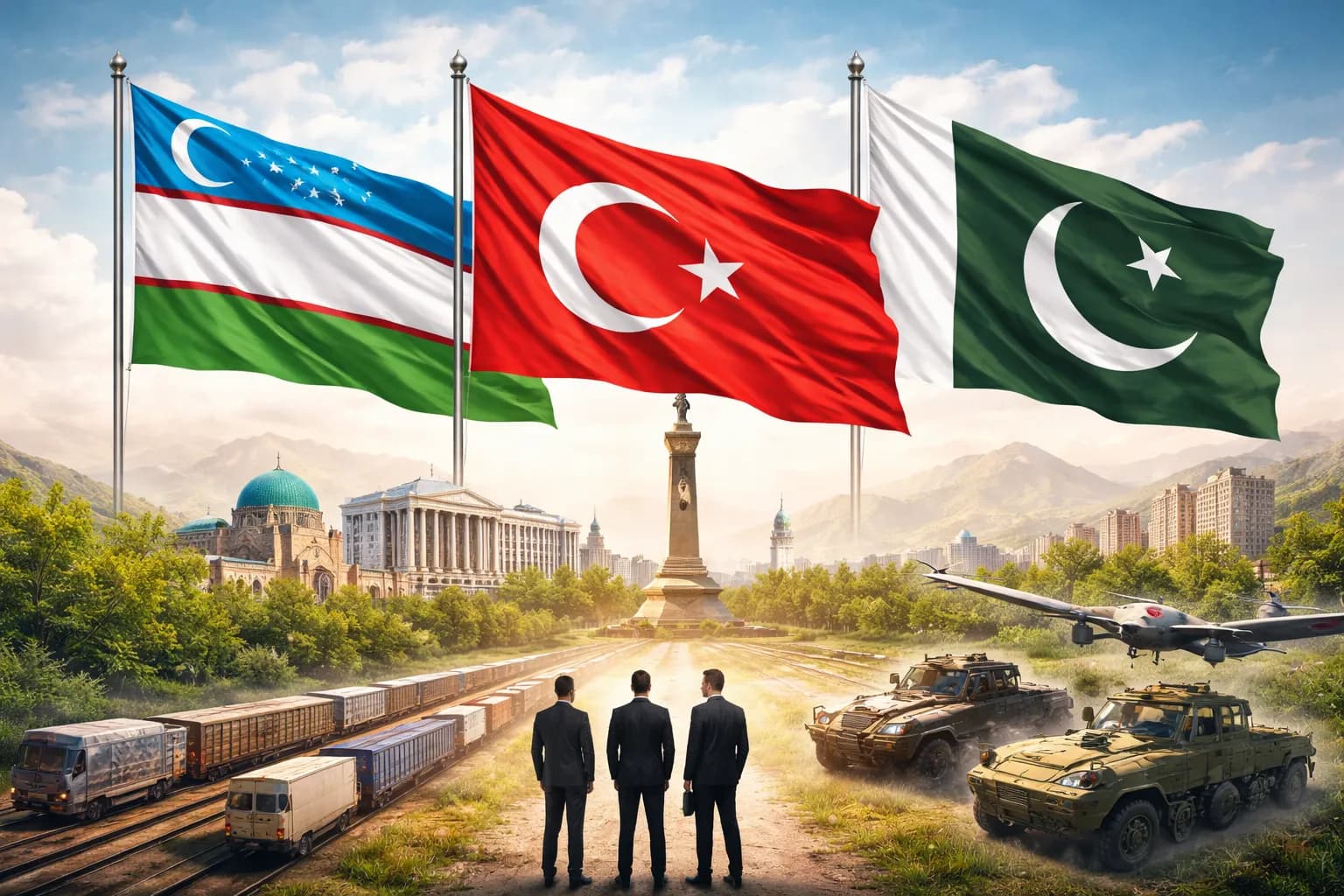
What Uzbekistan is doing today in foreign policy stands out precisely because the world has entered a phase where hesitation is more dangerous than decision. Russia’s invasion of Ukraine shattered the assumption that borders and sovereignty in Eurasia are protected by rules. Donald Trump’s return, with his transactional “every country for itself” worldview, has further weakened trust in global guarantees. For middle powers, the conclusion is simple: either you build your own pillars of security in advance, or you become the object of other people’s deals.
Seen through this lens, Uzbekistan’s strategy is not a reaction to current shocks but the result of long-term planning. PresidentShavkat Mirziyoyev began laying the foundations back in 2017, when he initiated Consultative Meetings of Central Asian leaders. At the time, this looked like cautious regional diplomacy. In hindsight, it was institutional preparation for a world in which major powers would no longer provide stability but generate risk. The invitation of Azerbaijan in 2025 confirmed this shift, signaling Central Asia’s readiness to move beyond post-Soviet inertia and engage partners based on shared interests rather than inherited dependencies.
An equally important, often overlooked element of Mirziyoyev’s thinking is his concept ofCentral and South Asia as a single, interconnected strategic space. For years, this idea was framed mainly in economic terms—transport corridors, trade routes, access to the Indian Ocean. Today, it is clear that the concept was always broader. Security in Central Asia is impossible without stability to the south, just as South Asia cannot be insulated from turbulence north of Afghanistan. This intellectual groundwork explains why Uzbekistan’s southern vector has never been secondary.
Why act now? Because the window of uncertainty is fully open. Russia is strategically weakened and increasingly sensitive even to neutral moves by its neighbors. Afghanistan remains unstable and more ideologically assertive. The West is absorbed by its own internal crises. In such conditions, delay would mean vulnerability. Tashkent chose another path: calm, systematic action without noise, ultimatums, or theatrical gestures.
Why Turkey and Pakistan? Because they are not symbolic partners but real middle powers with tangible capabilities.Turkeyis a major regional actor with a large economy, a developed defense industry, combat experience, and an independent foreign policy. It has proven its ability to defend its interests without deference to either Moscow or Washington. For Uzbekistan, Turkey strengthens the Turkic vector and provides access to an alternative center of power on Eurasia’s southern flank.
Pakistan is an even more telling choice. It is the only Muslim-majority nuclear power, with a large standing army and decades of experience in managing hard security threats. Pakistan has a direct stake in containing instability emanating from Afghanistan and possesses tools that few regional actors can match. The military-technical agreements signed with Islamabad are not about militarization; they are a strategic signal. Uzbekistan’s security is no longer tied to a single external provider, and the southern direction is no longer a gray zone.
Equally important is how Tashkent is doing this. There is no anti-Russian rhetoric, no public confrontation, no diplomatic spectacle. Moscow receives not a challenge in words but a reality in facts: Uzbekistan can diversify its partnerships and secure its interests independently. Afghanistan receives no threats, only a clear understanding of boundaries. Everything is handled in a technocratic, businesslike manner.
This is where Mirziyoyev’s leadership deserves particular credit. He does not turn foreign policy into a show, nor does he react impulsively to pressure. Instead, he builds systems. Regional dialogue formats, the Central–South Asia connectivity concept, partnerships with Turkey and Pakistan—these are not isolated moves but parts of a single, coherent strategy.
That is why today’s visits and agreements do not look like a sudden pivot. They look like the natural next step in a long journey. In a world where noise often substitutes for strategy, Uzbekistan has chosen something rarer and more effective: quiet power, strategic patience, and action taken before the storm fully breaks.
Nurmamatov Nurmuhammad, Tashkent State University of Law (TSUL)
Nurmuhammad Nurmamatov
Contributing writer at EUReflect.
Follow EUReflect
See more of our reporting on Google
Mark EUReflect as a preferred source and our stories are ranked higher for you in Top Stories, Discover and Google News — and carry a “preferred” badge when they are cited in AI results.
Add EUReflect as a preferred source