Air Defense Becomes the New Strategic Race
The U.S. is spending over $3 billion to triple Patriot and quadruple THAAD production after Middle East operations depleted stocks.
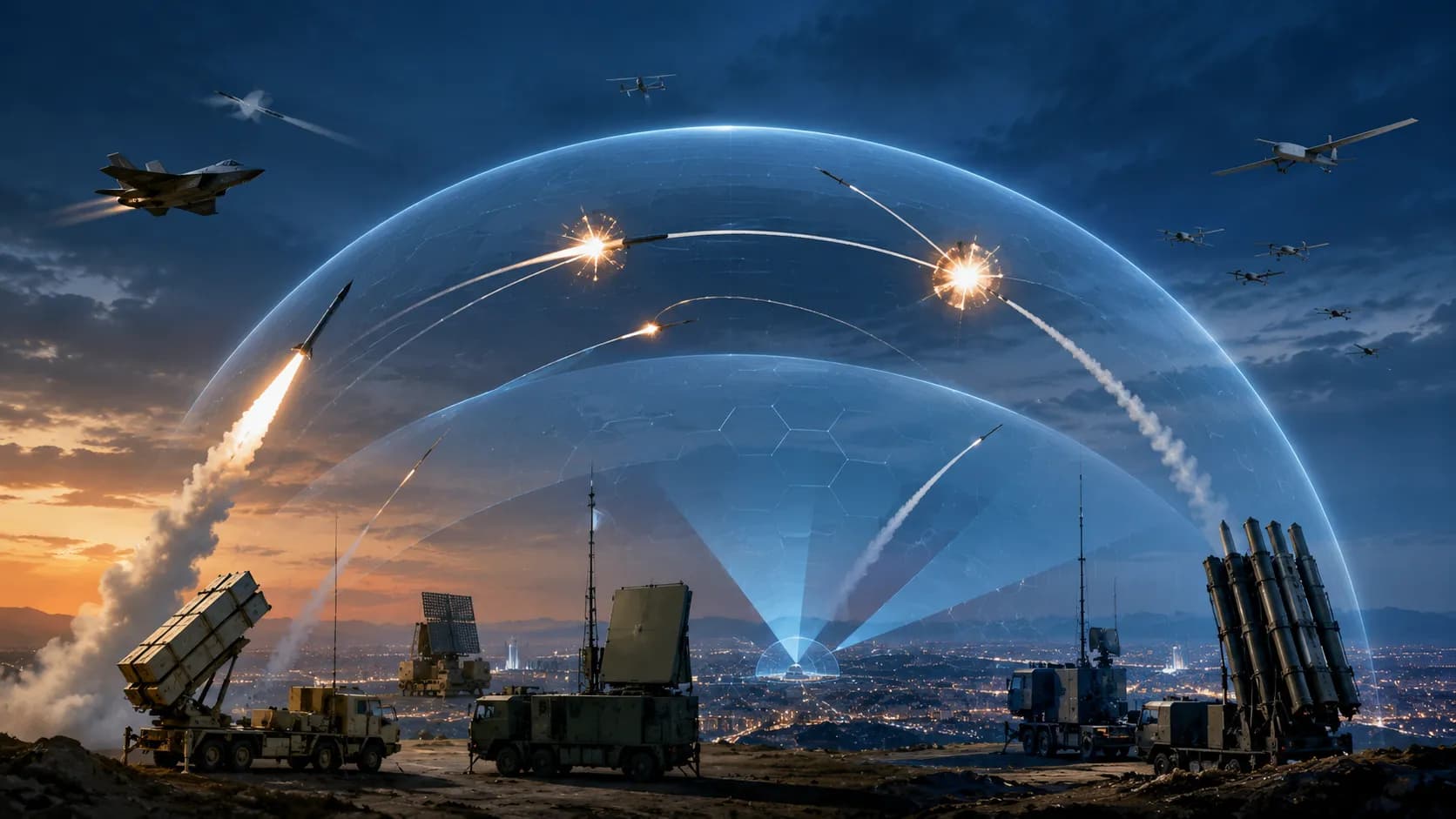
The wars of the past several years have fundamentally changed how military power is measured. Fighter aircraft and long-range missiles remain important, but the ability to protect cities, military bases, energy infrastructure and command centers from ballistic missiles, cruise missiles and drones has become equally strategic.
There is no single objectively “best” air-defense system. Modern defense depends on layers: different radars and interceptors must deal with threats ranging from cheap drones flying at low altitude to ballistic missiles arriving from the edge of space.
In 2026, five countries stand out because of the sophistication, scale or diversity of their air and missile-defense capabilities: the United States, Israel, Russia, China and, increasingly, the European defense network led by France and Italy.
United States: The Most Complete Global Network
The United States possesses perhaps the broadest overall air and missile-defense architecture.
At the tactical and theater level, Patriot PAC-3 MSE is designed to intercept aircraft, cruise missiles and ballistic threats. THAAD provides a higher layer against ballistic missiles, while Aegis-equipped naval forces extend missile defense to the sea.
The strength of the American model is therefore not one particular missile but its ability to combine satellites, early-warning radars, command networks, ground batteries and naval systems.
Recent wars, however, have exposed its biggest weakness: ammunition consumption.
Heavy interceptor use in the Middle East has sharply reduced U.S. Patriot and THAAD inventories. Washington responded in August with agreements worth more than $3 billion intended to triple production capacity for key Patriot components and quadruple it for THAAD.
This reveals an important lesson of modern air defense: possessing an advanced system means little if a country cannot manufacture enough interceptors for a prolonged war.
Israel: The Strongest Layered Model
Israel has arguably built the world's most extensively tested multi-layered national missile-defense architecture.
Its structure assigns different threats to different systems.
Iron Dome handles many short-range rockets and other lower-tier threats. David's Sling addresses more demanding medium-range threats. Arrow 2 and Arrow 3 provide the upper layers against ballistic missiles, while Iron Beam is introducing directed-energy technology into the architecture.
The U.S. Missile Defense Agency confirmed on August 6 that Israel and the United States had successfully completed another Arrow Weapon System test. The agency noted that Arrow 2 and Arrow 3 had intercepted numerous ballistic threats from Iran and Yemen during the previous three years.
Iron Dome has also been upgraded using lessons from recent combat, including improvements intended to counter rockets, cruise missiles, UAVs and high-volume attacks.
Israel's principal advantage is therefore experience.
Few countries have subjected an integrated national missile-defense network to such sustained real-world pressure.
Russia: Powerful Systems, Difficult Questions
Russia remains one of the world's leading developers of ground-based air defense.
The S-300 and S-400 families provide long-range coverage, while systems such as Buk and Pantsir create additional medium- and short-range defensive layers.
At the highest level sits the S-500 Prometheus, designed to expand Russian capabilities against advanced ballistic and potentially hypersonic threats.
On paper, this produces one of the world's deepest ground-based air-defense structures.
But the Ukraine war has also demonstrated that even dense air defenses can be penetrated.
Cruise missiles, drones, electronic warfare and attacks designed to overwhelm defenses have repeatedly challenged both Russian and Ukrainian networks.
This illustrates an important distinction between theoretical specifications and wartime performance. Russia remains technologically formidable, but modern combat has demonstrated that no air-defense umbrella is impenetrable.
China: The Most Difficult System to Measure
China may represent the greatest long-term competitor to American air and missile defense.
The People's Liberation Army operates a broad network built around systems including the HQ-9 family, while newer systems such as HQ-19 are intended to provide higher-tier ballistic-missile defense.
The PLA was still conducting live-fire exercises with the HQ-9B in late July 2026, demonstrating the system's continuing role in China's operational air-defense architecture.
China's advantage is not simply missile technology.
Its enormous industrial capacity, extensive radar infrastructure, rapidly improving space capabilities and integrated military command networks could allow Beijing to build defensive coverage on a scale few countries can reproduce.
Its disadvantage from an analytical perspective is combat evidence.
Compared with Israeli, American, Russian and Ukrainian systems, many of China's most advanced capabilities have limited publicly documented combat experience.
China may therefore possess one of the world's most sophisticated air-defense architectures, but important parts of its real wartime performance remain untested publicly.
Europe Is Building Its Own Shield
Europe historically depended heavily on American technology, particularly Patriot.
That dependence is now being reconsidered.
France and Italy developed the SAMP/T family around the Aster missile, while the newer SAMP/T NG is intended to strengthen European capabilities against increasingly advanced air and ballistic threats.
European states are simultaneously acquiring Patriot, Arrow 3, IRIS-T and other systems to construct a broader continental architecture.
But the war in Ukraine has exposed a major weakness: Europe does not yet possess enough interceptors and batteries for the scale of missile warfare now being observed.
The International Institute for Strategic Studies warned this year that Europe's most serious gap remains medium- and long-range ballistic-missile defense, while production capacity for European alternatives remains constrained.
Ukraine's experience makes this particularly visible. Kyiv continues to request additional Patriot interceptors as Russia intensifies missile attacks, while deliveries of new European systems are being accelerated.
The New Threat Is Saturation
Perhaps the most important lesson does not come from any single country.
It comes from Ukraine and the Middle East.
Modern attackers increasingly combine ballistic missiles, cruise missiles, decoys and inexpensive drones in the same operation.
The objective may not be to defeat an interceptor technologically. It can simply be to exhaust the defender economically and numerically.
SIPRI notes that saturation attacks designed to overwhelm air defenses and the rapid proliferation of inexpensive armed UAVs are already changing modern warfare.
This creates an uncomfortable equation.
A sophisticated interceptor can cost millions of dollars, while some attacking drones cost only a fraction of that amount.
Future air-defense networks therefore need inexpensive counter-drone weapons, electronic warfare and lasers alongside expensive missile interceptors.
Who Has the Strongest Defense?
If different criteria are separated, the picture becomes clearer.
The United States has the strongest overall global and technologically integrated architecture.
Israel has arguably the most mature combat-tested layered national missile-defense network.
Russia possesses one of the world's deepest families of land-based air-defense systems.
China combines rapidly advancing technology with the industrial capacity to become an increasingly formidable air-defense power.
Europe possesses several highly advanced systems but still needs greater scale, integration and interceptor production.
The decisive factor in the next major conflict, however, may not be which country owns the missile with the longest advertised range.
It may be which country can detect thousands of different threats, decide which ones actually need interception, connect multiple defensive layers and manufacture enough interceptors to keep fighting for months rather than days.
In 2026, the race for air superiority is therefore increasingly becoming a race for air denial.
Ahmet Balakan
Contributing writer at EUReflect.
Follow EUReflect
See more of our reporting on Google
Mark EUReflect as a preferred source and our stories are ranked higher for you in Top Stories, Discover and Google News — and carry a “preferred” badge when they are cited in AI results.
Add EUReflect as a preferred source