Are We Really Moving from the Nation State to the Network State?
Balaji Srinivasan's network state concept has been tested in Montenegro and Malaysia, but these experiments remain dependent on host countries for basic governance.
The nation state's historical dominance
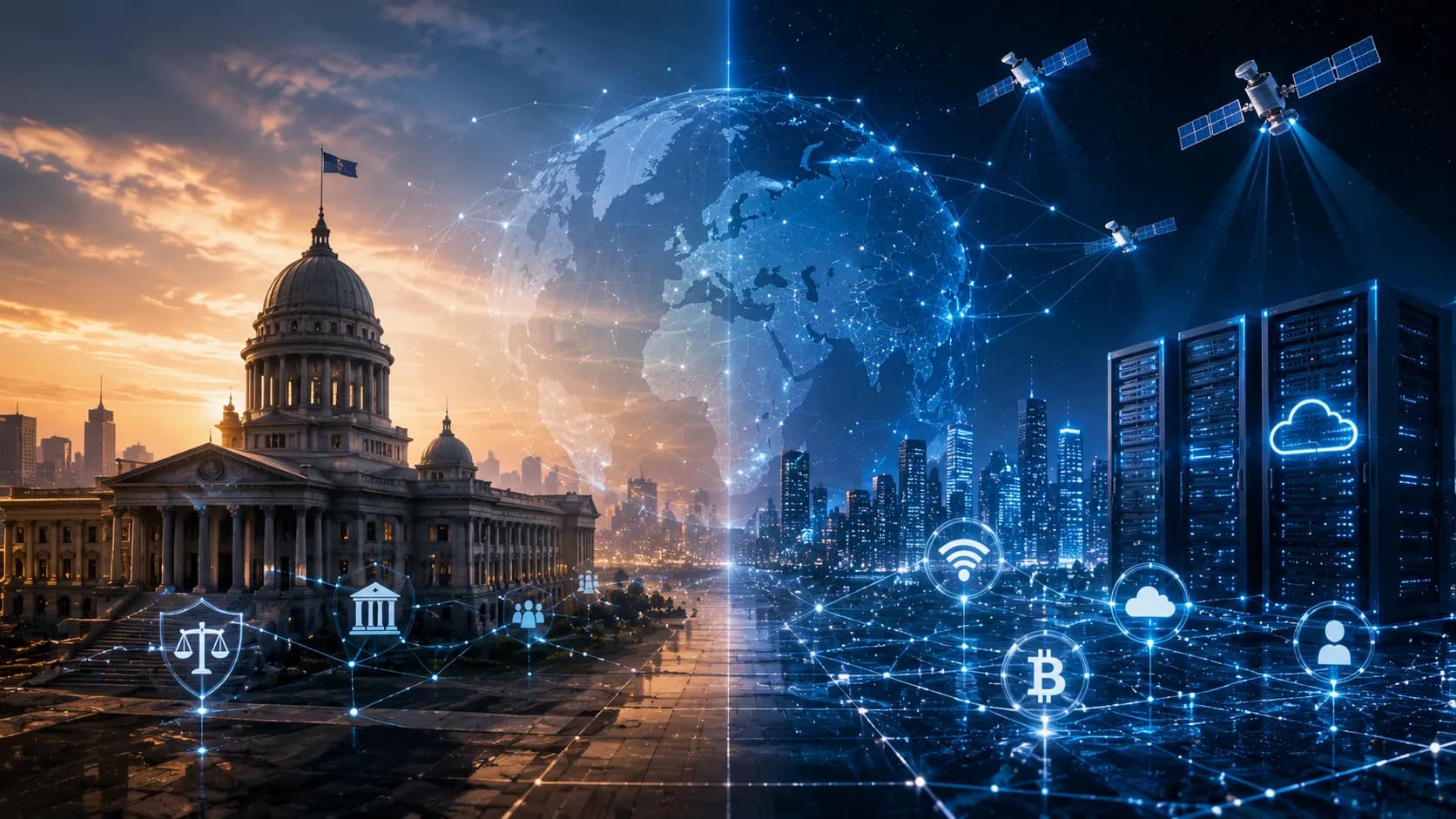
For more than four centuries, the nation state has been the dominant structure of political power. Territory, borders, taxation, citizenship, law and military force have defined sovereignty. Yet the foundations of modern society are increasingly digital. Artificial intelligence, cloud computing, satellite communications, cryptocurrencies and social media now influence how economies function and how citizens communicate. The question is no longer whether technology is changing sovereignty. It is whether political power is beginning to move from territory towards networks.
The network state concept
The idea of the “network state”, most prominently developed by Balaji Srinivasan, proposes that digitally organised communities could eventually evolve into political societies. Individuals would first connect online, build economic and social institutions, acquire physical territory and potentially seek diplomatic recognition. Experiments such as Zuzalu in Montenegro in 2023 and Network School in Malaysia in 2024 demonstrated that the concept can move beyond theory. But they also exposed its central weakness. Creating a digital community is relatively easy. Governing a society is not.
A functioning political community requires land, electricity, water, healthcare, security, taxation, courts and enforceable law. These remain overwhelmingly dependent on existing states. Network School itself illustrates the contradiction. Its own platform describes the project as founded in 2024 and built around turning internet communities into physical societies. Yet its activities have remained dependent on the legal and regulatory environment of the country in which it operates.
Technology platforms as evidence
The stronger evidence for changing sovereignty, however, comes not from experimental communities but from the enormous scale of existing technology platforms. Meta reported 3.60 billion daily active people across Facebook, Instagram, Messenger and WhatsApp in June 2026. That is an extraordinary concentration of global communication within one corporate ecosystem.
Cloud infrastructure presents an even more consequential concentration of power. Global enterprise spending on cloud infrastructure reached $143 billion in the second quarter of 2026, up 43 percent year on year. Amazon, Microsoft and Google accounted for 28 percent, 20 percent and 15 percent respectively, meaning three American companies controlled 63 percent of the global market measured by enterprise cloud infrastructure spending.
This is where the network state argument becomes politically significant. These companies are not governments, but governments increasingly depend on infrastructure supplied by companies. Data, computing capacity, communications networks and artificial intelligence systems have become strategic assets. The distinction between economic infrastructure and political infrastructure is therefore becoming increasingly blurred.
Starlink's strategic role
Starlink demonstrates the problem particularly clearly. During the war in Ukraine, satellite connectivity became strategically important because conventional communications infrastructure could be disrupted. Reuters reported that Ukraine had approximately 50,000 Starlink terminals in 2025 and remained heavily dependent on the system. Germany subsequently supported efforts to expand alternative satellite connectivity through Eutelsat.
A private company therefore possesses infrastructure with consequences extending beyond ordinary commercial activity. The political question becomes unavoidable: who should control communications infrastructure when it becomes essential to national security?
Palantir's government ties
Palantir provides another example. Its business is formally divided into commercial and government segments, with government customers including US and non US government agencies. Its 2025 annual report describes its software platforms as systems used by government and commercial organisations. The significance is not that Palantir has become a government. It has not. The significance is that private technology companies increasingly participate directly in functions associated with the modern state.
Democratic problems of digital access
Yet the network state faces a fundamental democratic problem. Digital access is not universal. The International Telecommunication Union estimates that around 6 billion people were online in 2025, while 2.2 billion remained offline. The remaining population is concentrated disproportionately in low and middle income countries.
This matters because a political model based on digital participation cannot automatically be described as democratic if billions cannot participate equally. Even among connected populations, economic inequality affects access to computing power, cryptocurrencies, digital assets and international mobility. The freedom to “exit” an undesirable political system is therefore far more realistic for a wealthy entrepreneur than for a low income worker.
There is another contradiction. Decentralisation does not necessarily mean decentralised power. A blockchain may distribute transaction verification, but developers, infrastructure providers, exchanges, investors and large holders can still possess disproportionate influence. A social network may connect billions of people while its rules are ultimately determined by a relatively small corporate leadership structure. The architecture may be distributed while decision making remains concentrated.
China's state integration
The opposite model is visible in China, where digital technology has generally been incorporated into state power rather than positioned as an alternative to it. Digital currencies, data regulation and technological surveillance demonstrate that governments can extend sovereignty into digital systems. Technology can weaken state authority, but it can also make states more capable of monitoring, regulating and controlling economic and social activity.
The United States represents a different model. Its technology sector remains predominantly private, but government agencies and technology companies increasingly operate in strategic partnership. Cloud computing, artificial intelligence, cybersecurity and satellite communications are simultaneously commercial and national security assets. The emerging system is therefore neither purely state controlled nor purely corporate. It is increasingly hybrid.
The state's enduring power
This makes the claim that the nation state is disappearing premature. States still possess the characteristics that digital communities cannot easily reproduce: territorial jurisdiction, taxation, courts, police forces, militaries and internationally recognised sovereignty. Technology companies can influence millions or billions of people, but they cannot independently enforce laws over territory in the way states can.
The more credible transformation is therefore not from nation state to network state, but from territorial sovereignty to digitally mediated sovereignty. The state is becoming increasingly dependent on networks, while networks are becoming increasingly subject to state regulation and geopolitical competition.
The most important statistic may therefore not be the number of people inside a digital community, but the concentration of infrastructure behind it. When three companies control 63 percent of global cloud infrastructure spending, when one corporate ecosystem reaches 3.6 billion daily users, and when a private satellite network can become strategically important during war, technology has already become part of the machinery of sovereignty.
The central question for the coming decades is consequently not whether corporations will replace governments. They probably will not. The deeper question is who will control the digital systems on which governments, economies and citizens increasingly depend.
The nation state may survive with its borders, flags and institutions intact. But its effective power will increasingly depend on data centres, algorithms, satellites, artificial intelligence, payment systems and digital networks. Sovereignty is not disappearing. It is moving into infrastructure that is increasingly shared between governments and private companies.
The future may therefore belong neither entirely to the nation state nor to the network state. It may belong to whoever controls the architecture connecting them.
Uroosa Khan
Contributing writer at EUReflect.
Follow EUReflect
See more of our reporting on Google
Mark EUReflect as a preferred source and our stories are ranked higher for you in Top Stories, Discover and Google News — and carry a “preferred” badge when they are cited in AI results.
Add EUReflect as a preferred source