Armenia’s European Moment
Armenia’s parliamentary election tests PM Pashinyan’s pro-European pivot as his Civil Contract party faces pro-Russian opposition. With peace with Azerbaijan, democratic integrity, and ties to Moscow all on the line, Armenians cast votes that could reshape the country’s future.
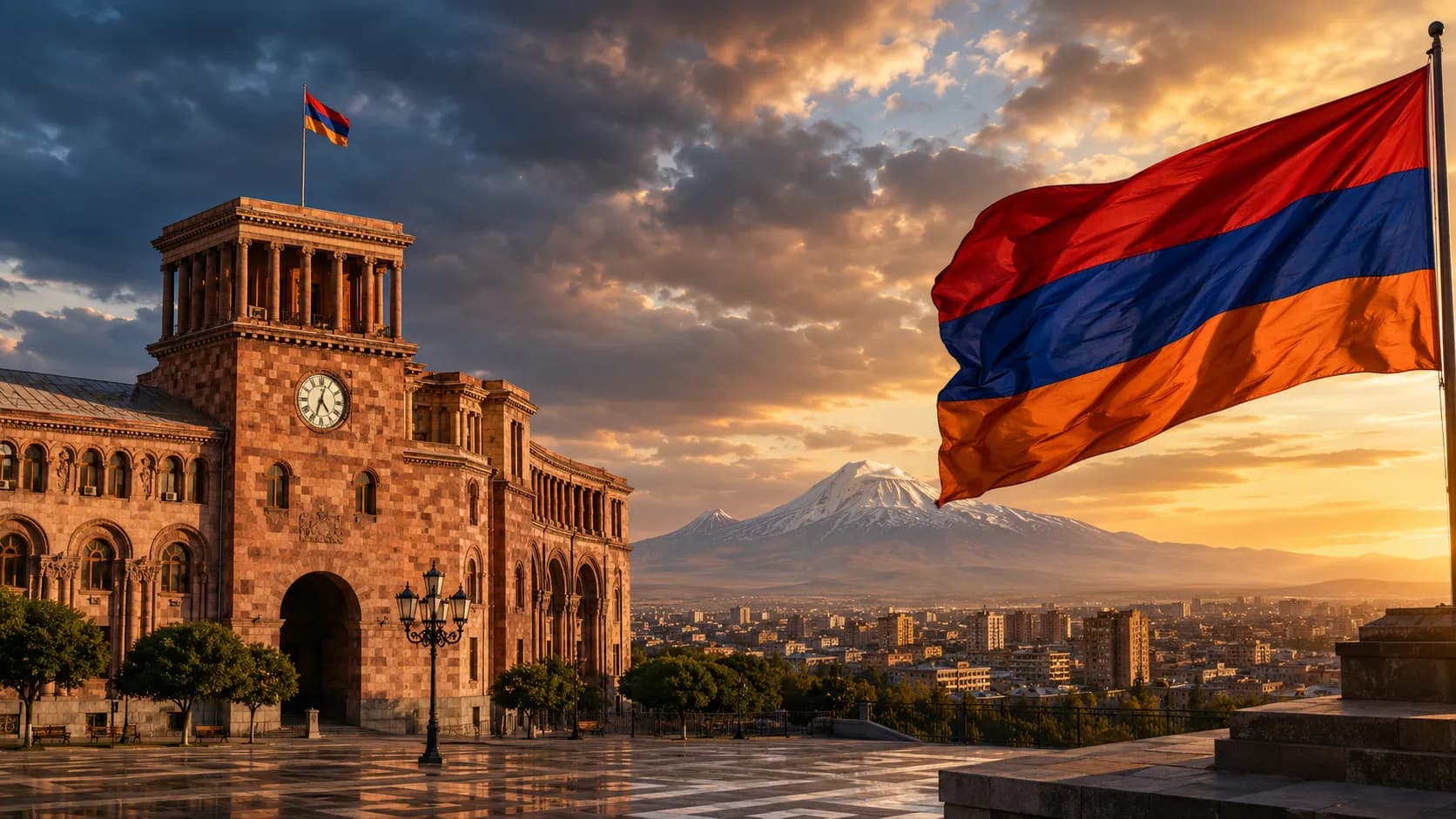
YEREVAN —Armenia went to the polls on Sunday, June 7, 2026, in a parliamentary election that carries consequences far beyond its borders. Framed by its incumbent Prime Minister Nikol Pashinyan as a civilisational choice — between a future anchored in European democratic values or a return to Moscow's orbit — the vote has drawn intense international attention from Brussels to Washington, and from Baku to the Kremlin. At stake is not merely the composition of Armenia's 101-seat National Assembly, but the country's geopolitical trajectory, its security architecture, its fragile peace with neighbouring Azerbaijan, and the identity of a nation still reckoning with the traumatic loss of Nagorno-Karabakh.
Voting commenced at 8:00 a.m. local time (04:00 GMT) across Armenia's polling stations and was scheduled to close at 8:00 p.m. (16:00 GMT). Two political blocs and seventeen registered parties participated in the contest, representing a wide spectrum of opinion on the country's future orientation. Pashinyan's ruling Civil Contract party entered the election as frontrunner, with most independent pollsters and political analysts projecting it to secure a leading position, though the scale of its majority remained uncertain in the days preceding the vote. The stakes, however, could not be described merely in terms of parliamentary arithmetic.
Casting his ballot on Sunday morning, Pashinyan offered a statement that crystallised the central themes of his campaign. He affirmed that Armenia would persist in strengthening its independence, democratic institutions, and rule of law, and underscored the European Union's role as the country's primary partner in implementing reforms. While simultaneously seeking to downplay alarm over the deteriorating relationship with Russia, he characterised ties with Moscow as "institutional and based on mutual respect" — a careful diplomatic formulation that nonetheless failed to obscure a fundamental rupture in what was once a close strategic alliance.
I. A Geopolitical Reorientation Years in the Making
Armenia's gradual drift away from Russia did not begin overnight. Since assuming power in 2018 following a wave of mass street protests that became known as the Velvet Revolution, Pashinyan has systematically repositioned his country's foreign policy, cultivating closer relationships with the European Union, the United States, and Western institutions more broadly. His administration's decision to suspend participation in the Russian-led Collective Security Treaty Organisation — following Moscow's conspicuous failure to provide meaningful military support during the 2020 Nagorno-Karabakh war and the decisive 2023 Azerbaijani offensive that led to the enclave's full collapse — represented the most dramatic expression of this shift.
The peace agreement signed at the White House last August between Armenia and Azerbaijan — brokered in part with American and European diplomatic facilitation — marked a watershed moment in this reorientation. For Pashinyan, the agreement represented not a capitulation, as his critics allege, but a pragmatic and courageous act of statesmanship: a recognition that the post-Soviet security guarantees Armenia had long relied upon had proven illusory. His campaign messaging has consistently returned to this theme, framing the election as a referendum on whether Armenians wish to consolidate the peace or risk renewed conflict under a government that would restore Russian dependency.
Economic indicators have offered Pashinyan a powerful secondary argument. Since coming to power, Armenia has recorded a near doubling of gross domestic product per capita — a remarkable trajectory that supporters attribute to improved governance, anti-corruption efforts, and deeper integration with Western markets. Voter Karine Darbinyan, 39, who attended a Civil Contract rally in Yerevan's central Republic Square, captured the sentiment of many Pashinyan supporters when she described watching Armenia grow visibly in real time. For many Armenians under fifty, the incumbent represents a break from the oligarchic corruption and Russian dependency that characterised the post-Soviet decades — a figure who, whatever his faults, has presided over genuine transformation.
II. Russian Pressure, Opposition Voices, and the Shadow of Karabakh
Moscow has not observed Armenia's westward drift passively. In the weeks preceding the election, Russian officials imposed restrictions on Armenian exports — a form of economic coercion that analysts widely interpreted as an attempt to influence the electoral outcome and send a warning to Yerevan about the costs of further distancing from Russia. More disturbing still were the thinly veiled rhetorical threats issued by senior Russian officials, including President Vladimir Putin, who drew unsettling comparisons between Armenia's geopolitical trajectory and Ukraine's — an analogy that, in the current European context, carried unmistakable menace.
The principal vehicle of pro-Russian sentiment in this election cycle is the Strong Armenia party, founded last year by Russian-Armenian billionaire Samvel Karapetyan. Karapetyan, who entered the campaign under conditions of house arrest following charges of plotting a coup — allegations he and his supporters regard as politically motivated — has built his campaign around a platform of restoring Armenian-Russian relations and pushing back against what he characterises as Western interference in Armenian affairs. Strong Armenia has positioned itself as the defender of national tradition and cultural continuity, particularly resonant among Armenians displaced from Nagorno-Karabakh.
A woman named Gayane, who identified herself as a native of Nagorno-Karabakh and declined to give her surname, articulated the emotional core of Strong Armenia's support base at a party rally in Yerevan last week. She expressed the belief that the current government had extinguished the hope once carried by the Armenian population of the enclave, and that Karapetyan offered the prospect of preserving what remained — Armenia itself, its identity, its traditions, its sovereignty. Her words gave voice to a profound grief felt by the roughly 100,000 ethnic Armenians who fled Karabakh following Azerbaijan's 2023 military operation, many of whom feel that Pashinyan's peace process amounted to an abandonment of their homeland.
The campaign was also shadowed by controversy. A day before the vote, Armenian investigators announced six arrest warrants targeting members of the Strong Armenia party on vote-buying allegations — a development that generated fierce debate about whether the prosecutions reflected genuine law enforcement action or represented an attempt by the government to hobble its most significant rival. Armenia's Central Election Committee ultimately permitted Strong Armenia to proceed with its candidacy following an appeal from the Republic party, another opposition grouping. The episode added further tension to an already charged electoral atmosphere.
III. Security, Identity, and the Question of Democratic Integrity
According to Maria Titizian, editor-in-chief of EVN Report, a Yerevan-based online news publication, the two dominant concerns shaping voter sentiment in this election are security and identity. Speaking to Al Jazeera from the Armenian capital, Titizian offered a nuanced assessment of the questions animating Armenian voters: how a small, landlocked country surrounded by larger and more powerful neighbours can guarantee its safety in a fundamentally altered regional environment; what kind of relationship it should maintain with Russia, especially after the assumptions underpinning its post-Soviet security framework were so decisively shattered; and whether deepening ties with Europe and the United States represents a viable long-term strategy, given the economic dependencies and geographic realities that continue to bind Armenia to its immediate neighbourhood.
The campaign itself has been marked by an unusually high degree of fear-based messaging from all sides. Pashinyan's Civil Contract party has warned voters that a pro-Russian opposition victory would inevitably lead to renewed warfare with Azerbaijan — a claim backed by the argument that only continued engagement with Western mediators can sustain the fragile peace architecture currently in place. The pro-Russian opposition has countered with equally stark economic warnings, arguing that severing ties with Russia — Armenia's primary energy supplier and a major market for its exports — would precipitate an economic catastrophe from which the country might not recover for a generation.
A further dimension of this election is the scrutiny directed at Pashinyan's own democratic record. Eight years after he swept to power on a mandate to dismantle oligarchic structures and restore the rule of law, his government faces mounting accusations of democratic backsliding — a pattern that critics argue has included the use of law enforcement and the judiciary against political opponents under the guise of combating coups and corruption. The government has consistently defended these actions as legitimate responses to genuine threats to constitutional order, but the frequency and timing of such prosecutions have generated concern among independent observers and civil society groups, both within Armenia and in European capitals. For voters who supported Pashinyan's original reform agenda, these questions introduce an uncomfortable tension into an already complex electoral calculation.
Conclusion: A Nation Defining Itself
The results of Armenia's parliamentary election will reverberate well beyond the Caucasus. For the European Union, a strong Civil Contract performance would validate the bloc's engagement strategy and encourage further integration talks. For the United States, it would reinforce the value of its diplomatic investment in the Armenia-Azerbaijan peace process. For Russia, it would represent a significant and deeply unwelcome setback — confirmation that a country it long regarded as part of its exclusive sphere of influence has chosen a different path, with popular consent.
Yet whatever the outcome, the election has already demonstrated something important: that Armenian society is deeply and genuinely divided on questions of identity, security, and belonging that do not lend themselves to easy resolution. The wounds of Karabakh are raw, the economic pressures from Russia are real, and the path toward Europe — however aspirationally attractive — remains uncertain and demanding. Armenia is a small nation making large decisions, and its people appear acutely aware of the weight of the moment.
What is clear is that Armenia is no longer the passive object of great power competition it once appeared to be. It is, with all the risks and opportunities that entails, an active subject — a country choosing its future. The polls have closed. The count has begun. And the world is watching.
Alvara Merrick
Contributing writer at EUReflect.
Follow EUReflect
See more of our reporting on Google
Mark EUReflect as a preferred source and our stories are ranked higher for you in Top Stories, Discover and Google News — and carry a “preferred” badge when they are cited in AI results.
Add EUReflect as a preferred source