Belgium, Federal Budget 2026–2029
Belgium, Federal Budget 2026–2029: A Vote of Confidence… But the Confidence Still Has to Be Earned
By Kadir Duran — Bruxelles Korner
Brussels, 28/11/2025
This morning, Parliament granted its confidence to the government, which presented the broad outlines of the federal budget for 2026–2029.
A budget described as “fair,” “balanced,” and “future-oriented.”
In reality, it is above all a massive fiscal clean-up operation, unprecedented since the Dehaene era.
€32 Billion in Consolidation: Accounting Miracle or Cold Necessity?
Adding up all the agreements reached since the government took office, the executive boasts €32 billion in budgetary efforts.
On paper:
80% through spending cuts and structural reforms
20% through new revenue
A flattering ratio yet it raises a crucial question:
Where will these savings fall, and on whom?
A “Difficult but Fair” Budget? That Depends on Who You Ask.
The government insists: this is a “difficult,” yet “equitable” budget.
Measures target several ambitions:
Boosting the value of work
Strengthening business competitiveness
Preserving purchasing power
Reintegrating long-term sick workers
Combating fiscal and social abuse
But behind the polished communication, the truth is clear:
the effort relies primarily on shrinking public expenditure, in a country where public services are already under extreme strain healthcare, mobility, justice, asylum reception, federal administrations operating below minimum capacity…
“Putting Public Finances Back on Track”: Yes, But at What Social Cost?
Official discourse claims this budget “puts Belgium back on track.”
But in the corridors of Parliament, many wonder:
Can this fiscal correction be sustainable without breaking what remains of the social state?
If the goal is admirable finally stabilising Belgium’s budgetary trajectory the risk is obvious:
making those who have the least pay the most,
while long-promised structural reforms remain stuck.
Not Since Dehaene Has Belgium Seen Such an Effort
The government loves to remind everyone that Belgium hasn’t experienced an adjustment of this magnitude since the Dehaene governments.
The comparison is bold:
Dehaene restructured to prepare Belgium for the euro.
Today, the cleanup is happening to patch years of federal and regional drift and political paralysis.
Triumphant Communication vs. Grassroots Skepticism
In the end, the confidence vote today should fool no one:
it is political, not popular.
Because one truth remains:
the confidence of citizens cannot be voted it must be earned.
And to earn it, it will take more than a “difficult but fair” budget.
It will take results.
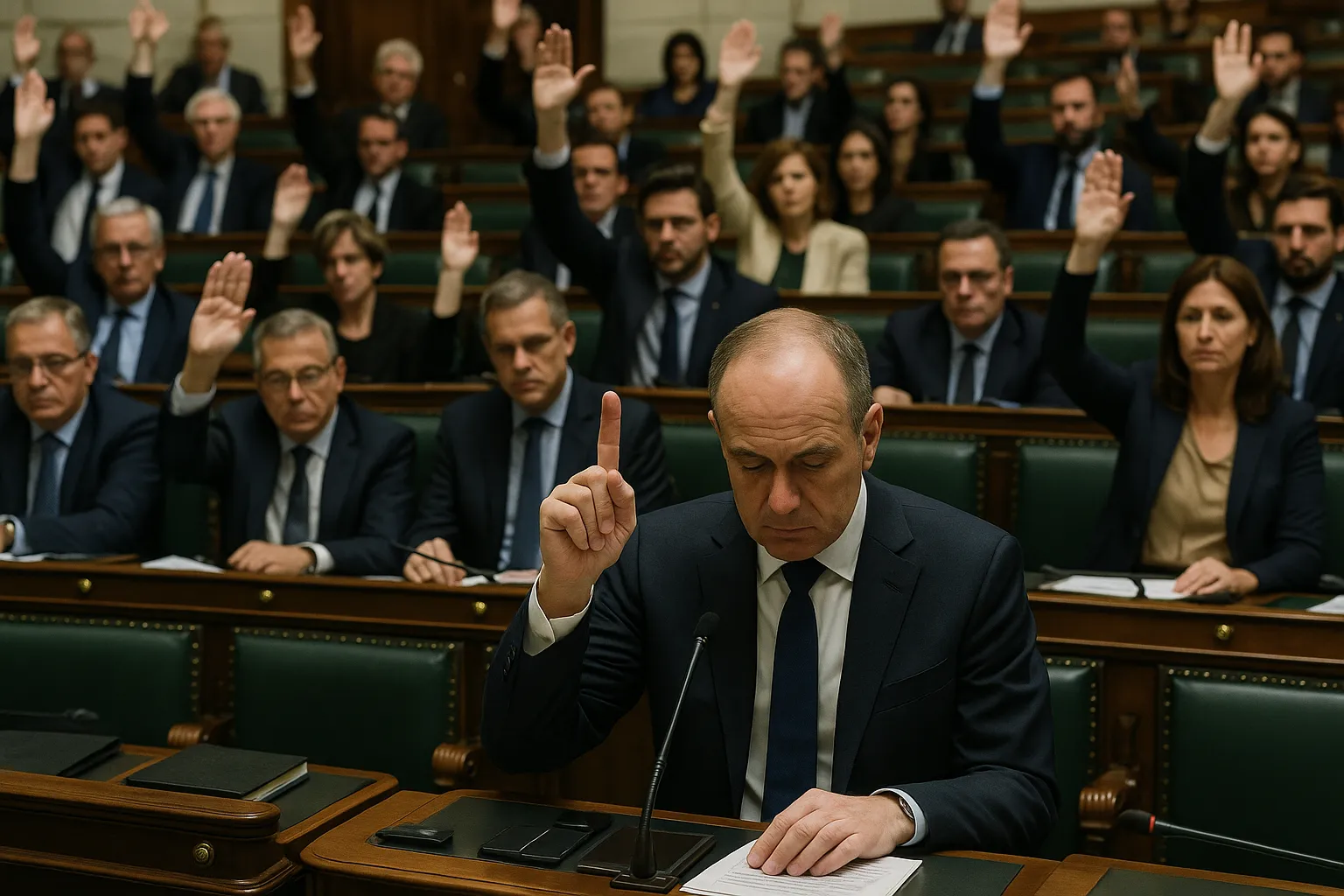
A Vote of Confidence… With Just One Finger Raised. A Government StandingBut On a Tightrope.
Confidence in the government was indeed approved today.
But not triumphantly.
Not enthusiastically.
Just barely by a figurative raised finger.
A narrow, fragile, almost trembling majority a political signal louder than any speech.
A Confidence Vote to Avoid an End-of-Year Collapse
Let’s be honest: this confidence vote looks more like a survival mechanism than a wholehearted endorsement of the 2026–2029 budget.
Behind the scenes, many acknowledge that this vote was nothing more than:
➡️ a last-minute shield to prevent the government from collapsing before January,
➡️ an obligatory gesture, not a deep conviction,
➡️ a way to postpone an already-expected implosion.
The climate is so tense that one sometimes feels this government is held together by instinct, not by shared vision.
A Political Victory… But a Thin One
Call it a “victory” if you want, but this confidence vote looks more like a last breath.
Because voting confidence is not governing.
And keeping a country stable in 2026 will be a very different challenge.
2026: The Most Turbulent Year Belgium Has Faced in a Long Time
The 2026–2029 budget may be marketed as “fair, balanced, and future-oriented,”
but 2026 is shaping up to be stormy:
visible social tensions,
difficult reforms ahead,
internal political fault lines,
exhausted citizens,
constant friction between regions and the federal level,
external pressure (markets, European Commission),
weakened administrative capacity.
The country is entering a weather zone where every cloud meets another.
Let’s Hope the Parties Made the Right Call
There remains a small, fragile but real hope:
that the parties made the right choice,
that they chose stability over immediate rupture,
and that Belgium will regain momentum,
a sense of direction,
and avoid being dragged down once again by internal quarrels, delays, and paralysing compromises.
But today, one thing is certain:
confidence has been voted…
not earned.
Kadir Duran
Contributing writer at EUReflect.
Follow EUReflect
See more of our reporting on Google
Mark EUReflect as a preferred source and our stories are ranked higher for you in Top Stories, Discover and Google News — and carry a “preferred” badge when they are cited in AI results.
Add EUReflect as a preferred source