BRUSSELS · 35 YEARS OF KYRGYZ INDEPENDENCE
Independence and Inheritance: Kyrgyzstan Celebrates 35 Years of Sovereignty in Brussels
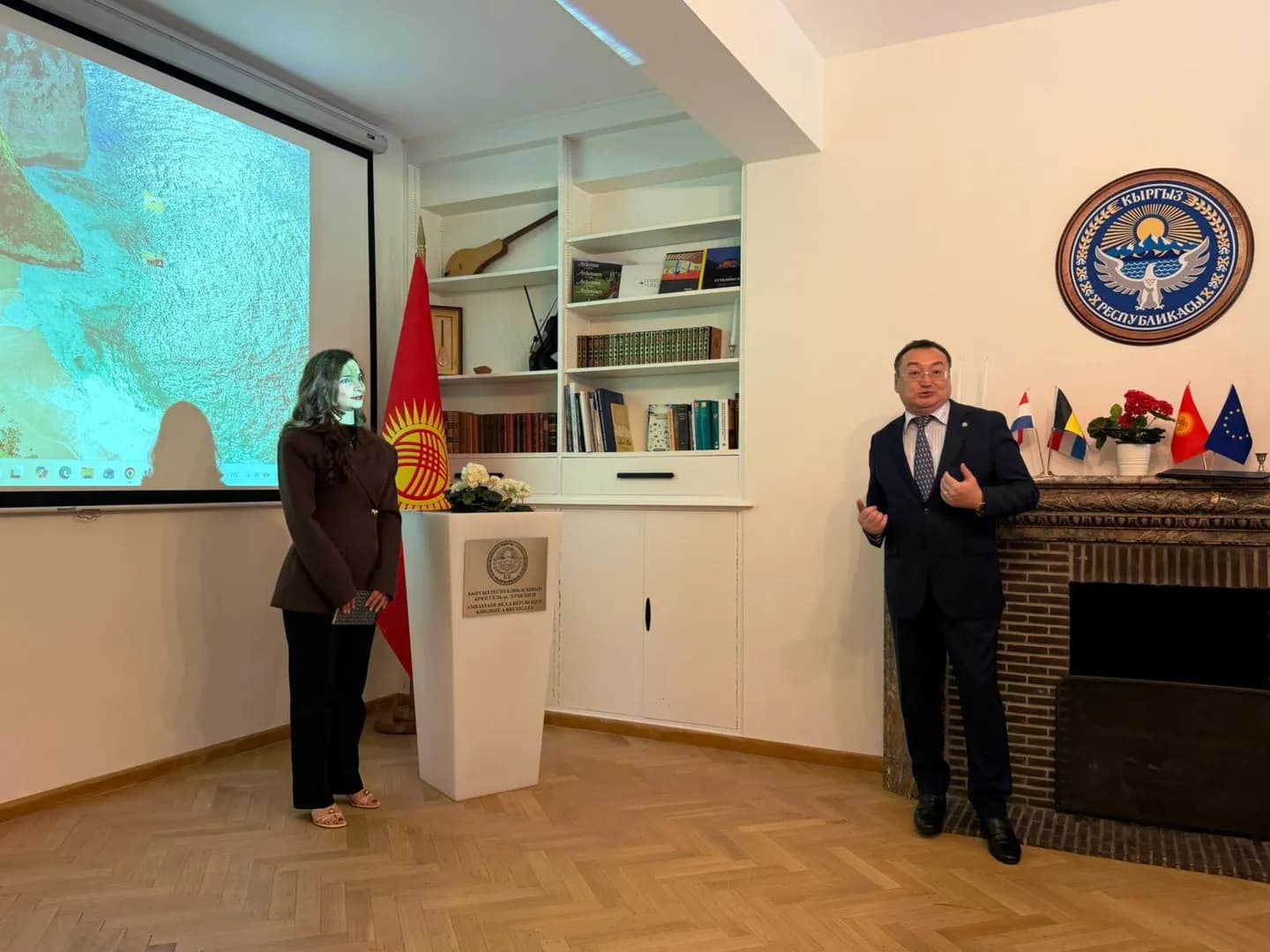
Ambassador Aidit Erkin traced a path “from national revival to national prosperity,” before Derya Soysal turned the room’s attention nine centuries back — to Yusuf Balasaguni, the medieval sage whose wisdom the Kyrgyz, Uzbek and Uyghur peoples all claim as their own.
Brussels, 31 August 1991 – 2026
On the eve of the Kyrgyz Republic’s National Day, the Embassy of Kyrgyzstan in Brussels welcomed diplomats, foreign mission staff, journalists, academics and members of the Kyrgyz community to mark 35 years since Bishkek declared its independence from the Soviet Union on 31 August 1991. The evening unfolded in two complementary movements: first, a statement of state from Ambassador Aidit Erkin on where Kyrgyzstan stands today and where it intends to go; and second, a journey nine centuries into the past, as Central Asia expert and journalist Derya Soysal presented the life and legacy of Yusuf Balasaguni — the 11th-century philosopher-statesman whose great book of wisdom, the Kutadgu Bilig, is claimed today as a shared inheritance across the Turkic world.
Ambassador's speech
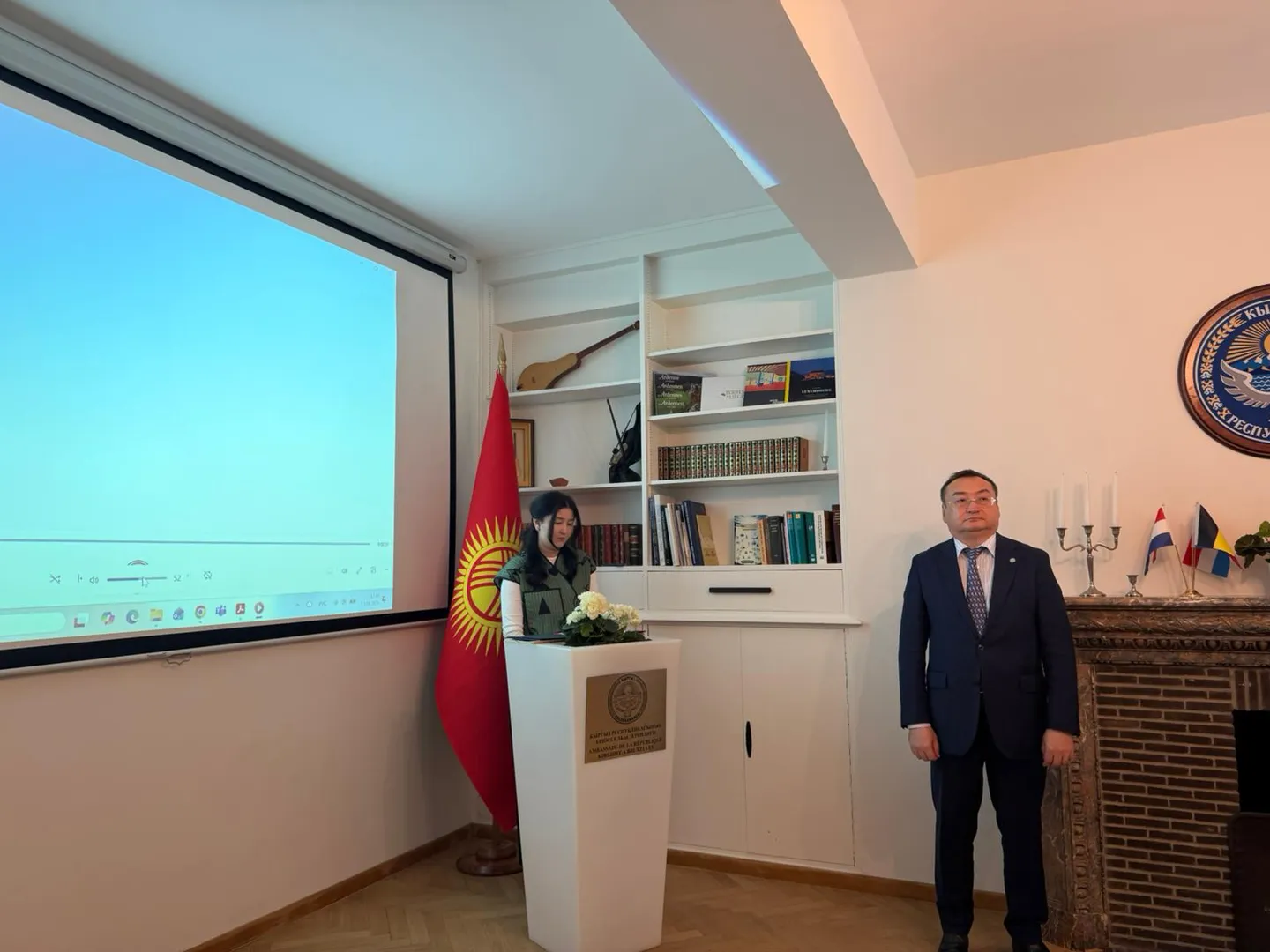
Opening the reception, Ambassador Erkin thanked guests and friends of Kyrgyzstan before setting out the meaning of the day in plain, deliberate terms: “Today we celebrate the National Day — our freedom, our liberty, our independence. Independence means the freedom to choose your own future.”
For the Ambassador, sovereignty is not an abstraction to be marked once a year with flags and speeches — it is a promise that has to be felt in daily life. “It is important for us that every citizen should feel the fruits of independence,” he said, “– a peaceful life, social harmony, increased well-being of the people, and the confidence of young generations in their future.” That framing set the tone for the rest of his address, which described a country moving, in his words, “from a period of national revival to a period of national prosperity.”
Reform, Connectivity and a New Silk Road
Ambassador Erkin pointed to the National Development Program of the Kyrgyz Republic until 2026 as evidence of concrete follow-through: continued judicial reform aimed at strengthening independence, ensuring transparency and expanding citizens’ access to justice, alongside sustained investment in technology and digital infrastructure to “drive innovation” and “improve public services.” He also cited the launch of construction on the China–Kyrgyzstan–Uzbekistan railway as a flagship regional project. “Together we are building a strong state with a vibrant civil society,” he said.
On relations with Europe, the Ambassador described a partnership resting on three pillars — respect for democracy, human rights and the rule of law as its “cornerstone”; economic cooperation as a “vital aspect,” bolstered by the EU’s Strategy on Central Asia and the Global Gateway initiative; and sectoral cooperation in energy efficiency, education, healthcare and environmental protection. He recalled a dense recent calendar of high-level engagement: summits between Central Asian leaders and the EU held in Kazakhstan (2022), Kyrgyzstan (2023) and Uzbekistan (2025), and President Sadyr Japarov’s June 2024 visit to the EU institutions in Brussels — milestones he said give the relationship “a strong impetus.” Belgium, Luxembourg and the Netherlands, he added, remain “trusted and strong partners in supporting reforms, promoting good governance, and bolstering economic development in Kyrgyzstan.”
The Ambassador closed on a historical note, reaching back to the Middle Ages, when his country lay along the Great Silk Road, and forward to the connectivity ambitions the EU and Central Asia now share: “Now it’s time to make the Silk Road Great again!”
He ended, as is customary, with a word of thanks in both languages of the room: “Thank you! Rahmat!”
A Voice That Still Speaks After 950 Years
If the Ambassador’s address looked at sovereignty through the lens of institutions and diplomacy, the second half of the evening looked at it through the lens of memory. Derya Soysal, presenting on Yusuf Balasaguni: 11th-Century Sage of the Karakhanid World, argued that 35 years of independence rest on a far older foundation — a millennium of Turkic statecraft, ethics and learning that Kyrgyzstan, and its neighbours, still draw on today.
“Nearly a thousand years ago, in the Chu Valley of today’s Kyrgyzstan,” Soysal told the audience, “a scholar named Yusuf Balasaguni wrote the first great book of the Turkic world — a mirror for rulers on justice, wisdom and the art of living well.”
Who Was Yusuf Balasaguni?
Born around 1018 in Balasagun — the winter capital of the Karakhanid Khanate, near present-day Tokmok in northern Kyrgyzstan, where the ruins survive today at the Burana site — Yusuf grew up in a learned, well-to-do family and mastered Turkic, Persian and Arabic alongside the sciences of his age, from ethics and astronomy to statecraft. At about fifty, he completed his life’s work and presented it to the prince of Kashgar, who honoured him with the title Khāṣṣ Ḩājib — “Privy Chamberlain.” He died around 1077 and is, by tradition, entombed in a mausoleum in Kashgar, in today’s Xinjiang.
The Kutadgu Bilig: “The Wisdom That Brings Happiness”
Composed around 1069–1070 and dedicated to Tavghach Bughra Khan, ruler of Kashgar, the Kutadgu Bilig — variously translated as “The Wisdom of Boundless Felicity” or “The Science of Being Happy” — runs to more than 6,500 verse couplets of Karakhanid Turkic, surviving today in three manuscripts held in Vienna, Fergana and Cairo. Soysal described it as the first major masterpiece of Islamic Turkic literature: a “mirror for princes” built, unusually for its era, in the Turkic tongue itself rather than in Arabic or Persian — proof, as she put it, that Turkic “was fully capable of handling complex philosophical, political, and literary concepts” alongside the classical languages that dominated the page.
The book unfolds as a dialogue among four allegorical figures, each embodying a virtue that Balasaguni believed a just state requires: Kün Toghdı (“Rising Sun”), the king, who represents Justice; Ay Toldı (“Full Moon”), the vizier, who represents Fortune; Ögdülmish (“Praised”), the vizier’s son, who represents Intellect; and Odghurmısh (“Awakened”), an ascetic who represents Contentment and spiritual insight. Through their exchanges, the text sets out how a ruler must govern with fairness and reason, defines the duties of different social classes, and weighs the pursuit of worldly success against readiness for the life to come.
“Do not be harsh in conduct — be gentle and patient; let your tongue be sweet, and your very self be good.”
— Yusuf Balasaguni, Kutadgu Bilig, c. 1069
“Look, man was born and died, but his word remained; he himself departed, his name remained.”
The Karakhanids
Soysal situated Balasaguni’s world within the Karakhanid Khanate (c. 840–1212), the first Turkic nomadic confederation to convert collectively to Islam — a shift catalysed around 934 by the conversion of Sultan Satuq Bughra Khan, which set off the wider Islamisation of Turkic peoples across the region. Formed from the Karluk tribal confederation, the Karakhanids fused steppe tradition with Islamic learning and Persianate court culture, ruling from cities such as Balasagun and Kashgar and, after conquering Samarkand around 999, from great Silk Road hubs like Bukhara as well. It was, in her words, “a crossroads where the steppe, the city and the Silk Road met” — the same crossroads that Ambassador Erkin invoked, centuries later, in his closing appeal to “make the Silk Road Great again.”
A Bridge That Unites
The presentation’s central argument was that Balasaguni belongs to a civilisation older than any modern border, and that his legacy is rightly claimed — not divided — by several nations at once. In Kyrgyzstan, the land of his birth, he is a national hero: his portrait has appeared on the country’s highest banknote, the 1,000 som note, since 2000, and the Kyrgyz National University in Bishkek was named after him (as Jusup Balasagyn) in 2002. In Uzbekistan, his Turkic verse is honoured as standing at the fountainhead of the literary tradition that later flowered in Samarkand, Bukhara and Khiva. Among the Uyghurs, he is revered as a founder of classical Uyghur literature, and his mausoleum in Kashgar remains a place of pilgrimage.
“Not a possession to divide, but a bridge that unites,” Soysal told the room — “his wisdom belongs to all who call themselves his heirs.” She closed by drawing the two halves of the evening together: thirty-five years of Kyrgyz sovereignty, she argued, rest on a much older heritage of governance and law that Balasaguni helped articulate; his conviction that a state lives by fair law echoes in every modern effort to build strong, accountable institutions; and his faith in learning as the road to happiness speaks directly to a young nation still investing in education and in its people. As shared heritage across borders, he unites Kyrgyzstan with its neighbours — and, through evenings such as this one in Brussels, with Europe too.
CONCLUSION
Taken together, the two parts of the evening offered a rare pairing: a head of mission’s account of a state in motion — reforming its judiciary, digitising its services, building railways and deepening ties with Brussels — followed by a scholar’s reminder that this same state carries a thousand years of accumulated wisdom about justice, restraint and the good life. “In honouring Yusuf Balasaguni,” the presentation concluded, “we honour a wisdom that belongs to us all.”
Kutlu bolsun — Happy 35th Independence Day. Rahmat · Thank you.
Presented at the Embassy of the Kyrgyz Republic, Brussels — 35 Years of Independence, 1991–2026.
Related Topics
EUReflect News
Site Administrator
Follow EUReflect
See more of our reporting on Google
Mark EUReflect as a preferred source and our stories are ranked higher for you in Top Stories, Discover and Google News — and carry a “preferred” badge when they are cited in AI results.
Add EUReflect as a preferred source