Brussels debate highlights growing pressure on EU to align climate ambition with economic reality
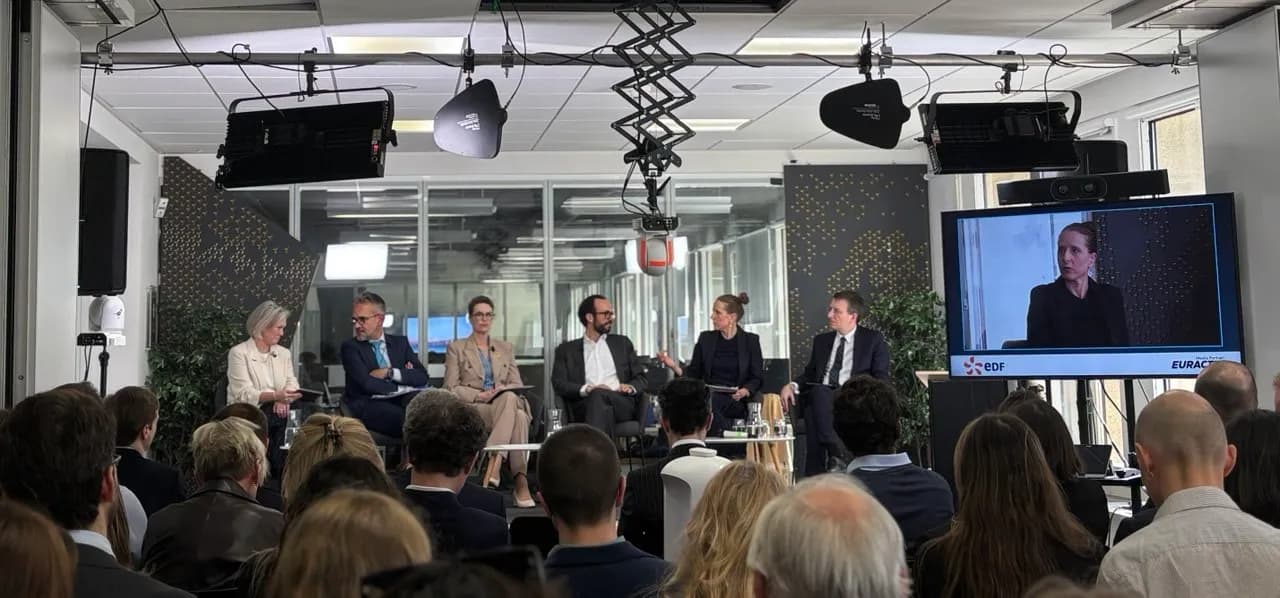
Brussels once again became a focal point for Europe’s energy debate this week, as policymakers, industry figures and analysts gathered for a discussion hosted by Euractiv in partnership with EDF. The event, titled “EDF’s Net Zero scenario – A pathway to a competitive, sovereign and decarbonized Europe,” brought together a cross-section of voices at a moment when the European Union is under increasing pressure to reconcile its climate targets with economic competitiveness and geopolitical realities.
From climate ambition to strategic necessity
What stood out in the discussion was a clear shift in tone. Achieving climate neutrality is no longer framed purely as an environmental obligation. Instead, it is increasingly seen as a question of sovereignty and industrial survival.
EDF’s updated net-zero scenario, presented during the session, reflects that shift. The roadmap places electrification at the centre of Europe’s transition, arguing that scaling up clean electricity production will be essential not only to cut emissions but also to stabilise energy costs and reduce dependence on external suppliers.
This argument resonated with a broader concern echoed throughout the debate: Europe risks falling behind if regulatory ambition is not matched by practical implementation and investment capacity.
A policy framework under strain
Much of the conversation revolved around the EU’s expanding body of climate and energy legislation. While participants acknowledged the importance of recent regulatory efforts, there was also a sense that the pace and complexity of new rules are creating friction.
From stricter emissions targets to evolving market design and reporting requirements, businesses are being asked to adapt quickly—sometimes faster than infrastructure and financing mechanisms can keep up.
Speakers pointed to a growing tension: on one hand, the EU is setting global standards for decarbonisation; on the other, European industries are facing rising costs and increased competition from regions with more flexible regulatory environments.
Voices from policy and industry
The event featured contributions from a range of stakeholders, each bringing a different perspective to the table.
Opening remarks by Marion Labatut set the stage for the discussion, followed by a detailed presentation of EDF’s scenario by Charles Weymuller. The panel that followed included Catherine Bauby, Marc Oliver Bettzüge, Pierre Schellekens and Sonya Twohig, with the conversation moderated by Dave Keating. Closing remarks were delivered by Luc Remont.
Despite differing institutional backgrounds, there was a notable degree of convergence on key issues—particularly the need for clearer long-term signals from policymakers.
Electrification as the backbone
If there was one point of consensus, it was the central role of electrification. Expanding electricity use across sectors—from transport to heavy industry—was repeatedly described as the most viable route to deep decarbonisation.
However, this transition comes with significant structural challenges. Grid capacity, cross-border coordination, and investment in new infrastructure were all identified as bottlenecks that could slow progress if not addressed urgently.
Investment, predictability and trust
Another recurring theme was the importance of predictability. Investors, speakers argued, need stable and coherent policy frameworks in order to commit to large-scale energy projects.
Frequent regulatory changes or unclear implementation pathways risk undermining confidence at a time when massive capital flows are required to transform Europe’s energy system.
In that sense, the debate moved beyond technical questions and into broader issues of governance and trust between institutions and the private sector.
A transition at a crossroads
What emerged from the discussion was not disagreement over the end goal—climate neutrality remains firmly in place—but uncertainty about the path forward.
Europe’s regulatory framework is becoming more comprehensive, but also more demanding. The challenge now lies in ensuring that these rules translate into tangible progress without weakening the continent’s industrial base.
As the event concluded, one message lingered: the success of Europe’s green transition will depend less on setting new targets and more on making existing ones achievable.
Olha Pashchenko
Contributing writer at EUReflect.
Follow EUReflect
See more of our reporting on Google
Mark EUReflect as a preferred source and our stories are ranked higher for you in Top Stories, Discover and Google News — and carry a “preferred” badge when they are cited in AI results.
Add EUReflect as a preferred source