Business Diplomat: Listen, Follow Through, Build Confidence
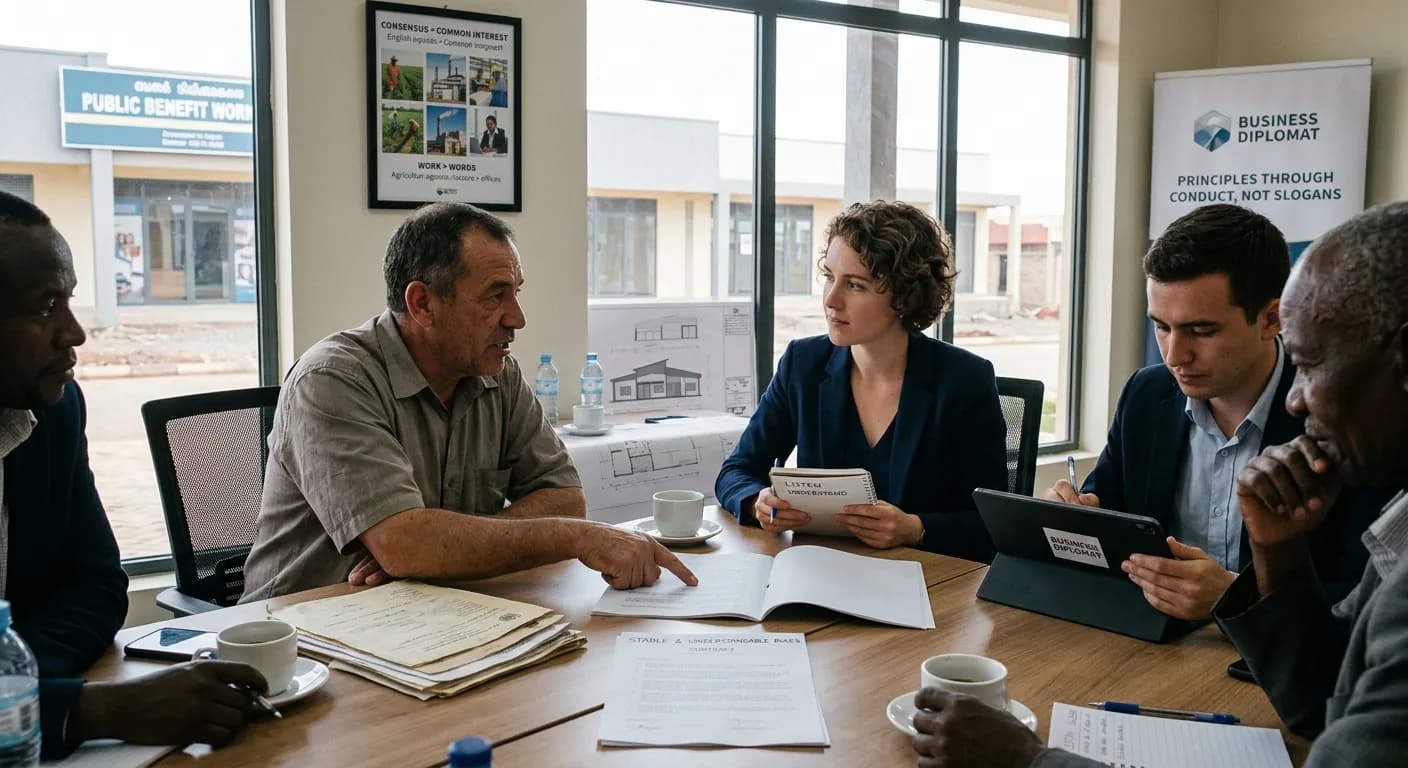
The first principle breaks problem-solving into four steps: listen, carry the issue to decision-makers, propose a solution, and follow through until a result is achieved. Each step addresses a common failure in institutional follow-through.

Introduction
Institutions are often judged by what they announce. A better test is what they do after the announcement: whether the problems they hear are carried to the people who can solve them, and whether anyone stays with the matter until it is resolved. In this part of its interview series, Business Diplomat presents three principles that describe such a way of working. Together they set out a task, a foundation and an outcome.
Three principles
"Our task is to listen to people, carry problems to the level of decision-making and legislation, propose solutions, and follow the process until a result is achieved.
A country's long-term future depends, above all, on knowledgeable and responsible people.
If entrepreneurs have confidence in tomorrow, they invest, create jobs and set the economy in motion."
Business Diplomat commentary
The three sentences move from method to people to results. The first describes how problems should be handled, the second names who makes a country's future, and the third explains what happens when both are in place.
A task in four steps. The first principle is unusually precise. It lists four actions in order: listen, carry the problem upward, propose a solution, and follow the process to the end. Each step guards against a familiar failure. Listening without carrying the problem upward leaves it where it was found. Raising a problem without a proposed solution adds a complaint to a pile. And proposing a solution without follow-up is where most good intentions stop. The closing phrase, "until a result is achieved", is the demanding part: it defines success by the outcome, not by the effort. This is also the working method of a good diplomat, who reports what is heard on the ground, recommends a course of action and stays with the file until it closes.
People before everything else. The second principle names two qualities, and the pairing matters. Knowledge without responsibility produces skilled people who serve only themselves. Responsibility without knowledge produces good intentions that cannot deliver. A country's long-term future needs both in the same person. Natural resources and favourable geography help, but they do not manage themselves. Institutions, companies and partnerships are run by people, and they are only as good as those people.
Confidence as an economic force. The third principle describes a chain: confidence leads to investment, investment to jobs, and jobs to a moving economy. The starting point is not capital but expectation. An entrepreneur who cannot foresee next year's rules postpones decisions and keeps resources idle. One who trusts that the rules will be stable and fairly applied commits for the long term. Confidence in tomorrow cannot be declared into existence. It is built by exactly the conduct the first principle describes: problems heard, raised and resolved.
How the three connect. Read together, the principles form a single argument. When business problems are listened to and followed through, entrepreneurs gain confidence. When knowledgeable and responsible people carry out that work, the confidence lasts. And lasting confidence is what turns into investment and employment.
The role of Business Diplomat. The platform's mission is to give young people experience, bring a diplomatic order to the business world, and benefit states by revitalising the economy. Each principle meets one part of it. Training knowledgeable and responsible young professionals answers the second. Acting as a channel that carries the concerns of the business community to decision-makers, with proposals attached, answers the first. And the confidence that results serves the third, the revitalised economy from which states benefit as well. Business Diplomat aims to be judged by the same standard the first principle sets: by results.
Conclusion
Listening that leads to action, people who combine knowledge with responsibility, and entrepreneurs who can trust tomorrow: these are the conditions of a healthy economy, and each depends on the others. Business Diplomat aims to contribute to all three by preparing capable young professionals, by carrying the voice of business to where decisions are made, and by helping build the confidence on which investment depends.
Sherzod Pulatov
Contributing writer at EUReflect.
Follow EUReflect
See more of our reporting on Google
Mark EUReflect as a preferred source and our stories are ranked higher for you in Top Stories, Discover and Google News — and carry a “preferred” badge when they are cited in AI results.
Add EUReflect as a preferred source