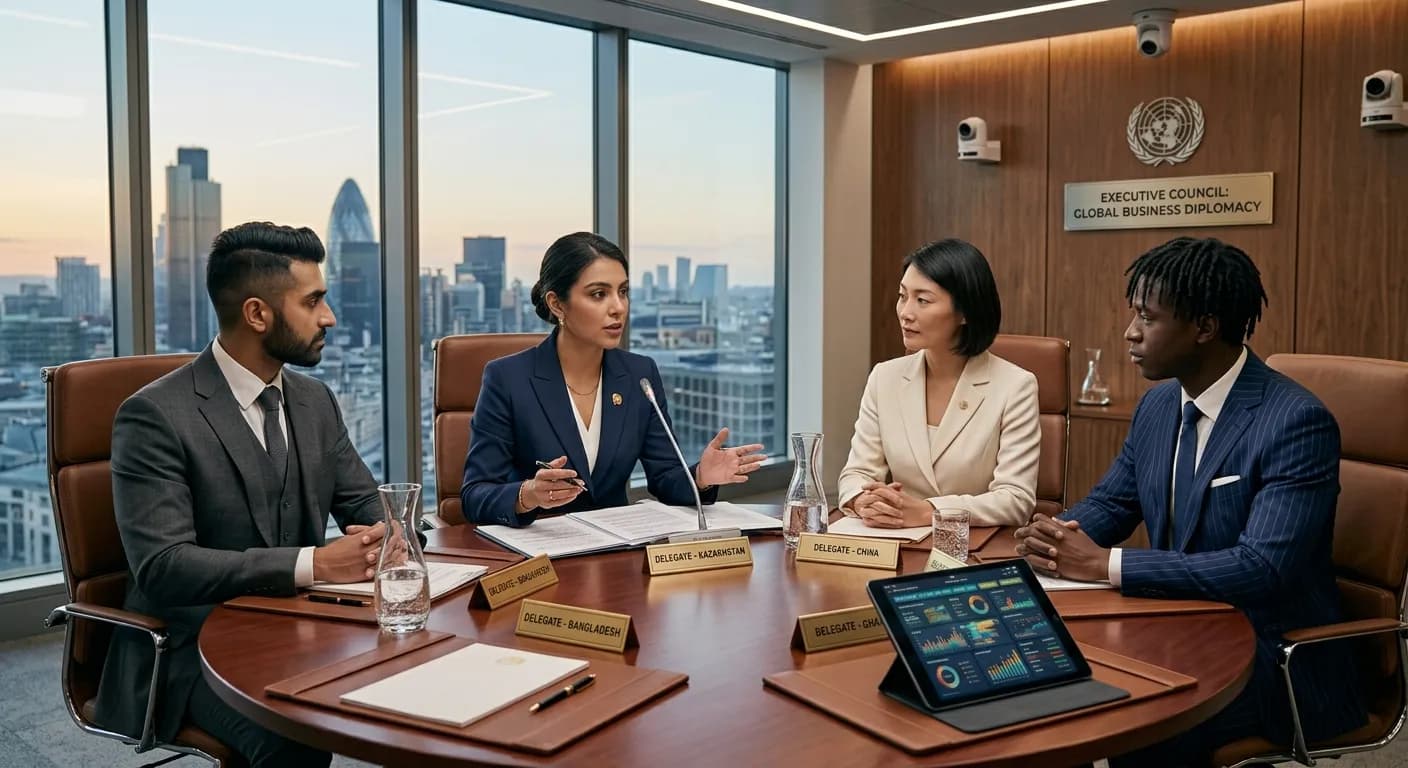
Business Diplomat: Protocol for the Digital Age
EUREFLECT conducted an exclusive interview with diplomat Lana Jalagonia on diplomacy, international business, and professional communication.

Introduction
The negotiating table is now often a screen. The visible elements of protocol, such as seating order, the welcome ceremony and the handshake, are absent from an online meeting. Do the rules of courtesy disappear with them, or do they take another form? In this question of its interview series, Business Diplomat presents the first-hand experience of someone who has worked in a Ministry of Foreign Affairs and coordinated with EU institutions and international partners.
Are the rules of diplomatic courtesy and protocol changing in the digital age; is a new etiquette emerging in online negotiations?
"In my experience, the rules of diplomatic courtesy and protocol are not disappearing in the digital age, but they are definitely evolving. Working in the Ministry of Foreign Affairs and coordinating with EU institutions, international partners and government counterparts, I have seen how much diplomatic communication has moved into digital spaces. Online meetings have become a normal part of international cooperation, negotiations and project coordination, particularly when participants are based in different countries and institutions.
I would say that a new form of etiquette is emerging, especially in online negotiations. Traditional diplomatic protocol is often very visible: how people are addressed, who speaks first, how a meeting is opened, where people sit, and how formal correspondence is conducted. Online, many of these physical signals disappear, so diplomacy increasingly depends on small digital behaviours that communicate the same things — respect, attentiveness, hierarchy and professionalism.
For example, punctuality has taken on an even more important meaning online. Joining a meeting on time, being technically prepared, checking that your microphone and camera work, and having the relevant documents available are not simply technical matters anymore; they are part of professional courtesy. The same applies to how participants enter a discussion. Interrupting someone is much more disruptive online because the natural cues of an in-person conversation are weaker. As a result, there is greater emphasis on waiting for someone to finish, using the 'raise hand' function when appropriate, and allowing the chair or moderator to manage the floor.
I have also noticed that online negotiations require a different sensitivity to silence and tone. In a physical meeting, you can often read body language, facial expressions, and the atmosphere in the room. Online, those signals can be limited or completely absent. A short response in a chat, a delayed email, or even the way a message is phrased can therefore be interpreted more strongly than intended. This makes clarity and diplomacy in written communication particularly important. A sentence that might sound neutral when said aloud can appear abrupt in an email or chat message.
Another emerging aspect is the etiquette around digital confidentiality. In diplomatic and inter-institutional work, participants have to be much more conscious of what can be shared on screen, what documents are circulated, who is copied into correspondence, and whether a meeting can be recorded. The boundaries between formal and informal communication are also less clear online. A negotiation may take place in a formal video conference but then continue through email or an instant-messaging platform. Knowing when to remain formal and when a more informal tone is appropriate has therefore become part of diplomatic judgement.
At the same time, I think online negotiations have made diplomacy somewhat more accessible and less hierarchical in certain respects. It is easier to bring experts into a meeting remotely, involve several institutions at once, or continue discussions without the cost and logistical burden of international travel. This can make negotiations more efficient, but it also means that diplomats and officials have to develop new habits for maintaining relationships when much of the interaction takes place through a screen.
From my own experience, therefore, I would not describe digital diplomacy as replacing traditional diplomatic protocol. Rather, it is creating a parallel layer of etiquette. The fundamental principles remain the same — respect, discretion, preparation, attentiveness and awareness of the other side — but they are expressed differently online. The emerging etiquette is less about formal gestures and more about digital attentiveness: respecting speaking time, being responsive, understanding the appropriate level of formality in different digital channels, protecting confidential information, and being conscious that technology can easily distort tone and context.
Ultimately, I think the most important change is that diplomacy online requires greater intentionality. In a physical meeting, many elements of courtesy happen naturally because the setting itself establishes the protocol. Online, those signals have to be created deliberately. The ability to do that while still maintaining trust and a constructive negotiating atmosphere is becoming an increasingly important diplomatic skill."
Business Diplomat commentary
This answer gives the question a clear reply: the rules are not disappearing; they are changing form. Its value lies in showing this through concrete behaviour instead of leaving it as a general judgement.
The same principles, new expressions. The main idea is gathered in the phrase "a parallel layer of etiquette". Respect, discretion, preparation and attentiveness stay the same, but they are now conveyed through small digital behaviours, not through seating plans or the order of greeting. For the business world this is a reassuring finding: there is no new body of rules to learn; it is enough to carry known principles into a new setting.
Technical preparation is a courtesy. That checking the microphone and camera in advance and having documents ready count as professional courtesy is the most practical observation in the answer. A party that spends the first five minutes of a meeting on connection problems has spent the other side's time. Not interrupting and leaving the floor to the moderator are the online form of the same respect.
The tone of writing. The point about silence and tone is especially valuable in international trade. Without body language, a short reply can seem cold, a delayed email reluctant and a direct sentence harsh. Between parties who speak different languages and come from different cultures, the risk is greater still. One more sentence of clarity and one more degree of tact in written communication prevent many misunderstandings.
Digital confidentiality. Screen sharing, the circulation of documents, who is copied into correspondence and permission to record are protocol questions that did not exist before. In business, what is at stake is commercial confidentiality. A wrong screen share or a carelessly widened recipient list can endanger a negotiation and a relationship of trust. Knowing which tone is appropriate when talks continue on a messaging app after the formal meeting belongs to the same judgement.
The opportunity and its price. The answer is balanced and also acknowledges what digitalisation brings: experts are easily included, several institutions come to the table at once, and the cost of travel disappears. For small and medium-sized companies this lowers the threshold for international contact. The price is that maintaining a relationship through a screen requires new habits. The closeness a face-to-face meeting creates does not arise unaided.
Intentionality. The final paragraph contains the deepest observation. In a physical setting the place establishes the protocol; online, the person has to establish it. Courtesy no longer happens naturally; it is shown deliberately. Those who have this skill can build trust despite the distance of the screen.
The role of Business Diplomat. The platform's mission is to give young people experience, bring a diplomatic order to the business world, and benefit states by revitalising the economy. Young professionals are at home with digital tools, yet the etiquette of those tools is rarely taught anywhere. Business Diplomat aims to combine diplomatic experience with the demands of the digital environment and give its members a culture of online negotiation and correspondence.
Conclusion
The digital age does not remove diplomatic courtesy; it adds a parallel layer to it. Respect, discretion, preparation and attentiveness remain, but they are expressed through a punctual connection, measured writing, protected information and care for speaking order. The greatest change is that this courtesy now calls for deliberate effort. Business Diplomat aims to raise a generation of business diplomats who can build trust in front of a screen as well.
Olha Pashchenko
Contributing writer at EUReflect.
Follow EUReflect
See more of our reporting on Google
Mark EUReflect as a preferred source and our stories are ranked higher for you in Top Stories, Discover and Google News — and carry a “preferred” badge when they are cited in AI results.
Add EUReflect as a preferred source