Business Diplomat: Safeguards That Work
Clear responsibilities, intercultural training, an approval process for sensitive statements and a response procedure: António Buscardini sets out what institutionalised reputation management looks like, and why it should stay proportionate. Interviewed by: Olha Pashchenko Interviewee: António Buscardini, Founder & CEO; President, Press Club Brussels Europe
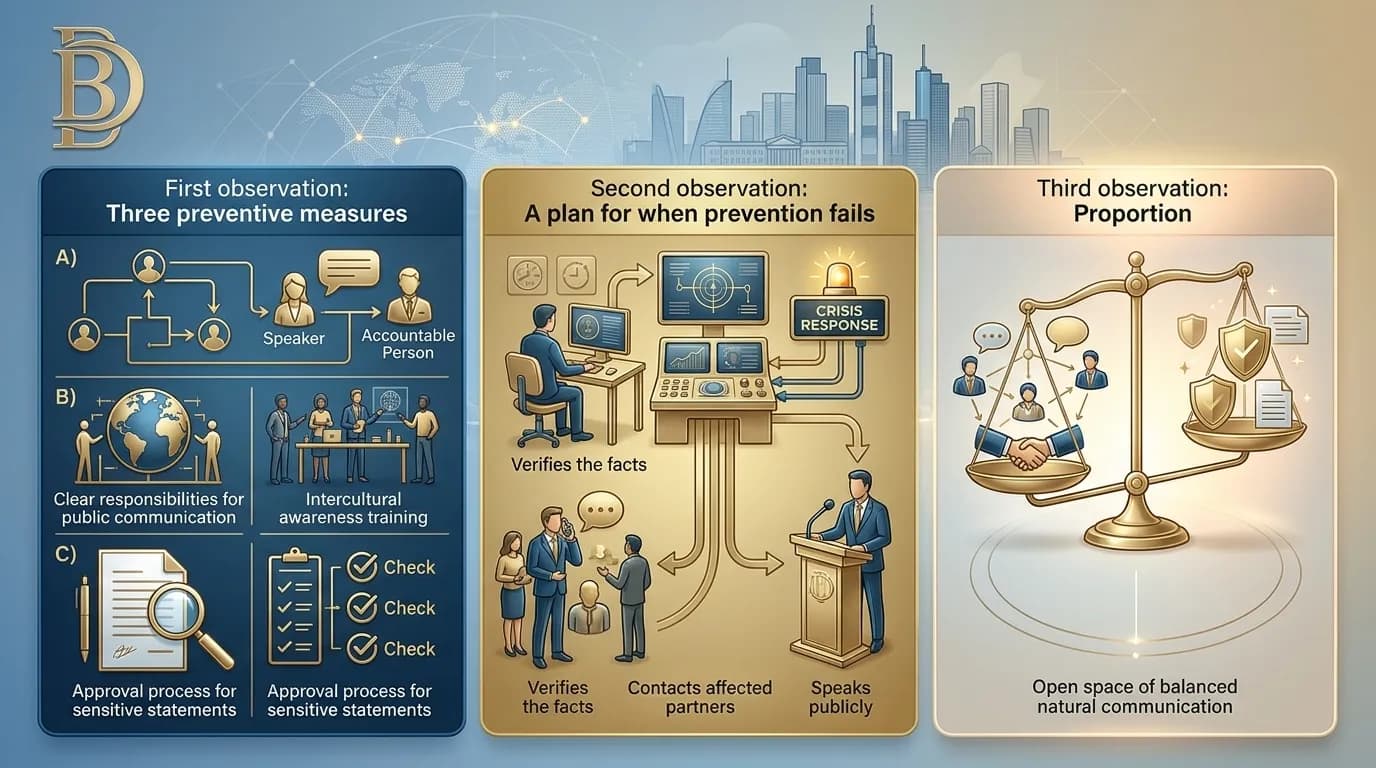
Saying that reputation matters is easy. Saying what an organisation should actually do about it is harder. In this part of its interview series, Business Diplomat presents an assessment by António Buscardini, Founder & CEO and President of the Press Club Brussels Europe. Having argued that reputation management belongs in everyday governance, he lists the practical elements that make this real.
Three preventive measures
First observation: three preventive measures
The assessment first names what should be in place before anything goes wrong:
“Businesses should establish clear responsibilities for public communication, train their teams in intercultural awareness and introduce an approval process for sensitive statements.”
Each of the three addresses a different weakness. Clear responsibilities remove the uncertainty about who is allowed to speak and who is accountable when someone does. Intercultural training deals with the problem of context: people who understand how a message may be read elsewhere are less likely to publish one that causes harm. An approval process for sensitive statements adds a second pair of eyes at the moment when it is cheapest to catch a mistake. The word “sensitive” matters: the process is meant for the statements that carry risk, not for every message.
A plan for when prevention fails
Second observation: a plan for when prevention fails
Prevention can reduce risk but not remove it. The assessment therefore adds a second layer:
“They also need a practical response procedure: who verifies the facts, who contacts affected partners and who speaks publicly.”
The three questions are about roles, not about wording. Someone must establish what actually happened before anything is said. Someone must contact the partners who are affected, personally and before they read about it elsewhere. And someone must be the public voice, so that the organisation does not speak in several tones at once. Settling these answers in advance saves hours at the moment when hours matter most.
Proportion as a safeguard
Third observation: proportion
The passage ends with a limit on the whole system:
“These safeguards should be proportionate, allowing people to communicate naturally while recognising the responsibilities that come with representing an organisation.”
This sentence prevents the argument from turning into an advertisement for control. A company that approves every message and trains its staff into silence has not protected its reputation; it has made itself unreadable. Buscardini asks for a balance: people should be able to speak in their own voices, with an awareness that when they represent an organisation, their words are also the organisation’s.
The logic of the assessment
The logic of the assessment
The three observations make a complete system. Before: responsibilities, training and approval. During: a response procedure with named roles. Throughout: proportion, so that safeguards do not suffocate normal communication. The structure moves from prevention to response to limits, which is the order in which a sensible institution builds such arrangements.
The role of Business Diplomat
The role of Business Diplomat
The platform’s mission is to give young people experience, bring a diplomatic order to the business world, and benefit states by revitalising the economy. A “diplomatic order” in communication looks very much like what Buscardini describes: defined roles, awareness of other cultures, care with sensitive statements and a clear procedure for when something goes wrong. Business Diplomat can give young professionals this framework early in their careers, before they are asked to build it for an organisation.
Conclusion
Institutionalising digital reputation means giving it structure: clear responsibilities, intercultural training, an approval process for sensitive statements and a response procedure that says who checks the facts, who calls the partners and who speaks. These measures should be proportionate, so that people can still communicate naturally. Business Diplomat aims to make this kind of preparation part of how young professionals learn to represent organisations.
Olha Pashchenko
Contributing writer at EUReflect.
Follow EUReflect
See more of our reporting on Google
Mark EUReflect as a preferred source and our stories are ranked higher for you in Top Stories, Discover and Google News — and carry a “preferred” badge when they are cited in AI results.
Add EUReflect as a preferred source