Business Diplomat: Trust Behind the Screen
Technology has made diplomacy faster, but trust still takes patience, cultural awareness and the ability to listen. Elene Metreveli says digital diplomacy needs traditional values adapted to new tools, not entirely new rules. Interviewed by: Olha Pashchenko Interviewee: Elene Metreveli, European Parliament (EPP Group)

Technology has solved the problem of distance. It has not solved the problem of trust. In this part of its interview series, Business Diplomat presents an assessment by Elene Metreveli, who works in the European Parliament for a Member of the EPP Group. Asked whether a new etiquette is emerging in online negotiations, she identifies the central tension of digital diplomacy and then answers the question of new rules with a clear position: adapt the old values rather than invent new ones.
Balancing efficiency and personal connection
First observation: the tension
The assessment names the problem directly:
“In my view, one of the biggest challenges is finding the right balance between efficiency and personal connection.”
Two goods are placed on a scale. Efficiency is what the digital medium delivers: meetings arranged in minutes, documents exchanged instantly, no travel. Personal connection is what it tends to erode: the conversation before the meeting, the meal afterward, the sense of the other person as a person. The word “balance” matters. Metreveli does not ask for a return to the old way, nor does she accept that efficiency should win by default. She asks for a judgment about where, in each relationship, the line should fall.
Second observation: what trust still requires
The second sentence explains why the balance is hard:
“Technology makes communication easier, but building trust still requires patience, cultural awareness, and the ability to listen.”
The sentence distinguishes communication from trust. Communication has become easy; trust has not. Three requirements are listed, and none of them can be accelerated. Patience runs against the speed the medium encourages. Cultural awareness demands knowledge that a video call does not supply on its own. The ability to listen is harder on a screen, where attention is divided and silence is awkward. The word “still” carries the argument: these requirements predate the technology and survive it unchanged. Trust is built at the pace of people, not of networks.
Adapting traditional diplomatic values
Third observation: no new rulebook
The third sentence answers the question about new etiquette:
“Ultimately, I don’t think digital diplomacy needs entirely new rules.”
The answer is negative, with a qualification. “Entirely” leaves room for new habits and conventions, but denies that the foundations must be rewritten. This is consistent with the distinction between form and principle that runs through the whole assessment. A new medium needs new manners, in the sense of practical adjustments; it does not need new values. The person who respected a counterpart across a table knows how to respect one across a screen, once the practicalities are learned.
Fourth observation: adaptation without loss
The closing sentence states the principle:
“Rather, we need to adapt traditional diplomatic values to modern ways of communicating, without losing the human element that makes diplomacy effective.”
The verb is “adapt”, not “replace” or “abandon”. Traditional values are carried into the new medium. The final clause is the warning: the human element must not be lost, and the reason given is practical, not sentimental. The human element is what “makes diplomacy effective”. Diplomacy works because people come to trust each other enough to make commitments. Remove the human element and the medium may still transmit messages, but it will no longer produce agreements.
The logic of the assessment
The logic of the assessment
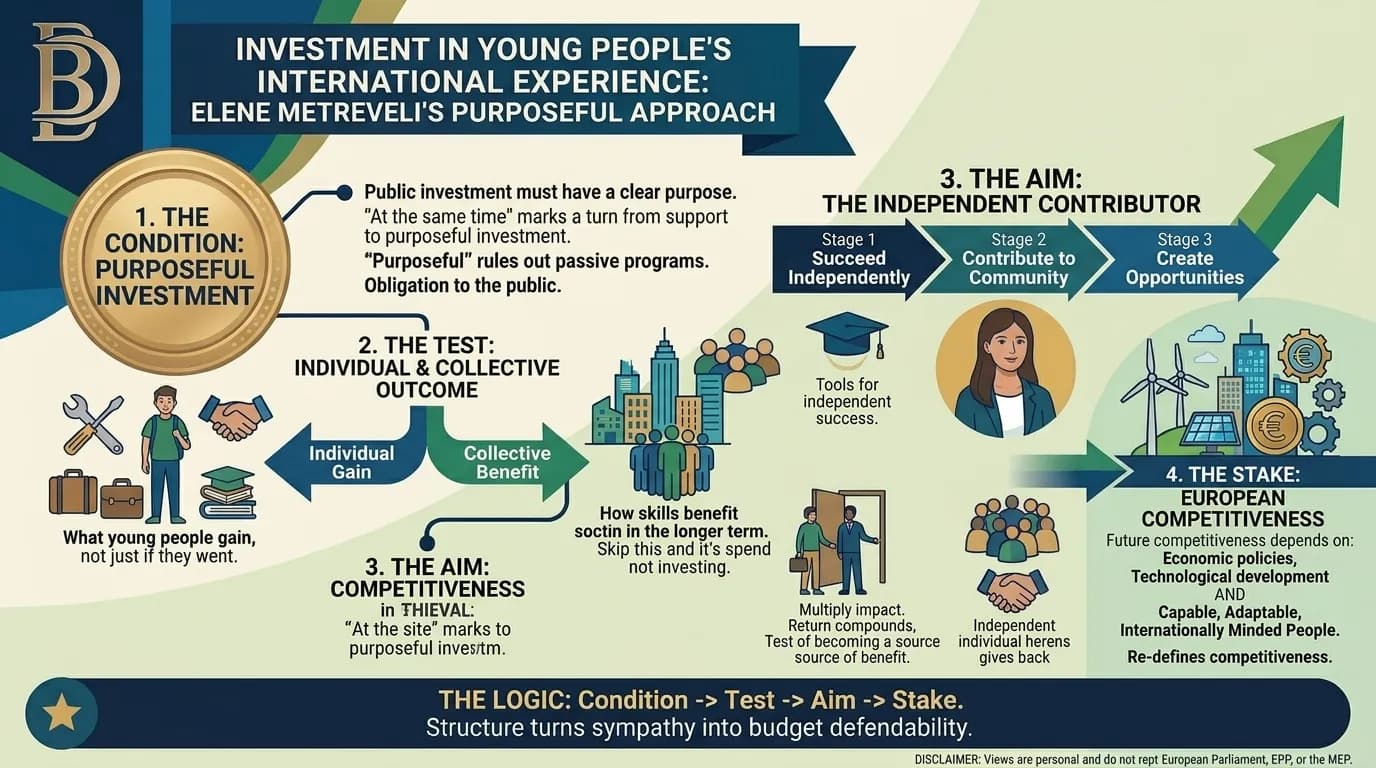
The four sentences form a complete argument. The challenge is to balance efficiency against personal connection. The balance is hard because trust still requires patience, awareness and listening, none of which the technology speeds up. The answer is not a new set of rules. It is the adaptation of old values to new means, with the human element preserved because it is the source of diplomacy’s effectiveness. The structure moves from tension to cause to answer to principle.
Business Diplomat's mission
The role of Business Diplomat
The platform’s mission is to give young people experience, bring a diplomatic order to the business world, and benefit states by revitalising the economy. Metreveli’s warning about the human element speaks directly to the first of these aims. Experience of the kind the platform offers cannot be acquired through a screen alone. Business Diplomat brings young professionals into the same room as diplomats, parliamentarians and businesspeople, because that is where patience, cultural awareness and the ability to listen are learned. It then expects them to carry those values into the email and the video call, which is the adaptation the assessment calls for.
Conclusion
The central challenge of digital diplomacy is the balance between efficiency and personal connection. Technology has made communication easy, but trust still demands patience, cultural awareness and the ability to listen. Digital diplomacy therefore does not need entirely new rules; it needs traditional diplomatic values adapted to modern means, with the human element preserved, because that element is what makes diplomacy work. Business Diplomat aims to be the place where young professionals learn those values in person and then carry them online.
Disclaimer: The views expressed in this article are solely the personal opinions of Elene Metreveli and do not represent the official positions of the European Parliament, the EPP Group, or the Member of the European Parliament for whom she works.
Related Topics
Olha Pashchenko
Contributing writer at EUReflect.
Follow EUReflect
See more of our reporting on Google
Mark EUReflect as a preferred source and our stories are ranked higher for you in Top Stories, Discover and Google News — and carry a “preferred” badge when they are cited in AI results.
Add EUReflect as a preferred source