Business Diplomat: Opportunity Without Privilege
International opportunities should not depend on money or personal connections, says Elene Metreveli, pointing to paid traineeships, professional exchanges and partnerships between universities, businesses and public institutions. Interviewed by: Olha Pashchenko Interviewee: Elene Metreveli, European Parliament (EPP Group)

Everyone agrees that international experience is good for young people. Fewer people ask who actually gets it. In this part of its interview series, Business Diplomat presents an assessment by Elene Metreveli, who works in the European Parliament for a Member of the EPP Group. Her answer on public support for young people’s international experience contains a section on access, and it is the most pointed part of the whole assessment. It names the barrier, explains who is kept out, and sets out what public support should look like.
The barrier of money and connections
First observation: the barrier
The assessment states the problem as a matter of principle:
“I don’t think international opportunities should depend on someone’s financial situation or personal connections.”
Two gatekeepers are named: money and connections. The first is obvious. A traineeship in another country costs rent, travel and months without a salary, and only some families can carry that. The second is less visible but just as effective. Many opportunities are never advertised; they pass by word of mouth, through a parent’s colleague or a professor’s acquaintance. Metreveli refuses both as a basis for selection. The word “should” is normative: this is not a description of how things are but a statement of how they ought to be.
Who is left out
Second observation: who is left out
The second sentence turns from principle to people:
“There are many talented and motivated young people who simply lack the resources or information to access them.”
The sentence is careful. The young people in question are “talented and motivated”, so the problem is not with them. What they lack is of two kinds: resources and information. The distinction matters for policy. Lack of resources is solved with money. Lack of information is solved with outreach, and it is often the cheaper and more neglected half. A programme that is fully funded but known only to those already in the right circles has not solved the access problem; it has merely subsidised it.
Where public support comes in
Third observation: where the state comes in
The third sentence is short:
“This is where public support can make a real difference.”
The placement is precise. Public support is not asked to do everything; it is asked to intervene exactly where the private barriers are. Where a family cannot pay, the state can. Where information does not circulate, a public institution can make it circulate. “Real difference” implies a contrast with support that is symbolic, announced but not reaching those who need it.
What good support looks like
Fourth observation: what good support looks like
The assessment then becomes practical:
“In Europe, programmes such as Erasmus+ have shown how valuable international mobility can be. I believe we should also pay more attention to practical experience, including paid traineeships, professional exchanges, and partnerships between universities, businesses, and public institutions. The private sector also has an important role to play, particularly in helping young people develop skills that are relevant to today’s labour market.”
Erasmus+ is cited as proof that mobility programmes work. But the word “also” signals a shift of emphasis from study to practice. Three instruments are listed. The first is paid traineeships, and the adjective is the point: an unpaid traineeship reproduces exactly the financial barrier named at the start. The second is professional exchanges. The third is partnerships between universities, businesses and public institutions, which means the three sectors that hold the opportunities should organise them together rather than separately. The private sector is given a specific task: labour-market relevance. Public programmes can fund mobility; businesses know which skills are actually needed.
The logic of the assessment
The logic of the assessment
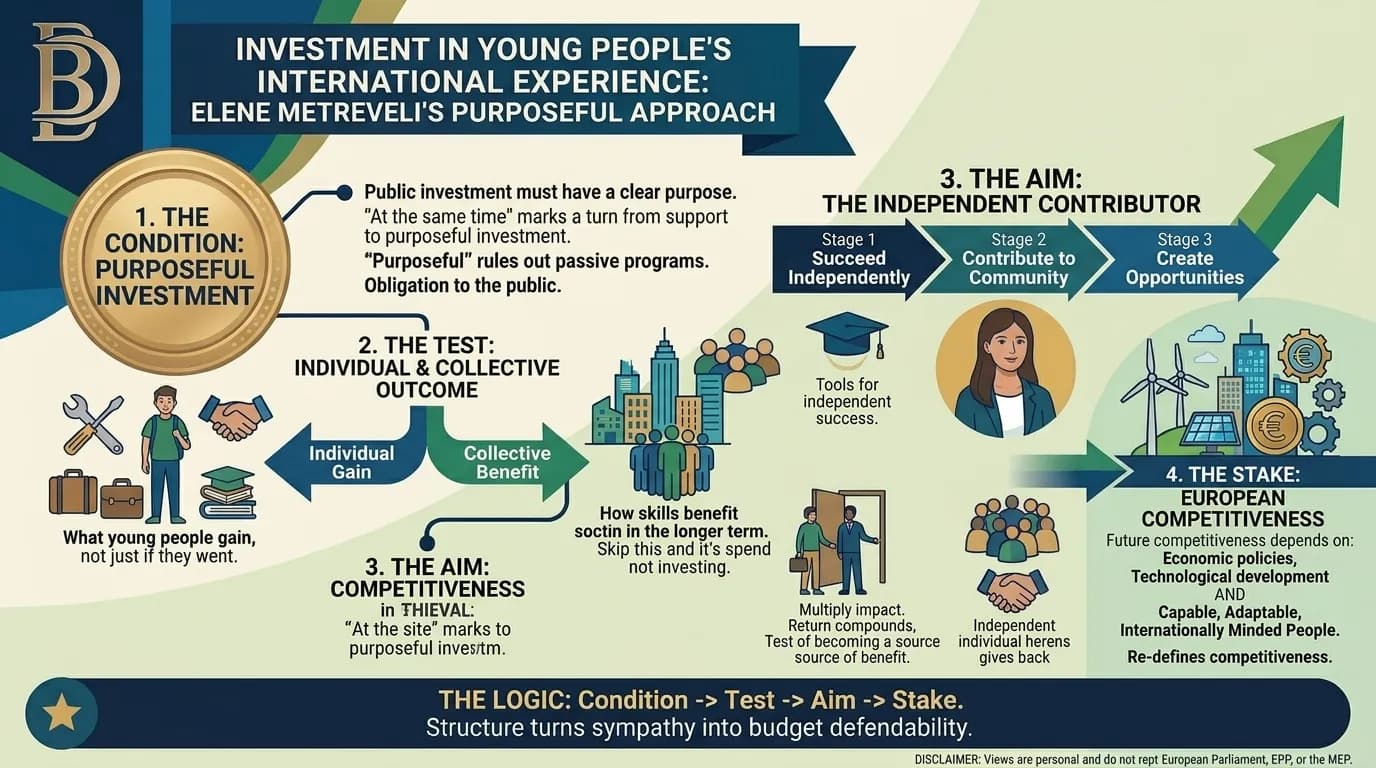
The four steps form an argument. Access should not depend on money or connections. Those excluded are capable people lacking resources or information. Public support belongs exactly at that point. And the form it should take is practical, paid and organised in partnership, with the private sector supplying relevance. The argument moves from principle to diagnosis to remedy to design, which is the order in which a policy is properly built.
The role of Business Diplomat
The role of Business Diplomat
The platform’s mission is to give young people experience, bring a diplomatic order to the business world, and benefit states by revitalising the economy. The partnership Metreveli calls for, between universities, businesses and public institutions, is the space in which Business Diplomat operates. By connecting young professionals directly with diplomats, officials and businesspeople, the platform addresses the second barrier in particular: information and connections. A young person who has no family link to the diplomatic or business world can acquire one through the platform. In this sense Business Diplomat works as a mechanism for turning privilege into access.
Conclusion
International opportunities should not depend on a young person’s financial situation or personal connections. The talented and motivated who are kept out lack resources or information, and public support belongs exactly there. The right instruments are paid traineeships, professional exchanges and partnerships across universities, business and public institutions, with the private sector ensuring that the skills acquired are the ones the labour market needs. Business Diplomat aims to be one of the partnerships through which that access is opened.
Disclaimer: The views expressed in this article are solely the personal opinions of Elene Metreveli and do not represent the official positions of the European Parliament, the EPP Group, or the Member of the European Parliament for whom she works.
Olha Pashchenko
Contributing writer at EUReflect.
Follow EUReflect
See more of our reporting on Google
Mark EUReflect as a preferred source and our stories are ranked higher for you in Top Stories, Discover and Google News — and carry a “preferred” badge when they are cited in AI results.
Add EUReflect as a preferred source