Business Diplomat: An Investment in the Future
Elene Metreveli argues that young people’s international experience is not an expense but a public investment, building the ability to understand other societies, work across backgrounds and see beyond the national perspective. Interviewed by: Olha Pashchenko Interviewee: Elene Metreveli, European Parliament
The cost question
When the subject of young people going abroad comes up, the discussion usually turns to cost. Who pays for the exchange, the traineeship, the year at a foreign university? In this part of its interview series, Business Diplomat presents an assessment by Elene Metreveli, who works in the European Parliament for a Member of the EPP Group. Asked whether states should treat young people’s international experience as a public investment, she answers with a clear yes and then explains what the investment actually buys.
An expense or an investment
First observation: an expense or an investment?
The assessment opens without hesitation:
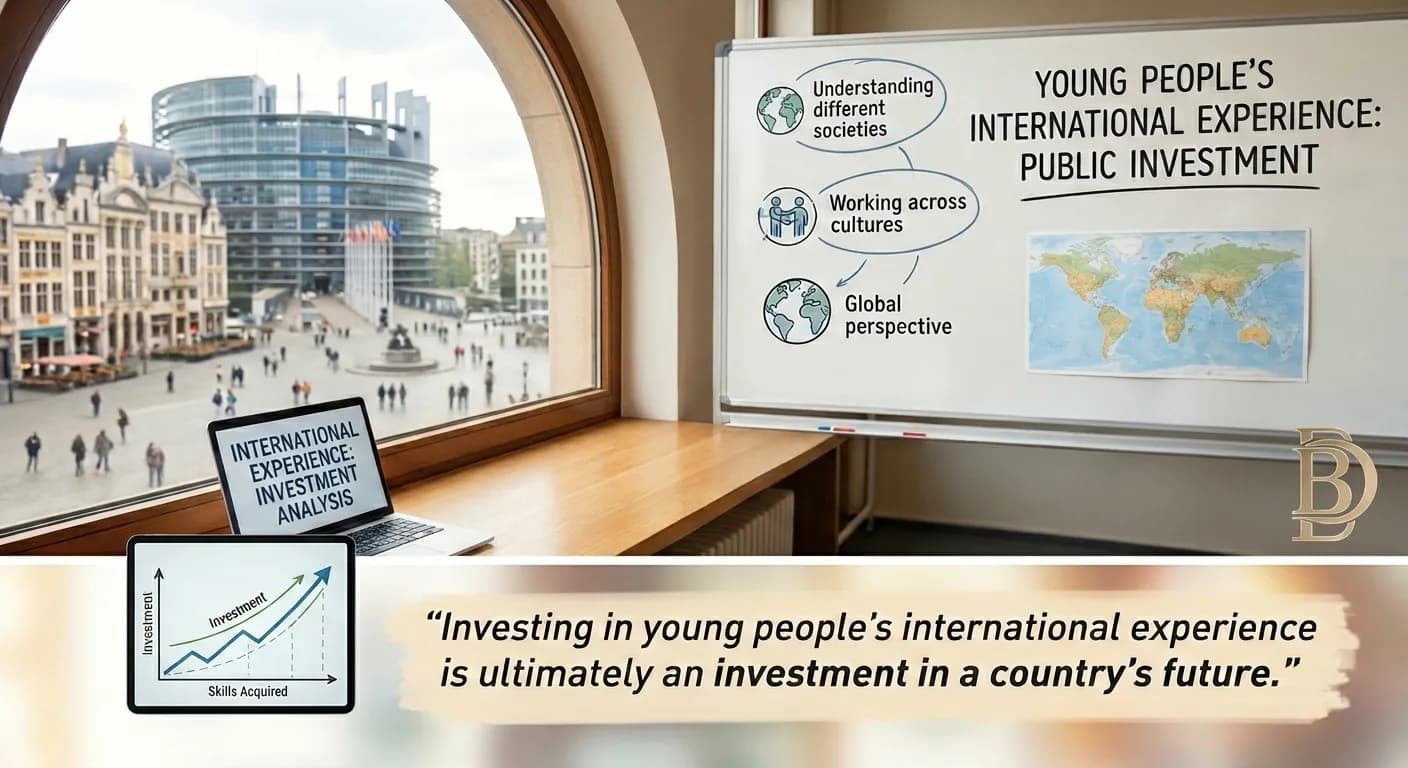
“I believe they should. Investing in young people’s international experience is ultimately an investment in a country’s future.”
The decisive word is “investment”. An expense is money that leaves; an investment is money that returns. By placing international experience in the second category, Metreveli changes the question. The issue is no longer whether a state can afford to send young people abroad, but what it receives in return. The word “ultimately” adds a time dimension: the return does not arrive next year. It arrives when the young person who studied or worked abroad is leading an institution, a company or a negotiation.
What education leaves out
Second observation: what education usually leaves out
The second sentence identifies what is missing from the ordinary debate on education:
“We often discuss education in terms of qualifications and employment, but I think there is another dimension that deserves more attention, which is the ability to understand different societies, work with people from different backgrounds, and see challenges beyond one’s own national perspective.”
Qualifications and employment are measurable, and that is why they dominate. The “other dimension” is harder to count but no less real. Metreveli breaks it into three abilities. The first is understanding other societies: knowing why people elsewhere think and decide as they do. The second is working with people from different backgrounds: not merely tolerating difference but producing results with it. The third is seeing challenges beyond one’s own national perspective: recognising that most of today’s problems, from trade to climate, do not stop at a border. None of these appears on a diploma, yet each one decides whether a professional can operate internationally.
How the skills are acquired
Third observation: how the skills are acquired
The third sentence names the channels and the results:
“Whether through education, professional exchanges, or working in an international environment, young people gain a better understanding of how institutions, economies, and societies function. They also learn to adapt, take responsibility, and become more confident in their own abilities.”
Three channels are listed, and they are not equal in weight. Education abroad is the classic route. Professional exchanges bring the young person into a working institution. Working in an international environment is the most demanding, because the stakes are real. What the three share is that they teach by exposure rather than by instruction. The results are of two kinds. The first is knowledge of how institutions, economies and societies function, which is the raw material of any international career. The second is personal: adaptability, responsibility and confidence. A young person who has had to manage alone in a foreign system returns with a different relationship to difficulty.
The logic of the assessment
The three sentences move in a line. International experience is an investment, not an expense. What it develops is the dimension of education that qualifications do not capture: understanding, cooperation and perspective. And it develops these through exposure, which also produces adaptability, responsibility and confidence. The structure moves from the category of the thing to its content and then to the mechanism by which it works. Each step makes the opening claim more concrete.
The role of Business Diplomat
The role of Business Diplomat
The platform’s mission is to give young people experience, bring a diplomatic order to the business world, and benefit states by revitalising the economy. Metreveli’s assessment describes the first of these aims from the perspective of a European institution. Business Diplomat does not wait for public programmes to reach every young person; it offers the exposure that the assessment describes, bringing young professionals into contact with diplomats, parliamentarians and businesspeople from different countries. The skills it seeks to develop are the same three Metreveli lists: understanding other societies, working across backgrounds and seeing beyond the national frame.
Conclusion
States should treat young people’s international experience as a public investment because it is one. Its return is a generation able to understand other societies, work with people of different backgrounds and see challenges beyond the national perspective, while gaining the adaptability, responsibility and confidence that only exposure produces. These qualities are not measured by qualifications, but they decide who can act internationally. Business Diplomat aims to create the ground on which young people acquire them.
Disclaimer: The views expressed in this article are solely the personal opinions of Elene Metreveli and do not represent the official positions of the European Parliament, the EPP Group, or the Member of the European Parliament for whom she works.
Olha Pashchenko
Contributing writer at EUReflect.
Follow EUReflect
See more of our reporting on Google
Mark EUReflect as a preferred source and our stories are ranked higher for you in Top Stories, Discover and Google News — and carry a “preferred” badge when they are cited in AI results.
Add EUReflect as a preferred source