Business Diplomat: Purposeful Investment
Public support for young people’s international experience must be purposeful, Elene Metreveli says: it should help individuals succeed independently, contribute to their communities and create opportunities for others. Interviewed by: Olha Pashchenko Interviewee: Elene Metreveli, European Parliament (EPP Group)
Assessing what participants become
It is easy to fund an exchange programme and count the participants. It is harder to say what the participants became. In this part of its interview series, Business Diplomat presents an assessment by Elene Metreveli, who works in the European Parliament for a Member of the EPP Group. Having argued that states should invest in young people’s international experience, she adds a condition that is often missing from such arguments: the investment must have a purpose, and the purpose must reach beyond the individual.
The condition of purposeful investment
First observation: the condition
The assessment introduces the condition with a qualifying phrase:
“At the same time, public investment needs to be purposeful.”
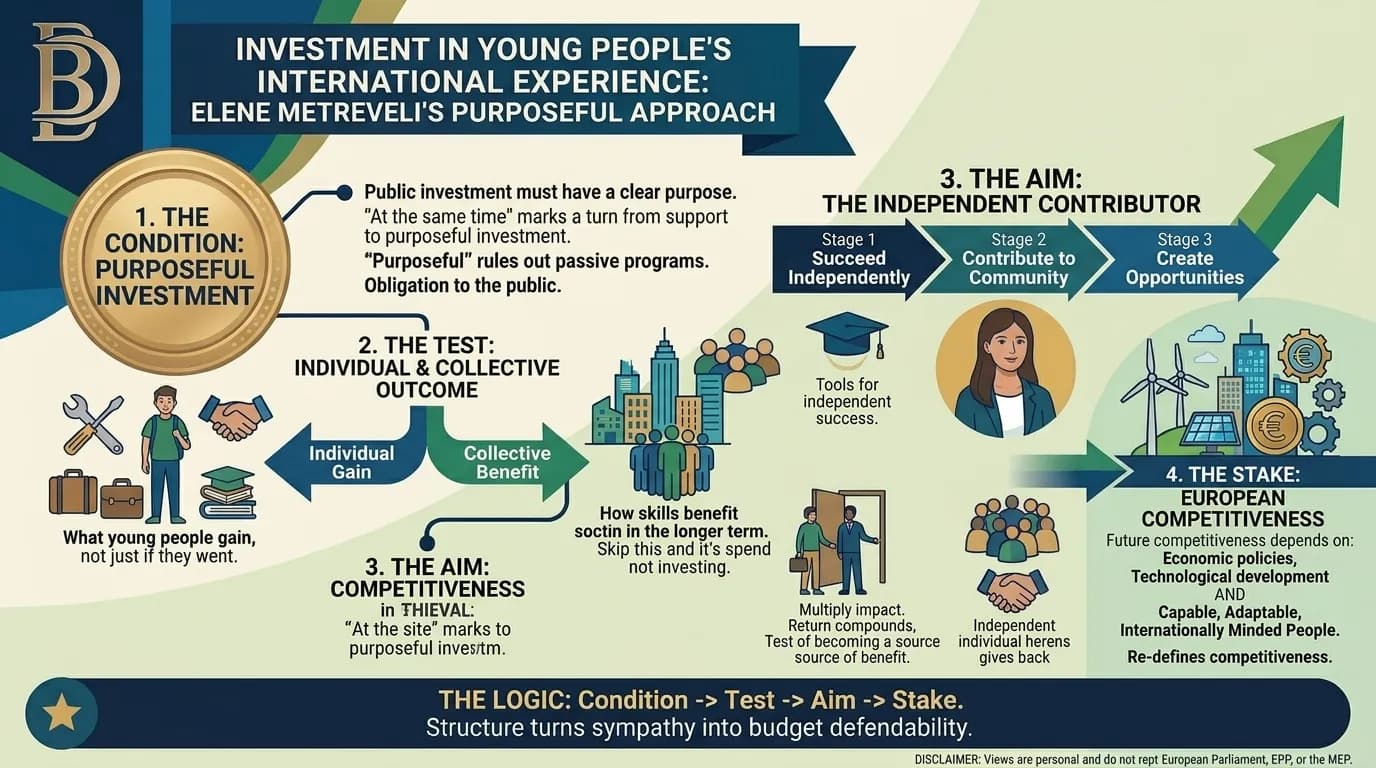
“At the same time” marks a turn. Up to this point the assessment has argued for more support; now it says what kind. The word “purposeful” rules out a certain type of programme: the one that exists because it sounds good, sends people abroad and never asks what happened next. Public money carries an obligation to the public, and that obligation is not discharged by the act of spending.
Two questions for any programme
Second observation: two questions a programme must answer
The second sentence states the test:
“Providing opportunities is important, but we should also consider what young people gain from them and how those skills can benefit society in the longer term.”
The sentence sets two questions beside the act of providing. The first is what the young person gains: not whether they went, but what they returned with. The second is how those gains benefit society over the longer term. This second question is the one most programmes skip. It asks for a link between the individual’s skills and a collective outcome, and it asks for it over a horizon longer than a budget year. A programme that cannot answer either question is spending, not investing.
The aim in three steps
Third observation: the aim in three steps
The third sentence defines the aim:
“The aim should be to give individuals the tools to succeed independently, contribute to their communities, and create opportunities for others.”
The aim unfolds in three stages, and the order is deliberate. First, independence: the young person is equipped to succeed without continued support. Second, contribution: the independent individual gives back to a community. Third, multiplication: the contributor creates opportunities for others, who begin the cycle again. The structure describes a programme that ends its own dependency. The state invests once; the return compounds. The phrase “create opportunities for others” is the strongest test of purpose, because it asks whether the person who benefited has become a source of benefit.
The European stake
Fourth observation: the European stake
The assessment closes by placing the argument in its own context:
“For me, this is especially relevant in the European context. Our future competitiveness depends not only on economic policies or technological development, but also on having capable, adaptable, and internationally minded people. Giving young people the opportunity to develop these qualities is, in my view, one of the most valuable investments a country can make.”
The word “competitiveness” connects the argument to the hardest-headed part of policy. Europe debates its competitiveness in terms of regulation, energy and technology. Metreveli adds a third term: people, and specifically people who are “capable, adaptable, and internationally minded”. The three adjectives echo the skills described earlier in the assessment. The closing sentence returns to the language of investment, now with a ranking: “one of the most valuable”. The claim is not modest, and it is made deliberately.
The logic of the assessment
The logic of the assessment
The four sentences impose discipline on an argument for generosity. Investment must be purposeful. Purpose means asking what the young person gained and how society benefits. The aim is a three-stage sequence from independence to contribution to multiplication. And the stake is nothing less than competitiveness. The structure moves from condition to test to aim to stake, which turns a sympathetic cause into a case that can be defended in a budget debate.
The role of Business Diplomat
The platform’s mission is to give young people experience, bring a diplomatic order to the business world, and benefit states by revitalising the economy. The third element of that mission is precisely the “longer term” benefit to society that Metreveli demands of any purposeful investment. Business Diplomat is built on the sequence she describes: young professionals are given experience, they become capable of acting independently, they contribute to the business and diplomatic communities, and in time they open doors for those who follow. The platform treats the young person not as a beneficiary but as a future source of benefit.
Conclusion
Public investment in young people’s international experience must be purposeful. That means asking what the young person gains and how society benefits over the longer term, and aiming for a sequence in which individuals succeed independently, contribute to their communities and create opportunities for others. In the European context, this is a matter of competitiveness, which depends on capable, adaptable and internationally minded people as much as on policy or technology. Business Diplomat aims to be a place where that sequence begins.
Disclaimer: The views expressed in this article are solely the personal opinions of Elene Metreveli and do not represent the official positions of the European Parliament, the EPP Group, or the Member of the European Parliament for whom she works.
Olha Pashchenko
Contributing writer at EUReflect.
Follow EUReflect
See more of our reporting on Google
Mark EUReflect as a preferred source and our stories are ranked higher for you in Top Stories, Discover and Google News — and carry a “preferred” badge when they are cited in AI results.
Add EUReflect as a preferred source