China Builds Power Beyond Its Borders
Beijing's strategy blends trade, infrastructure, and diplomacy, with Xi Jinping set to attend the SCO summit in Kyrgyzstan and visit Egypt for the first time in a decade.
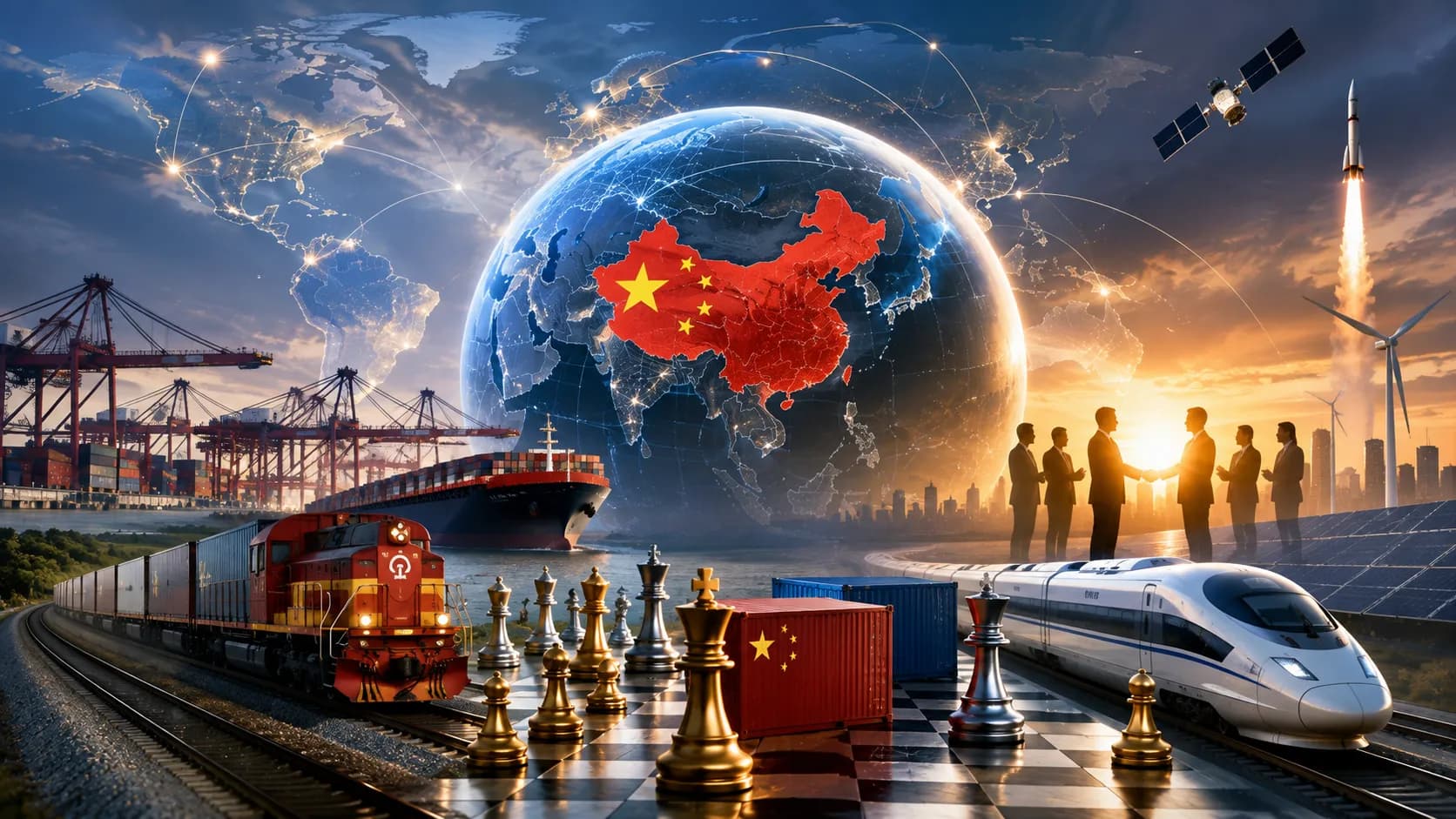
China's campaign to establish itself as a global superpower is increasingly being conducted through foreign policy rather than military power alone. In 2026, Beijing is combining trade, infrastructure, technology, access to strategic resources, diplomacy and selective security cooperation to expand its influence across Asia, Africa, the Middle East and the wider Global South.
The strategy is becoming particularly visible this week. President Xi Jinping is preparing to attend the Shanghai Cooperation Organization summit in Kyrgyzstan before making his first state visit to Egypt in a decade. At the same time, China is deepening economic and defence relations with major emerging economies such as Indonesia.
Taken together, these developments reveal an important feature of China's rise: Beijing is attempting to build power through networks of economic dependence and political partnership rather than through traditional alliances alone.
The Global South Becomes Central
China increasingly presents itself as a political representative and development partner of the Global South.
Beijing argues that developing countries should receive greater representation within institutions such as the IMF and World Bank, while simultaneously strengthening alternative platforms including BRICS and the Shanghai Cooperation Organization. China will assume the BRICS chairmanship in 2027, giving Beijing another mechanism through which to influence international economic and security debates.
This strategy gives China an important advantage.
Rather than asking developing countries to formally choose between China and the West, Beijing generally offers investment and political cooperation while emphasizing sovereignty and non-interference.
That approach can be attractive to governments seeking economic development without becoming formally aligned with either Washington or Beijing.
The Belt and Road Is Changing
The Belt and Road Initiative remains one of China's most important foreign-policy instruments, but its character is evolving.
The first phase was dominated by railways, ports, highways, energy facilities and other large infrastructure projects. China's newer approach increasingly combines infrastructure with industrial production, digital technologies, renewable energy, vocational training and technological cooperation.
This distinction is strategically important.
Building a railway gives China economic influence. Helping establish industrial ecosystems, telecommunications networks, energy infrastructure and technology platforms can create relationships lasting decades.
China is therefore moving from exporting infrastructure toward exporting parts of its development model.
Central Asia Is Becoming More Important
Central Asia has emerged as one of the clearest examples.
Xi's upcoming visit to Kyrgyzstan for the SCO summit demonstrates the region's growing importance to Beijing. China requires Central Asia for energy, minerals, overland trade routes and connectivity toward Europe and the Middle East.
China's influence is also expanding as Russia's traditional economic dominance in the region weakens.
Research published this year argues that Beijing is developing new trade corridors, technological relationships and economic structures that gradually reduce Central Asia's dependence on Moscow.
For China, Central Asia is therefore becoming more than a neighboring region. It is part of the geographic architecture connecting the Chinese economy with Eurasia.
Technology Is Becoming Foreign Policy
Another important transformation concerns technology.
China increasingly exports electric vehicles, batteries, telecommunications equipment, renewable-energy systems, artificial intelligence capabilities and advanced manufacturing technologies alongside traditional infrastructure.
Its relationship with Indonesia illustrates this approach.
The two countries agreed this month to deepen cooperation in artificial intelligence, satellites, green energy, rail transportation, minerals and defence. Chinese investment in Indonesia reached approximately $3.9 billion during the first half of 2026, according to Indonesian figures cited by Reuters.
China is particularly interested in Indonesia's enormous nickel resources, which are strategically important for batteries and electric vehicles.
This illustrates how Beijing increasingly connects foreign policy with technology and resource security.
Economic Relations Are Expanding Into Security
China has traditionally avoided building an alliance system comparable to that of the United States.
But economic partnerships are increasingly developing security dimensions.
China and Indonesia agreed this month to strengthen military cooperation, while discussions have included a potential joint ammunition factory and Chinese technology transfers.
The Shanghai Cooperation Organization provides another mechanism through which China can combine diplomacy, economics and security cooperation.
This does not mean China is attempting to reproduce NATO.
Its model is different: Beijing generally prefers flexible partnerships that allow countries to maintain other relationships while simultaneously becoming economically and strategically closer to China.
Egypt Shows China's Middle East Ambition
Xi's upcoming visit to Egypt is another significant signal.
Egypt controls the Suez Canal, connects Africa with the Middle East and Mediterranean and occupies an important position in global shipping.
Xi's visit will be his first state visit to Egypt in ten years.
China's broader Middle Eastern strategy reflects the same logic visible elsewhere: maintain relations with competing states, expand trade and investment, secure energy supplies and avoid becoming permanently tied to one regional bloc.
This gives Beijing room to work simultaneously with countries that may have conflicting interests.
China Wants to Influence the Rules
China's ambitions increasingly extend beyond bilateral relationships.
A Chinese government white paper released this summer calls for reforms to global governance and greater representation for developing countries while promoting Chinese initiatives in areas including artificial intelligence governance, data security, climate policy, cyberspace and international mediation.
This represents the next stage of China's superpower strategy.
A country becomes a major economic power by producing goods and accumulating capital.
A superpower, however, also influences the institutions and rules through which other countries operate.
China increasingly wants to do both.
Beijing's Strategy Has Limits
China's rise nevertheless faces significant obstacles.
Territorial disputes in the South China Sea continue to generate distrust among neighboring states. Indonesia, for example, is strengthening relations with China while simultaneously maintaining defence cooperation with the United States and Japan.
Other countries welcome Chinese investment but remain concerned about economic dependence, debt, trade imbalances, local employment and Beijing's political influence.
China must therefore solve a difficult strategic problem: expanding its influence without creating a coalition designed to contain that influence.
China's Superpower Strategy Is Becoming Clearer
China's foreign policy in 2026 increasingly operates through several interconnected instruments: infrastructure creates connectivity, trade creates dependence, technology creates long-term integration, investment creates political relationships, resources strengthen industrial security and multilateral institutions increase diplomatic influence.
Military modernization remains important, particularly around Taiwan and the Western Pacific. But China's global strategy extends far beyond its armed forces.
Beijing is attempting to create an international environment in which more countries depend on Chinese markets, capital, infrastructure and technology while simultaneously supporting a greater Chinese role in global governance.
That may ultimately be the most important element of China's superpower strategy.
China is not simply trying to become stronger inside the existing international system. It is increasingly trying to gain enough influence to help shape what that system becomes.
Ahmet Balakan
Contributing writer at EUReflect.
Follow EUReflect
See more of our reporting on Google
Mark EUReflect as a preferred source and our stories are ranked higher for you in Top Stories, Discover and Google News — and carry a “preferred” badge when they are cited in AI results.
Add EUReflect as a preferred source