India’s Diplomatic Traffic Signals a More Assertive Global Role
Despite Western pressure, India maintains its Russia partnership, using platforms like the SCO to engage multiple powers simultaneously.
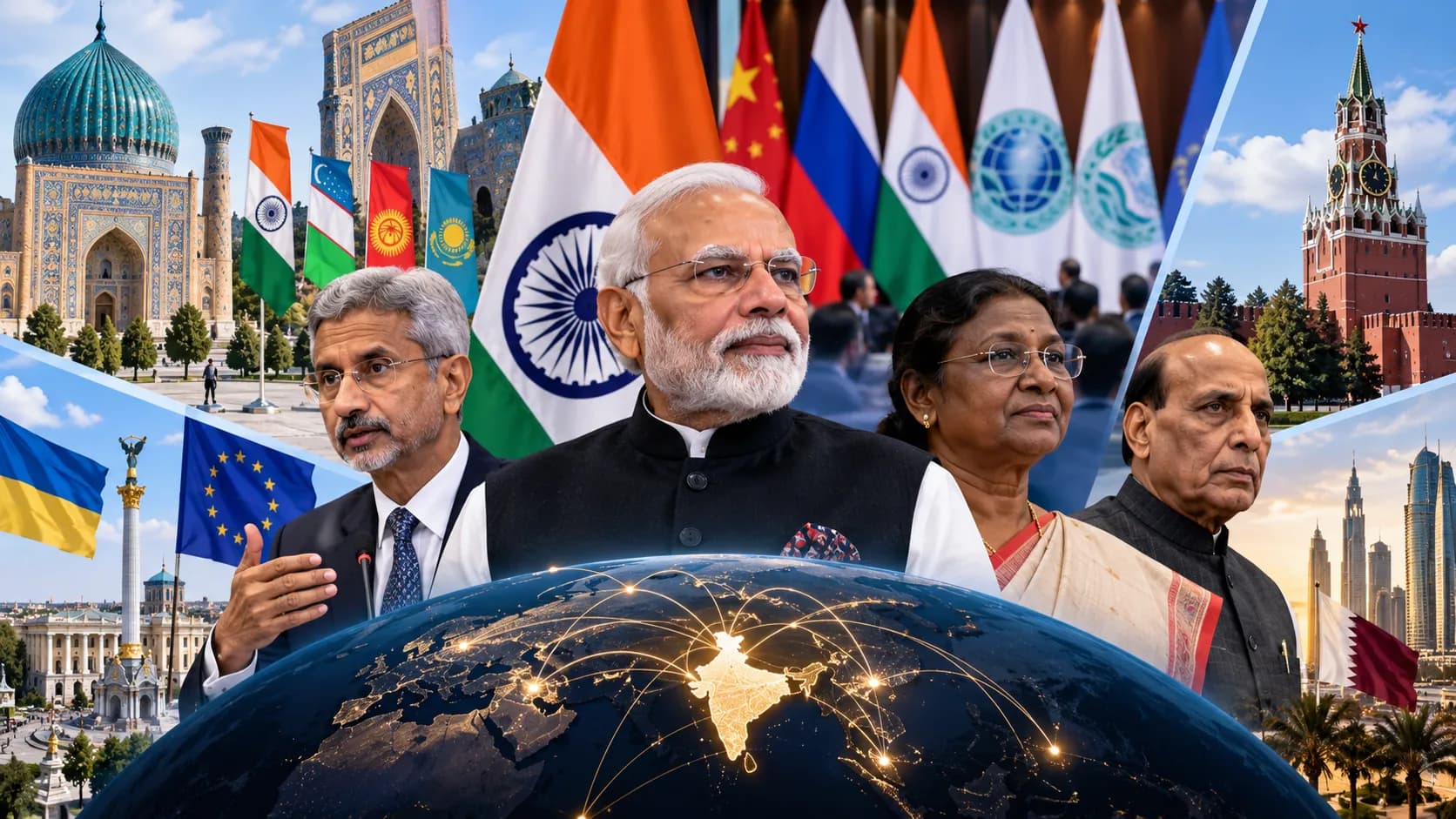
India has experienced an unusually intense period of diplomatic activity over the past two weeks, with Prime Minister Narendra Modi, External Affairs Minister S. Jaishankar, President Droupadi Murmu and the wider Indian security establishment engaging different parts of the international system almost simultaneously.
From Central Asia to Russia and Europe, New Delhi’s recent diplomatic traffic reveals something larger than a collection of bilateral meetings. India appears to be reinforcing a foreign-policy model based on strategic autonomy: maintaining established partnerships while simultaneously developing relations with multiple centres of global power.
Modi Places Central Asia at the Centre
Prime Minister Narendra Modi’s state visit to Uzbekistan on 29–30 August was one of the most consequential stops in this diplomatic sequence.
According to the official joint statement issued by the Prime Minister of India, Modi and Uzbek President Shavkat Mirziyoyev conducted a comprehensive review of bilateral relations as well as regional and international issues.
The visit produced agreements covering higher education and research, economic cooperation, tourism, mining, environmental issues, culture, Ayurveda and regional partnerships.
Read the official details of Modi’s talks in Uzbekistan
The visit carried considerable symbolic weight as well. President Mirziyoyev awarded Modi the “Oliy Darajali Do’stlik” Order, Uzbekistan’s highest honour for foreign leaders.
Read the official announcement
The developments demonstrate that India increasingly views Central Asia not simply through the traditional lens of security and Afghanistan, but also through connectivity, minerals, technology, education, investment and long-term geopolitical engagement.
Central Asia and the SCO
Following Uzbekistan, Modi travelled to the Kyrgyz Republic for the Shanghai Cooperation Organisation summit.
Ahead of the visit, the Indian Prime Minister described security, connectivity and opportunity as central elements of India's approach to the region. He also identified terrorism, separatism and extremism as continuing threats to regional peace and stability.
For New Delhi, participation in the SCO provides an important platform through which India can simultaneously engage Russia, China, Iran and the Central Asian republics.
India wants deeper Eurasian integration, but it also continues to emphasise sovereignty and its own strategic independence.
Russia Remains Essential
Russia continues to occupy a distinctive position in India's foreign-policy architecture.
Despite profound changes in the international system, New Delhi has resisted pressure to abandon its longstanding relationship with Moscow. Energy, defence, technology and wider strategic cooperation remain important components of the partnership.
At the same time, India has repeatedly advocated dialogue and diplomacy regarding the war in Ukraine.
This balancing act represents one of the clearest examples of India's strategic-autonomy doctrine: New Delhi wants to preserve its relationship with Moscow without closing diplomatic channels with Ukraine, Europe or the United States.
Jaishankar and India’s Multi-Directional Diplomacy
External Affairs Minister S. Jaishankar represents another important pillar of this strategy.
India's foreign minister has increasingly pursued diplomacy across competing geopolitical spaces, reinforcing relationships with traditional partners while simultaneously expanding India's engagement with Europe, the Gulf, the Indo-Pacific and the Global South.
This is not simply diplomatic flexibility.
It reflects India's attempt to avoid permanent dependency on any single international bloc.
Rather than choosing between Russia and the West, New Delhi increasingly seeks productive relationships with both.
President Murmu Defines the Economic Dimension
President Droupadi Murmu has also provided an important indication of how India sees the future of its diplomacy.
Speaking to Indian Foreign Service officer trainees on 27 August, Murmu said India's economic rise was creating new possibilities for its engagement with the world.
She specifically encouraged India's future diplomats to identify international opportunities in investment, technology, manufacturing, renewable energy and innovation.
Read President Murmu’s official remarks
Her message suggests that Indian diplomacy is increasingly expected to contribute directly to the country's economic transformation.
Diplomats are therefore no longer tasked solely with managing political relations. They are increasingly expected to attract investment, build technological partnerships and connect India with emerging economic opportunities.
What Is India Trying to Achieve?
The diplomatic activity of recent weeks suggests that New Delhi is pursuing neither traditional neutrality nor conventional non-alignment.
A more accurate description is multi-alignment combined with strategic autonomy.
India can cooperate with Russia while maintaining dialogue with Ukraine.
It can participate in the SCO alongside China while protecting its own sovereignty concerns.
It can develop strategic relations with the United States and Europe without automatically adopting every Western geopolitical position.
It can maintain relations with Iran while simultaneously developing extensive partnerships with the Gulf states.
And it can expand its presence in Central Asia without presenting itself as an ideological challenger to either Russia or China.
Central Asia Is Becoming Increasingly Important
One of the strongest signals emerging from recent Indian diplomacy concerns Central Asia.
Uzbekistan offers opportunities in minerals, education, technology, healthcare, environmental cooperation and investment. The SCO provides India with a broader Eurasian political platform, while Russia remains a major strategic partner.
Prime Minister Modi himself described a stronger India–Uzbekistan partnership as potentially becoming a significant force for “peace, progress and prosperity in Central Asia.”
Read Modi’s official statement in Uzbekistan
India Wants a Seat at Every Important Table
Taken together, the diplomatic movements of Modi, Jaishankar, Murmu and India's wider foreign-policy establishment reveal a country increasingly comfortable engaging competing powers simultaneously.
India does not appear interested in becoming merely the Asian pillar of a Western geopolitical strategy. Nor does it appear willing to position itself permanently inside a China-Russia-centred political bloc.
Instead, New Delhi is attempting something considerably more ambitious: maintaining sufficiently strong relationships with competing centres of power to preserve its freedom of action.
This is ultimately what distinguishes India's emerging diplomacy.
New Delhi does not simply want a seat at the world's most important tables. It increasingly wants India to become one of the tables around which global diplomacy is conducted.
Alvara Merrick
Contributing writer at EUReflect.
Follow EUReflect
See more of our reporting on Google
Mark EUReflect as a preferred source and our stories are ranked higher for you in Top Stories, Discover and Google News — and carry a “preferred” badge when they are cited in AI results.
Add EUReflect as a preferred source