Cooking Sustainably with Malaysia: A Culinary Showcase with Malaysian Palm Oil
At a culinary showcase in Brussels, Malaysia made its case for sustainable palm oil through nasi lemak, Belgian fries and a timely message to the EU: certification, traceability and market access must go hand in hand.
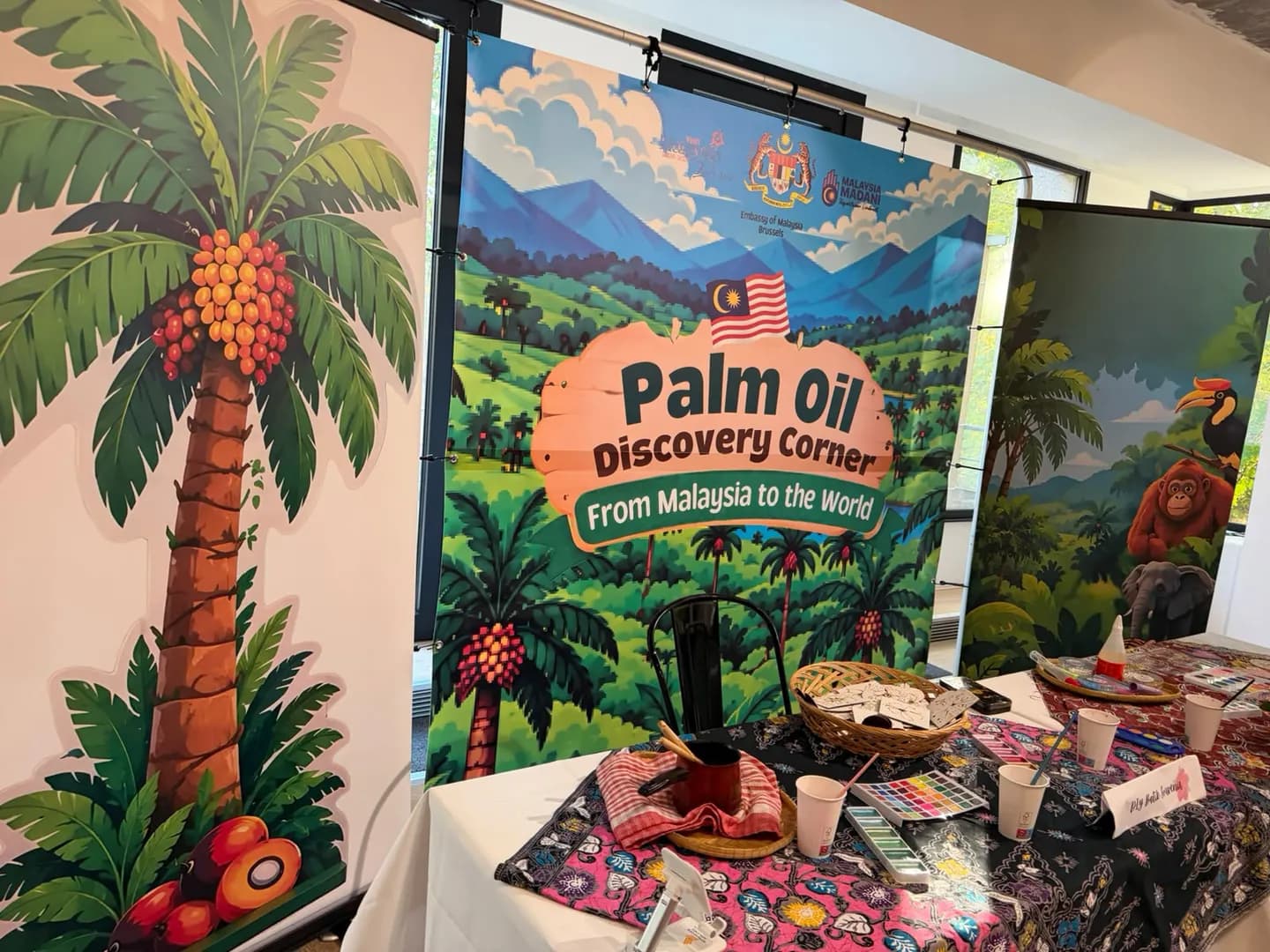
Cooking Sustainably with Malaysia: One Ingredient, Two Kitchens
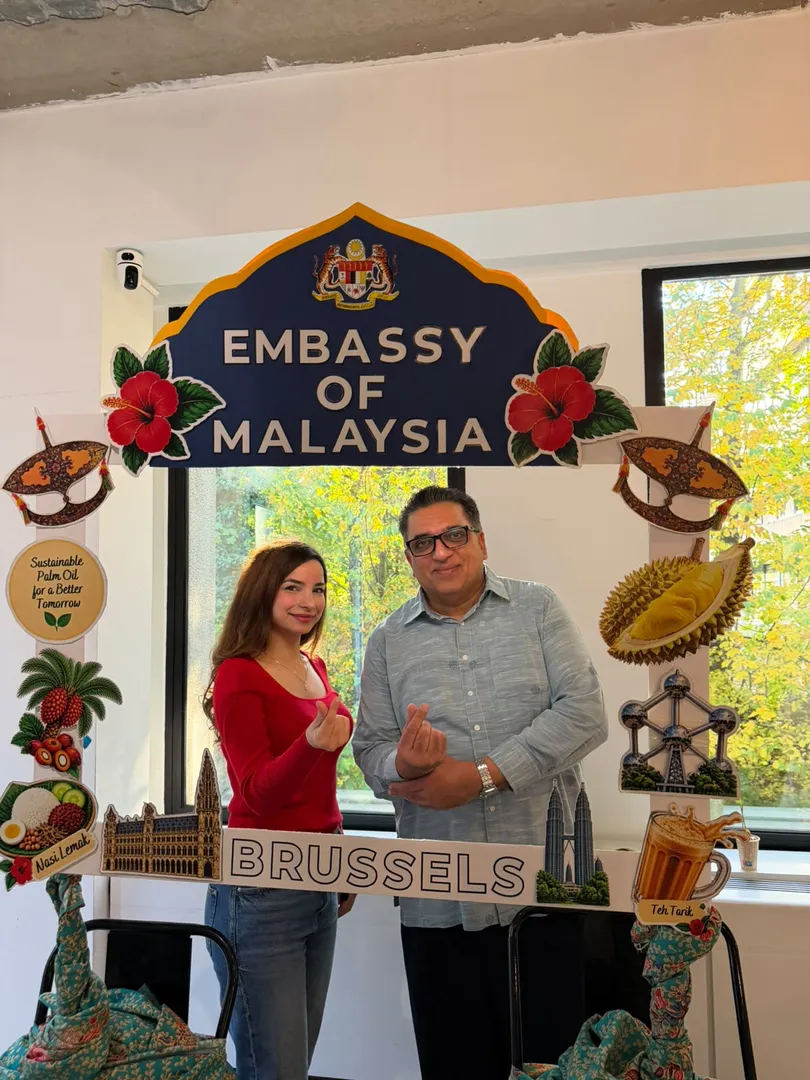
Brussels, 5 November 2026 — At the Excellis Centre, the Embassy of Malaysia turned an everyday ingredient into the focus of an afternoon devoted to food, sustainability and the future of EU–Malaysia relations. “Cooking Sustainably with Malaysia: A Culinary Showcase with Malaysian Palm Oil” was the Embassy’s first event of its kind: a live culinary demonstration, a briefing on responsible production, and a timely intervention in one of the most sensitive debates between Kuala Lumpur and Brussels.
The event was opened by journalist Derya Soysal, who welcomed guests including H.E. Ambassador Maria Castillo Fernandez, the European Union’s Special Envoy for the Indo-Pacific, and members of the Malaysian community.
Two kitchens, one ingredient
The concept was straightforward: show how a single ingredient can connect Malaysian and Belgian culinary traditions. Guests were served nasi lemak bungkus, beef and chicken satay, curry puffs, kuih kasturi, teh tarik and roti jala with chicken curry — all prepared with Malaysian palm oil, both as an ingredient and for frying.
The most symbolic dish, however, was Belgian. For the first time, the Embassy served Belgian fries fried in Malaysian palm oil.
“Two kitchens, one ingredient. Through live cooking demonstrations, you will discover how sustainable Malaysian palm oil complements different culinary traditions, from authentic Malaysian favourites to Belgian specialties.”
The choice of fries was more than a culinary gesture. It placed Malaysian palm oil directly within a familiar European food culture, making the point that the ingredient is already part of everyday European consumption rather than a distant tropical commodity.
The opening remarks also reminded guests that palm oil is present in far more products than most consumers realise.
“Palm oil is part of everyday life, often without us noticing it. It is used in the food we eat, the cosmetics we buy, and products ranging from pharmaceuticals to renewable energy. It is also one of the world’s most versatile and efficient vegetable oils.”
The science behind the cooking
The showcase was not only about taste. Speakers explained why palm oil remains widely used in food manufacturing, particularly in products requiring stability, texture and long shelf life.
Malaysian palm oil’s oxidative stability makes it suitable for high-temperature cooking, including frying. Its naturally semi-solid consistency also provides texture and functionality in bakery products, confectionery and specialty fats.
The presentation highlighted another practical advantage for food producers: palm oil can be used in formulations without partial hydrogenation, offering an alternative to oils associated with industrially produced trans fats. Palm oil also naturally contains vitamin E compounds, including tocopherols and tocotrienols, although levels vary according to processing and refining.
The presentations that followed, from the Malaysian Palm Oil Council, SD Guthrie Netherlands and Halal Quality Control Belgium, expanded on these themes, linking the food on guests’ plates to certification systems, supply-chain controls and European market demand.
What sits behind the bottle
For European consumers, questions about palm oil often begin long before the product reaches the kitchen. Malaysia’s response, presented during the event, rests on its national certification system.
Malaysian Sustainable Palm Oil, or MSPO, is mandatory across the Malaysian industry. The MSPO 2.0 standard includes a deforestation cut-off date, commitments to human rights and customary rights, prohibitions on forced, trafficked and child labour, anti-discrimination and anti-harassment requirements, and greenhouse-gas emissions calculations.
According to figures presented at the event, approximately 92% of Malaysia’s oil palm planted area was MSPO-certified as of August 2026.
Certification is also being supported by a wider traceability architecture. Malaysia’s National Commodity Traceability System, SKKM, is designed to integrate e-MSPO, GeoSAWIT and the Sawit Intelligent Management System into a single platform. By combining certification data, geolocation coordinates and verified transactions, the system aims to allow buyers to trace the origin of their oil. It is expected to launch in early 2027.
“For European consumers, the questions about palm oil often begin long before it reaches the kitchen. In Malaysia, they are answered through a national system.”
A reliable supplier for Europe
The event also underlined the economic weight of the Malaysia–EU palm oil relationship. In 2025, the European Union imported 1.03 million tonnes of palm oil from Malaysia, worth USD 5.1 billion and representing roughly one-third of Malaysia’s total palm oil exports.
According to Eurostat data cited during the event, around 80% of EU crude and refined palm oil imports are used for food purposes. Imports of solid palm oil fractions, including palm stearin, have remained relatively stable at between 500,000 and 650,000 tonnes annually since 2019.
These figures explain why palm oil remains embedded in European food manufacturing, from bakery products and spreads to confectionery and snack foods. They also explain why Malaysia sees the EU Deforestation Regulation, due to apply to large and medium-sized companies from 31 December 2026, as a decisive test for the future of the trade relationship.
“As European consumers and food businesses increasingly prioritise sustainability and responsible sourcing, Malaysia continues to strengthen its sustainable production standards and supply-chain transparency.”
Malaysia’s position
In her interview with EU Reflect, H.E. Dato’ Mohd Khalid Abbasi Abdul, Ambassador of Malaysia to Belgium, Luxembourg and Head of Mission to the European Union, made Malaysia’s position explicit.
“The whole idea of today’s event is to tell our European friends that we in Malaysia fully comply with the EUDR,” he said. “We do not do deforestation. We do not kill orangutans. We do everything sustainably, and it has been proven.”
He pointed to Malaysia’s decade-long efforts to improve the palm oil sector and to the MSPO certification scheme as evidence of that commitment.
“In Malaysia, we have what we call MSPO, the Malaysian Sustainable Palm Oil Certification, which has been proven to be as strong as RSPO in the EU,” the Ambassador said. “We have taken many efforts and we have proved this to the world.”
He also stressed the commercial reality behind the debate. “17% of Malaysia’s exports to the EU are palm oil and palm oil products,” he said. “If Malaysia had a problem, certainly the Europeans would not buy our palm oil.”
His conclusion was deliberately memorable: “My fellow Europeans wake up and even go to bed with Malaysian palm oil.”
More than a commodity
Throughout the event, Malaysia sought to reframe palm oil not simply as an environmental controversy, but as an industry with social and economic consequences.
“For Malaysia, palm oil is much more than a commodity. Behind the industry, there are hundreds of thousands of families, including smallholders whose livelihoods depend on it. Any discussion about its future must keep these people in view, alongside our responsibility to protect the environment.”
That framing is central to Malaysia’s diplomacy in Europe. Kuala Lumpur argues that sustainability cannot be separated from the livelihoods of smallholders and rural communities, and that credible national certification systems should be recognised as part of the solution rather than dismissed as insufficient.
“For us, sustainability is not an option. It is a national commitment.”
A wider partnership
The culinary showcase also took place as EU–Malaysia free trade negotiations regain momentum. Talks resumed in January 2025, and the fifth round was held in Brussels from 21 to 25 September 2026. While progress has been made, issues including services and investment, export duties, motor vehicles, geographical indications and raw materials remain under discussion.
Ambassador Khalid described the renewed negotiations as moving quickly.
“We restarted the free trade agreement negotiations with the European Union in 2025,” he told EU Reflect. “In just over one year, we have already had five rounds of talks. The last round took place here, and the next round will be in Kuala Lumpur in January.”
He expressed hope that an agreement could be finalised in 2027.
“If everything goes well, next year, in June or July, we will be ready to finalise it,” he said. “And probably by November, we can ratify it.”
For the Ambassador, however, the agreement must be built on political will, mutual benefit and a recognition of both sides’ needs.
“An FTA is a very important trade agreement,” he said. “First, it requires political will. Second, it must be a win-win situation. Third, it must complement the needs of both sides.”
He acknowledged that difficult files remain, including automotive trade, government procurement and the EUDR. Yet his broader message was clear: palm oil should not be allowed to define or limit the entire Malaysia–EU relationship.
Food as diplomacy
The strength of the event lay in its ability to make a complex policy debate tangible. Guests did not begin the afternoon with a lecture on deforestation or certification. They began with satay, nasi lemak, teh tarik and Belgian fries.
Only then did the discussion move to oxidative stability, traceability systems, MSPO standards and European market access. By that point, palm oil was no longer an abstract commodity. It was an ingredient in the food guests had just eaten.
That was the Embassy’s quiet but deliberate message: Malaysia is not asking Europe to lower its sustainability expectations. It is asking Europe to recognise the systems Malaysia has built, the livelihoods the industry supports, and the practical role palm oil already plays in European food culture.
As the afternoon made clear, the future of Malaysian palm oil in Europe may be decided not only in negotiating rooms, but also in kitchens — Malaysian and Belgian alike.
EUReflect News
Site Administrator
Follow EUReflect
See more of our reporting on Google
Mark EUReflect as a preferred source and our stories are ranked higher for you in Top Stories, Discover and Google News — and carry a “preferred” badge when they are cited in AI results.
Add EUReflect as a preferred source