Syria's Reconstruction and the Role of Business
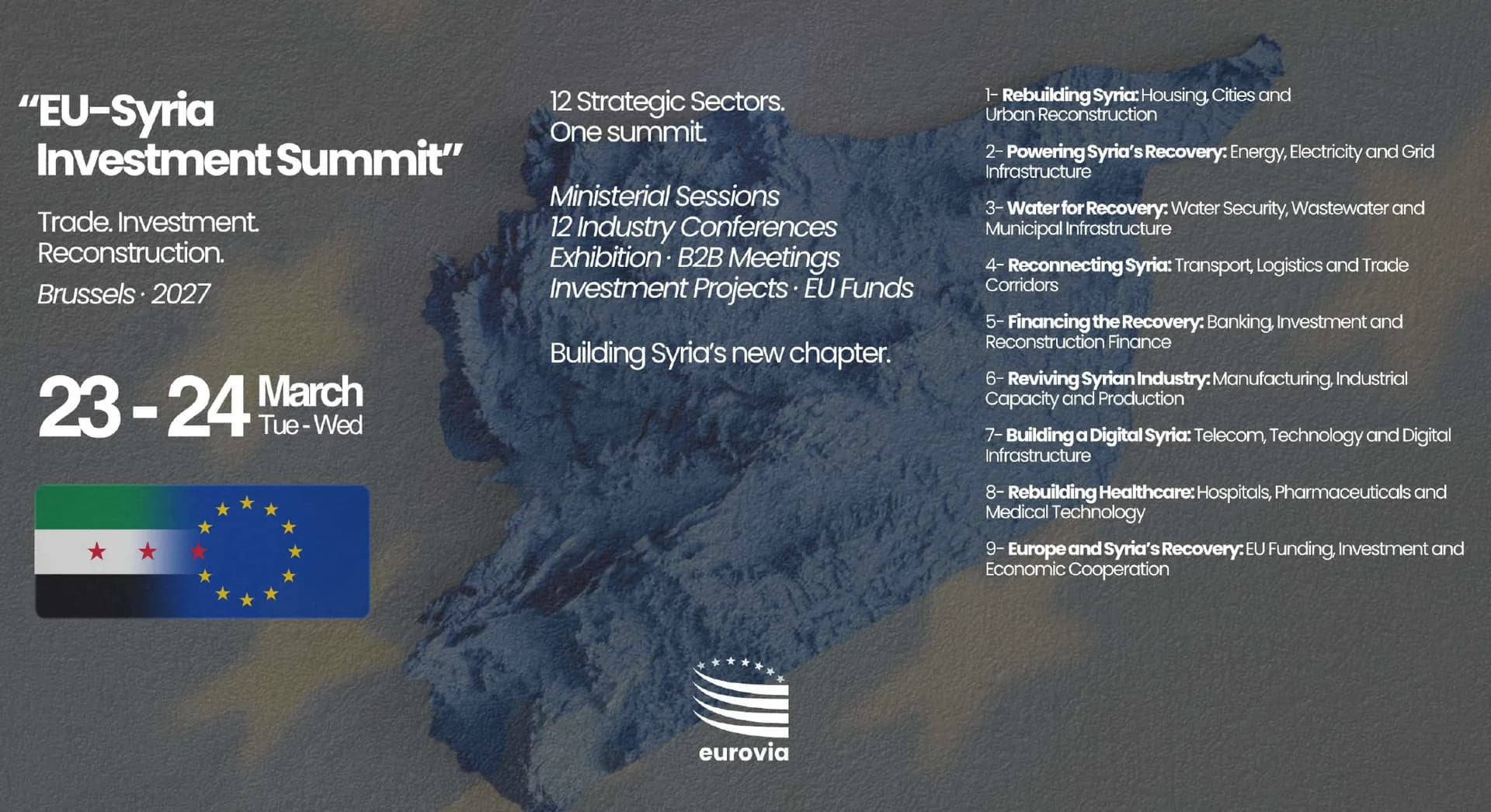
The EU–Syria Investment Summit, set for Brussels on 22–24 March 2027, aims to match more than 200 Syrian companies with over 400 European firms and organisations across twelve strategic sectors.
Introduction
Syria is entering a new era after more than a decade of conflict. As sanctions begin to be lifted and the first contracts of the reconstruction decade are signed, the country's future will be shaped not only by political negotiations but by economic partnerships. One of the core premises of neoliberal theory is that commercial interdependence between nations and communities raises the threshold for conflict, rendering war an irrational choice in the face of mutual gains. From Norman Angell's "great illusion" thesis to Montesquieu's principle that "commerce brings peace," and Thomas Friedman's "golden arches" metaphor, a broad intellectual tradition argues that economic integration produces security.
Syria represents one of the most current and critical tests of this theoretical framework: if European companies, investors and development banks engage in Syria's reconstruction at an early stage, the resulting web of interdependence could become one of the strongest guarantors of political stability. It is precisely this vision that the EU–Syria Investment Summit, scheduled for 22–24 March 2027 in Brussels, seeks to materialise. Organised by Eurovia in media partnership with EUREFLECT, the summit aspires to be the first private-sector-focused international platform dedicated to Syria's economic recovery.
1. Syria's Economic Reconstruction and the Strategic Importance of the Private Sector
Years of conflict have left massive destruction across virtually every sector in Syria — housing, energy, transport, water infrastructure, healthcare, industry, agriculture and digital systems. Repairing this destruction through public resources alone is not feasible; European technology, private-sector investment, trade finance, engineering expertise and industrial equipment stand out as indispensable components of the process.
From a neoliberal perspective, early private-sector involvement in reconstruction is not merely an economic preference but a strategic security investment. In an environment where market mechanisms function, property rights are protected and commercial contracts are enforceable, social actors tend towards competition rather than violence. The presence of European business partners across Syria's twelve strategic sectors — from housing and urban reconstruction to energy and grid infrastructure, water security to transport corridors, banking to digital infrastructure — will serve as an economic anchor for the country's political transition.
The summit plans to present 20–30 investment projects and aims to bring together more than 200 Syrian companies with over 400 European companies and organisations. These figures clearly illustrate the scale of reconstruction and the decisive position of the private sector in this process.
2. The EU–Syria Investment Summit: A New Cooperation Platform in Brussels
The EU–Syria Investment Summit is designed to go beyond a conventional conference format, creating a platform that paves the way for concrete business agreements. Taking place at the Autoworld exhibition hall in Brussels — within walking distance of the European Commission and Council buildings — the summit aims to seat Syrian government representatives at ministerial level, European institutions, development banks and the private sector at the same table.
The three-day programme will begin on Monday with a VIP welcome reception and Leaders' Dinner; Tuesday and Wednesday will feature twelve sector conferences, an international exhibition, over 1,000 pre-arranged B2B meetings and CEO-investor roundtable sessions. European Commissioner for the Mediterranean Dubravka Šuica is expected to participate in the high-level programme, with ministerial-level participation from several European governments also anticipated.
One of the summit's most notable features is its "sanctions-aware" design. Joint sessions with the European External Action Service (EEAS) and the European Commission will clarify the current EU sanctions framework for companies, establishing the legal ground on which they can invest with confidence. This approach puts neoliberal thought's emphasis on "institutional trust" into practice: for markets to function, not only capital but transparency of rules is required.
3. The Security–Development Nexus: Markets That Build Peace
The most important test of neoliberal peace theory in the Syrian context is whether trade can genuinely reduce conflict. Historical data demonstrates that the probability of armed conflict drops significantly between country pairs with high levels of economic interdependence. The European Union's own founding story — transforming economic integration into lasting peace, beginning with the Coal and Steel Community — constitutes the strongest empirical evidence for this thesis.
Adapting this model for Syria's reconstruction requires several critical conditions to be met. First, European companies' investments in Syria must support stability through "sunk cost" logic: companies that make major infrastructure investments in a country acquire a direct stake in the continuation of that country's stability, forming an important lobby for diplomatic pressure. Second, the role of job creation in preventing radicalisation: employed populations have a far higher threshold for turning to violence than unemployed masses. The summit's tenth conference theme — "Skills for the Future: Education, Employment and Human Capital" — directly addresses this link.
Third, the bridging function of the Syrian diaspora: millions of Syrians living in Europe are uniquely positioned to strengthen commercial ties through both business networks and cultural mediation capacity. The summit has placed the utilisation of this potential on its agenda.
Finally, the Memoranda of Understanding (MoUs) and partnership agreements to be announced at the summit's closing session will carry not only a commercial but also a political message: Europe is ready to support Syria's recovery and is demonstrating this support through concrete investment commitments.
Conclusion
Syria's reconstruction will be one of the largest urban and economic repair projects of the 21st century. It is clear that this process cannot be sustained solely through humanitarian aid and public funds; the effective participation of the private sector will be decisive both for the pace of economic recovery and the establishment of lasting peace.
Neoliberal theory posits that trade and investment are mechanisms that produce security. The EU–Syria Investment Summit offers the opportunity to translate this theoretical proposition into practice. More than 2,000 participants gathering in Brussels on 22–24 March 2027 — ministers, ambassadors, CEOs, bankers and project owners — will not only sign contracts; they will also lay the economic foundations of Syria's peace infrastructure.
The cost of war is incalculable; but the returns of peace can be calculated. Investing in Syria's reconstruction is the most rational choice for both Europe and Syria.
İsmail Polat
Ph. D. in International Relations
Follow EUReflect
See more of our reporting on Google
Mark EUReflect as a preferred source and our stories are ranked higher for you in Top Stories, Discover and Google News — and carry a “preferred” badge when they are cited in AI results.
Add EUReflect as a preferred source